

Poliklinika Aviva, a member of the Arsano Medical Group, is one of Croatia’s leading multidisciplinary private healthcare providers. From its base in Zagreb, it serves thousands of patients whose expectations increasingly reflect the high standards of service, transparency, and safety.
In 2025, Aviva reached a milestone no other Croatian private healthcare provider has yet claimed — it became the first to implement ISO 7101:2023, the new international quality-management standard for healthcare, and the first to receive AACI accreditation.
Both recognitions were independently confirmed and highlighted the same strength: Aviva’s disciplined approach to understanding, measuring, and acting on patient feedback.
Accreditation Context: ISO 7101 & AACI
ISO 7101:2023 is a new global standard for healthcare quality, the first international management-system standard written specifically for healthcare. Published in 2023, it sets out a framework for organisations to run a people-centred, performance-evaluated, continuously improving system of care.
It uses the Plan–Do–Study–Act (PDSA) cycle and places clear expectations on leadership, risk, evidence-based decisions, and improvement. Importantly, ISO 7101:2023 requires organisations to monitor, analyse, and improve service-user experience, elevating patient feedback from a side task to a structural requirement.
AACI (American Accreditation Commission International) is a global accreditor recognised by ISQua EEA. Its standards evaluate how an organisation aligns clinical quality, governance, safety culture, risk management, and continuous improvement.
AACI is also one of the few bodies that provide certification for ISO 7101 management systems, allowing the two frameworks to reinforce each other.
Where the frameworks overlap
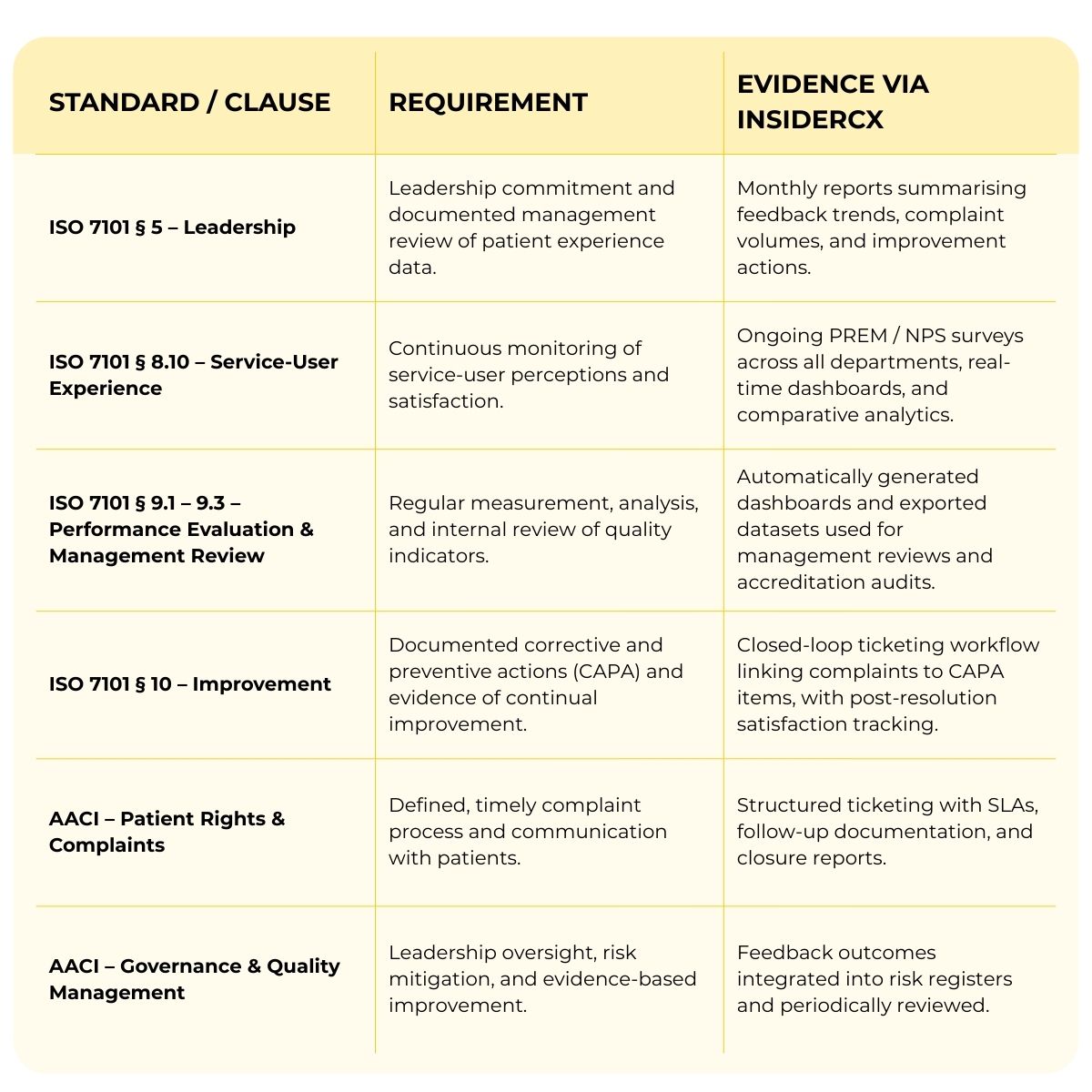
Although ISO 7101 and AACI emerged from different institutions and traditions, their expectations converge in a number of (important) ways. Both assume that a modern healthcare organisation is not judged only by clinical outcomes — but by how it listens, how it learns, and how transparently it improves.
Both frameworks require:
- Structured, consistent monitoring of patient experience, not occasional surveys.
- Documented feedback loops, where insights lead to actions and actions lead to measurable outcomes.
- Leadership involvement, ensuring decisions are grounded in evidence rather than anecdote.
In practice, this creates a shared operating philosophy:
A healthcare organisation must be able to demonstrate that patient voices shape the way it manages risk, measures performance, and makes strategic decisions.
For providers preparing for accreditation, the question becomes not whether they gather feedback, but whether they can show that the feedback actually drives improvement. This is the context in which Aviva began its accreditation journey.
The challenge: from fragmented insights to a unified patient voice
As part of the wider Arsano Medical Group, Aviva had access to a large volume of patient comments, complaints, and informal impressions — but much of it was scattered across different channels. Some teams tracked Google Reviews, while others relied on paper forms or ad-hoc phone calls.
For daily operations, this fragmentation was merely inconvenient; for accreditation, it was a structural risk. Auditors from both ISO 7101 and AACI expect organisations to demonstrate consistency, traceability, and actionability. Without a unified system, Aviva risked presenting isolated snapshots rather than a coherent picture.
The clinic needed a platform capable of consolidating all feedback, automating follow-up, and generating evidence suitable for audit — all while supporting a culture of continuous improvement rather than compliance-driven reporting.
The solution: InsiderCX as the feedback backbone
Aviva implemented the InsiderCX platform across departments, joining the rest of the Arsano Medical Group in building a centralised patient-experience system. The shift was deeply rooted in the operational level, redefining how the organisation interacted with its own feedback ecosystem.
What InsiderCX introduced was a single spine connecting patient comments, staff response workflows, and leadership data:
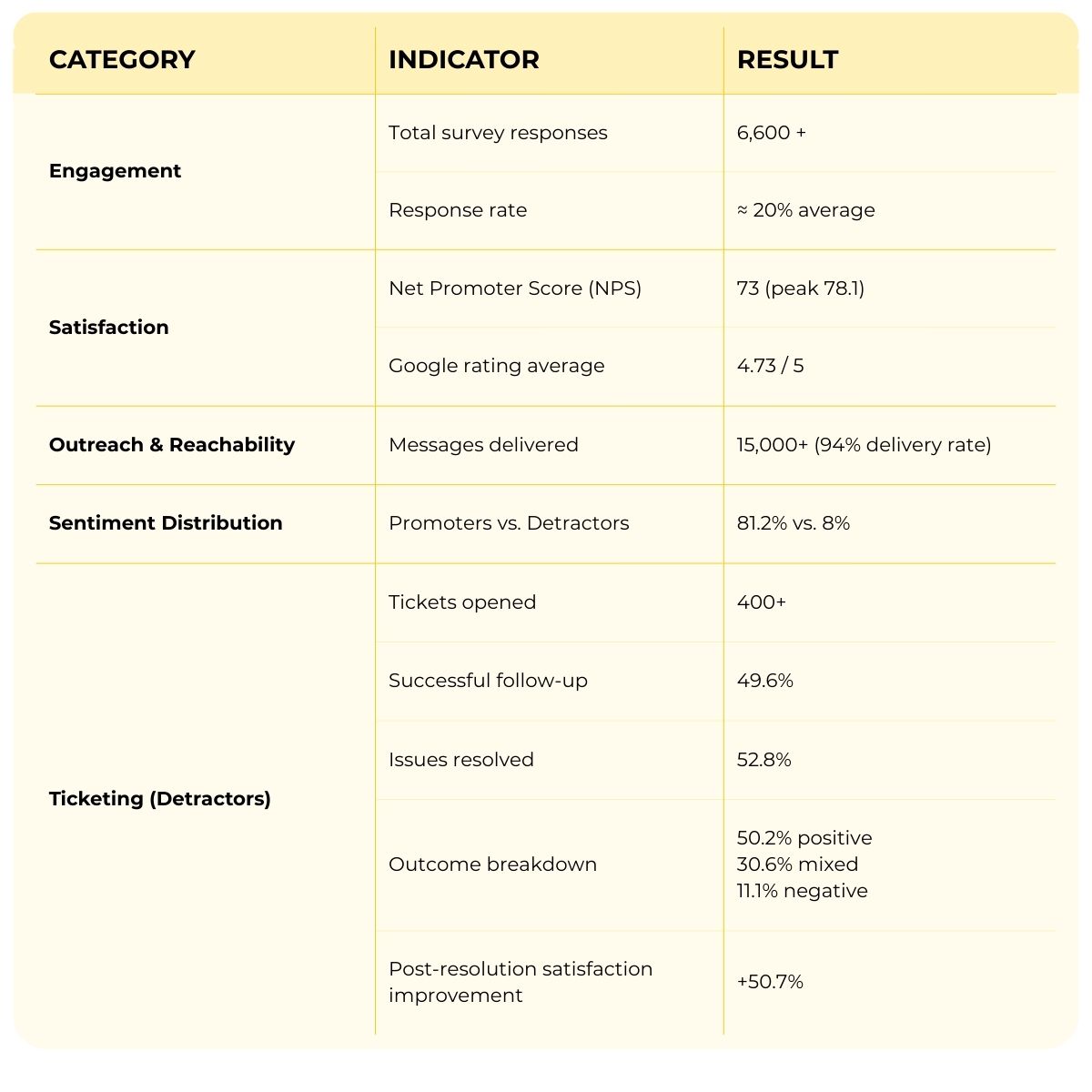
- Automated post-visit surveys standardised how Aviva listened. Every patient received the same opportunity to comment, and every detractor triggered a ticket.
- That ticket moved through a structured resolution process, creating an auditable chain of actions that ISO 7101 and AACI auditors could trace from beginning to end.
- Google Review integration added a public-facing dimension, bringing both internal and external signals into one dashboard.
- And for leadership, the platform surfaced patterns that previously remained hidden — recurring friction points, service gaps, scheduling delays, or communication issues that were hard to quantify without a central system.
Over time, InsiderCX became an integral part of Aviva’s quality-management rhythm. Teams reviewed trends in meetings, updated risk registers based on detractor categories, and fed insights directly into the PDSA cycle.
By the time auditors arrived, this system wasn’t something Aviva “prepared” — it was something that was being used on a daily basis.
Lessons learned & organisational impact
The most significant changes were cultural. What began as a digital transformation quickly became a shift in accountability.
Feedback stopped being something the Quality department simply collected and became something the organisation worked through. A number of teams and department heads were all engaged in the resolution process, moving the conversations from “Do we have data?” to “What is this telling us?” and “What do we do next?”
Leadership’s relationship with patient-experience metrics also changed. NPS trends, detractor tickets, service categories, follow-up times — all became part of ongoing internal reviews. Crucially, the data was consistent and comparable across time, letting leadership connect feedback to staffing patterns, scheduling capacity, clinical workflows, and operational KPIs.
When AACI surveyors and ISO 7101 auditors assessed Aviva, they noted that feedback was not treated as an administrative add-on, but as a structural component of risk management and improvement.
In other words, the organisation didn’t merely collect insights, it incorporated them into its decision-making architecture. This was the foundation of Aviva’s success, and the accreditation was not an endpoint — but a validation of systems already in motion.
Looking ahead
Aviva now treats continuous feedback as an asset embedded within its ISO 7101 management system. The mechanisms that helped it achieve accreditation are the same mechanisms that now help it refine clinical processes, improve communication, and strengthen operational reliability.
Aviva has now set a new quality benchmark for Croatian private healthcare — one where feedback is not simply collected, but actively shapes the future of care.
As expectations continue to rise in the healthcare environment, Aviva’s experience offers a clear message for care providers: international accreditation is achieved not through one-off audits, but through consistent measurement, governance, and a willingness to listen.
Alignment with accreditation standards
Quantified results & metrics

When AACI surveyors and ISO 7101 auditors assessed Aviva, they noted that feedback was not treated as an administrative add-on, but as a structural component of risk management and improvement. Aviva has now set a new quality benchmark for Croatian private healthcare — one where feedback is not simply collected, but actively shapes the future of care.