


An in-depth understanding of the type of questions you’re using is a crucial component for extracting meaningful and actionable insights from your patient feedback forms. Different question types serve distinct purposes, and each has its own strengths and challenges when it comes to analysis.
The way responses are analyzed depends on the format of the question — whether it’s a multiple-choice question, a Likert scale, open-ended text questions, or ranking questions.
This article will explore how to approach feedback analysis based on the question types used in surveys.
This is a catch-22 dilemma: should you analyze responses differently according to question types, and should you even include different question types in the first place? The answer to both is Yes, but it does come with one or two disclaimers.
One of them is the complexity of open-ended data — analyzing open-ended questions requires more time and resources due to the need for text analysis, manual coding, or NLP tools. Aside from that, asking too many different types of questions in a single survey can overwhelm respondents and lead to survey fatigue, lowering response rates or the quality of responses.
Once you get the answers, the different types of data (quantitative vs. qualitative) can be difficult to compare directly, requiring a careful approach to integrating insights.
On the other hand, multiple-choice, Likert scales, and yes/no questions provide structured data that can be quickly quantified and analyzed, making it easier to track trends and measure overall performance.
Combining different question types allows for a more comprehensive view of patient feedback, giving you both a high-level overview and detailed insights.
Multiple-choice questions are one of the most common formats in feedback surveys, allowing patients to choose from a list of predefined responses. They provide structured data, which is easy to analyze and interpret.
How to analyze:
Insider tip: Multiple-choice questions are great for identifying general trends but may lack depth in understanding patient experiences.

Likert scales allow patients to rate their experiences or satisfaction on a continuum, such as a 1 to 5 or 1 to 7 scale. These questions provide more nuanced data compared to simple yes/no or multiple-choice formats.
How to analyze:
Insider tip: Likert scale data provides a more detailed view of patient satisfaction and allows for both snapshot and trend analysis.

Open-ended questions ask patients to describe their experiences or provide feedback in their own words. These questions can yield rich, qualitative data, offering deep insights into patient feelings, concerns, or suggestions.
How to analyze:
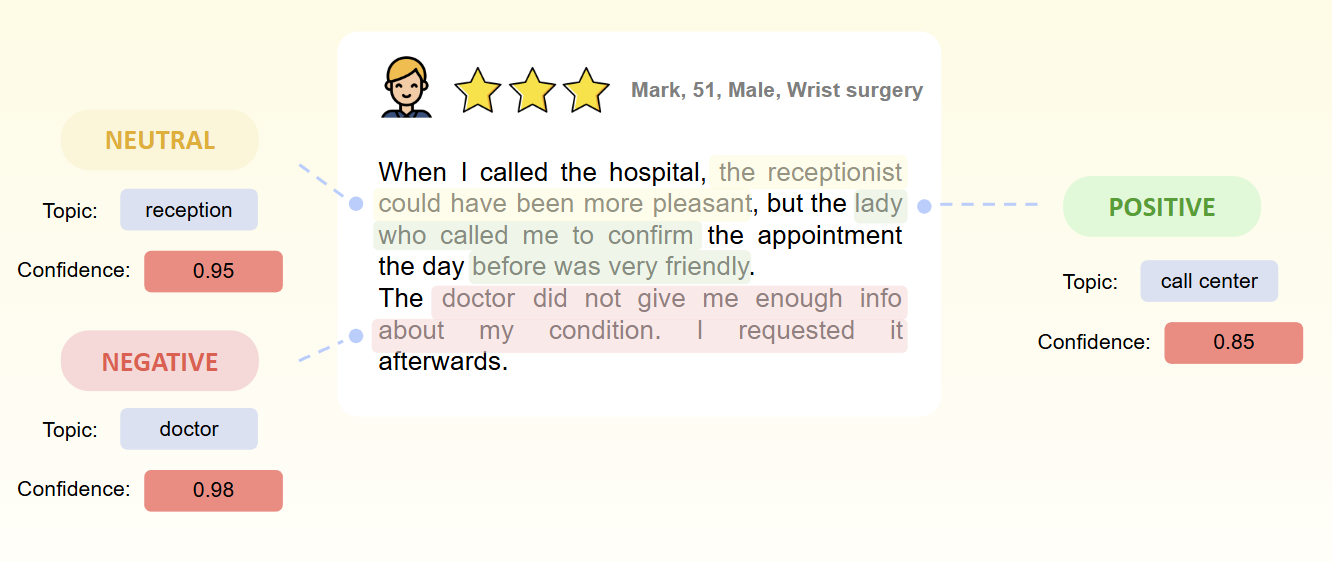
Insider tip: Open-ended questions provide valuable context and deeper understanding but require more effort to analyze compared to structured questions.
Ranking questions ask patients to prioritize several options in order of importance or preference. This format helps identify what patients value most in their healthcare experience.
How to analyze:
Insider tip: Ranking questions are excellent for identifying patient priorities but can be challenging to interpret if preferences are not clear-cut or vary widely.
Yes/No and other binary questions are simple and straightforward, often used to assess basic aspects like whether a patient received a service or if they are satisfied with a specific element of care.
How to analyze:
Insider tip: Binary questions provide clear, actionable data but lack the depth needed to understand underlying patient concerns.
Effective analysis of healthcare feedback depends on understanding the types of questions used and how each can contribute to your overall understanding of patient experiences. Strategically combining and analyzing different question types will give you a comprehensive view of patient satisfaction and areas for improvement.
Want data to improve patient experience & satisfaction?

Easily collect and analyze patient feedback. Get actionable insights to optimize processes and raise care quality.
Related articles:
Analyze patient feedback. Optimize workflows to deliver a superb patient experience. Stop your never-ending battle with patient retention.


Enter your email to book a demo. We'll show you how InsiderCX helps private clinics fix problems before they become bad reviews and recover lost revenue.


