


The patient journey is a term that captures the full spectrum of a patient's experience in healthcare, starting from their first symptoms to the follow-up care. It's a concept that helps healthcare providers see their services from the patient's perspective.
Mapping out each step of the patient's experience helps healthcare organizations identify specific areas for improving their services and processes.
In this article, we're going to take a close look at how to implement patient journey mapping at your clinic or hospital.
What is a patient journey map?
A patient journey map is a conceptual model that describes the series of interactions, experiences, and processes that a patient goes through when navigating the healthcare system. It includes all the steps, touchpoints, and emotions involved in addressing a health issue, from the initial recognition of symptoms to the resolution of the condition or ongoing management.
A well-mapped patient journey offers a unified view of the patient experience and provides actionable insights to improve healthcare delivery and outcomes.
The benefits of patient journey mapping
Patient journey mapping sheds light on how patients navigate through their healthcare experience, revealing opportunities to streamline processes and remove friction.
Depending on how detailed your patient journey map is and the areas you focus on, there’s a huge amount of potential benefits in taking the time to do it right:
- Identifies pain points: It reveals where patients experience confusion, delays, repeated paperwork, poor communication, anxiety, or gaps in care.
- Improves patient experience: Teams can redesign touchpoints such as appointment scheduling, intake, diagnosis, treatment, follow-up, billing, and support to make care easier and more compassionate.
- Supports better care coordination: Mapping shows how patients move across departments, providers, digital tools, and support services, making handoffs and responsibilities clearer.
- Reduces inefficiencies: It can reveal duplicated steps, bottlenecks, unnecessary visits, and administrative friction that waste time for both patients and staff.
- Improves communication: It helps organizations understand what information patients need, when they need it, and which channels work best.
- Reveals emotional needs: Patient journeys often include fear, uncertainty, frustration, or relief. Mapping these emotions helps teams create more supportive care experiences.
- Supports equity and accessibility: Mapping can reveal where certain groups face extra barriers, such as language issues, transportation problems, digital access gaps, or financial concerns.
- Guides service and process improvement: It gives leaders a practical framework for prioritizing improvements based on real patient needs rather than assumptions.
Seeing healthcare through the patient’s eyes is transformative. It shifts the focus from a purely clinical perspective to a more holistic view, considering the emotional, psychological, and practical aspects of patient care.
The key stages in the patient journey
Understanding the main phases is essential for creating your own patient journey mapping template. Here's a rough breakdown:
- Awareness: This initial stage is where the patient first recognizes symptoms or health concerns. Effective communication and educational resources are key as they ease anxiety and guide patients towards seeking proper medical advice.
- Diagnosis: In this phase, healthcare professionals determine the patient's condition. Clear, empathetic communication and accurate information are vital to help patients understand their situation and the proposed treatment plans.
- Treatment: This stage involves the actual medical interventions or therapies. Patients should be fully informed about their treatment options and what to expect, ensuring their active participation and compliance.
- Follow-Up: Post-treatment, this stage is for monitoring the patient's progress and recovery. Consistent follow-up appointments and open lines of communication are essential to address any concerns or complications that may arise.
- Ongoing care: Especially relevant for chronic conditions, this stage focuses on long-term health management. Continuous support, education, and encouragement are key to helping patients manage their health effectively over time.
Below is an example of a patient journey map provided by the US Department of Veterans Affairs.

Here is an excerpt from the document to give additional context:
The VA Patient Experience Journey Map represents a common set of moments Veterans experience before, during, and after a health care appointment visit. While this map does not represent what happens to every Veteran during every appointment, it is a good starting point to define the ideal patient experience at VA and recognize high impact improvement opportunities.
Important sidenote: A dental clinic and a fertility clinic can end up with significantly different patient journey maps, reflecting the different types of care provided and the number of touchpoints. For more examples and visualizations, check out our patient journey infographic.
How to create a patient journey map
Creating a patient journey map involves visually charting the patient's experience through healthcare services, providing a clear and actionable guide to provide better care and improve patient satisfaction.
Step 1: Define objectives and scope
The first step in creating a patient journey map is to establish its goals. These objectives could range from streamlining care processes to identifying quality gaps in the follow-up care. Clear goals guide the mapping process, ensuring that the end result is focused and actionable.
Next, it's important to decide the scope of the journey map — some maps cover the entire patient journey, while others focus on specific aspects, such as finding the ways to improve the diagnosis or treatment phase.
The choice will depend on the clinic's goals and the specific areas they aim to improve.
Step 2: Understand the patient's perspective
To truly understand the patient's perspective, you have to engage with them directly. Conducting patient interviews and surveys provides valuable insights into their experiences, feelings, and expectations — firsthand information is instrumental in creating a journey map.
Another key component is to review patient complaints. This data often highlights areas that need improvement and can reveal common challenges that patients face.
It's important to include a diverse range of patient profiles in this process — different patients have unique experiences based on their age, background, medical conditions, and other factors. A comprehensive journey map should reflect this diversity to ensure that the care provided is inclusive and considers the needs of different patient groups.
Step 3: Gather and analyzing data
Gathering data includes collecting information from electronic health records (EHRs), patient feedback, and staff interviews. Each source offers unique insights, from the clinical data in EHRs to the operational insights provided by your staff.
Once data is collected, the next step is to analyze it to identify common patterns, pain points, and areas for improvement. This analysis identifies the bottlenecks in the patient journey and the factors that affect patient satisfaction.
Finally, it's important to understand the emotional journey of patients: this involves analyzing how patients feel at each stage of their healthcare experience, from anxiety or confusion in the early stages to relief or frustration in the later stages.
As mentioned earlier, recognizing these emotional aspects will be key to providing compassionate, patient-centered care.
Step 4: Identify key stages and touchpoints
The fourth step involves mapping out the primary stages of the patient journey. The idea is to lay out a clear framework that captures each significant phase in the patient's healthcare journey.
A big part of this process is identifying key touchpoints — situations where patients directly interact with healthcare services. Common touchpoints include:
- scheduling appointments
- having consultations
- receiving treatments
- getting post-treatment visits
- numerous small interactions with healthcare staff
Understanding these touchpoints helps in pinpointing areas where patient experience can be enhanced, whether it's through improved communication, reduced waiting times, or more compassionate care.
Step 5: Build patient personas
Building patient personas involves creating detailed profiles that represent various user groups within the patient population. These personas should include demographic information, health conditions, preferences, and behaviors.
Here’s an example of a patient persona:
- Name: Maria Gonzalez
- Age: 42
- Health Conditions: Recently diagnosed with Type 2 Diabetes
- Family History: Family history of diabetes and heart disease
- Lifestyle: Busy professional, struggles with balancing work and personal life, limited time for exercise
- Healthcare Preferences: Prefers clear, straightforward communication; appreciates digital health tools for monitoring and convenience
- Behavioral Characteristics: Highly engaged in her health but often feels overwhelmed with information; values trust and empathy in her healthcare providers
- Goals: To manage her diabetes effectively without disrupting her busy lifestyle, and to learn more about preventive health measures
Empathy mapping and surveys that measure patient activation levels can be a great way to gather the necessary information and build personas that effectively represent different patient groups.
This deeper understanding helps you tailor healthcare services that meet the specific emotional and practical needs of each persona, like Maria, who needs clear communication and digital health tools for her busy lifestyle.
Step 6: Visualise the patient journey map
Since a patient journey map is a document that will need to be easily accessible, shareable, and periodically updated, it should be created in a digital form.
Here are some tips for creating patient journey maps that are clear, comprehensive, and easy to understand:
- Add visual aids: Employ visual aids such as icons, color coding, and symbols to differentiate and highlight key stages, touchpoints, and emotions. This enhances clarity and quick comprehension.
- Use simple language: Avoid medical jargon and complex terminology. Use simple, straightforward language that can be easily understood by everyone involved, including non-medical staff.
- Incorporate flowcharts or diagrams: Utilize flowcharts, diagrams, or storyboards to visually represent the journey stages. These tools help in mapping out the patient experience in a logical and easily digestible format.
- Focus on patient perspective: Ensure the map is reflective of the patient's perspective. Include elements that represent patient experiences and emotions at each touchpoint.
- Leverage visualisation tools: If you have a more complex patient journey, there are patient journey mapping tools that can help simplify the process with customisable templates.
- Periodically review and update the document: Keep the map updated to reflect any changes in healthcare processes, practices, or patient feedback.
This will ensure that the patient journey map is not only informative but also easy to understand and actionable.
Step 7: Highlight pain points and opportunities
This step focuses on identifying and highlighting areas that cause friction and dissatisfaction. These could be long wait times, unclear communication, or inadequate follow-up care.
Marking these pain points on the map makes it easier to prioritize them for action.
This is also a great opportunity to throw in ideas for improvement and innovation — adopting new technologies, improving patient communication strategies, or streamlining appointment scheduling processes.
Patient journey optimization: Turning your map into measurable improvements
Creating a patient journey map is only the first step. The real value comes from using that map to improve the patient experience in practical, measurable ways.
Patient journey optimization is the process of reviewing each stage of the patient journey, identifying where patients experience friction, and making targeted improvements that lead to smoother, more supportive care.
Below are some best practices to follow.
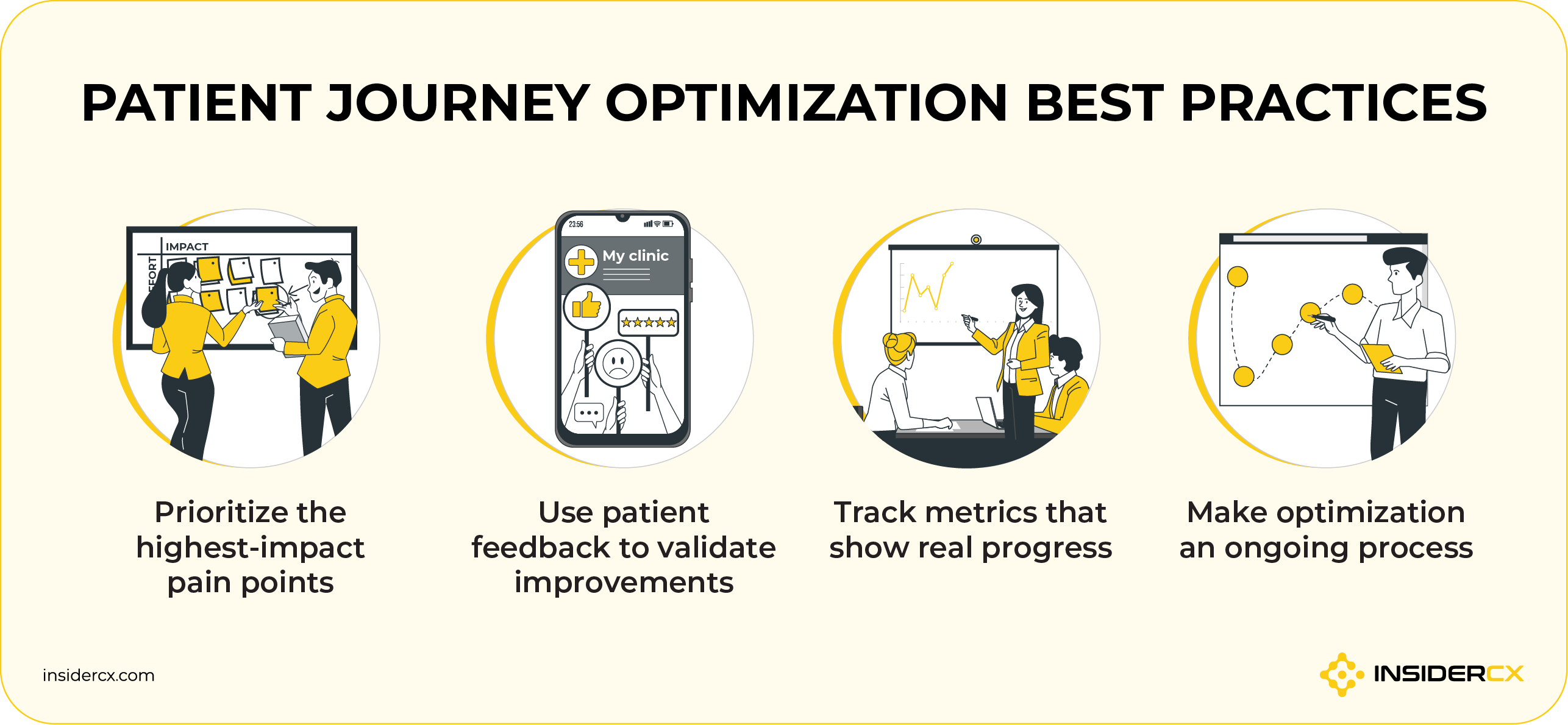
1. Prioritize the highest-impact pain points
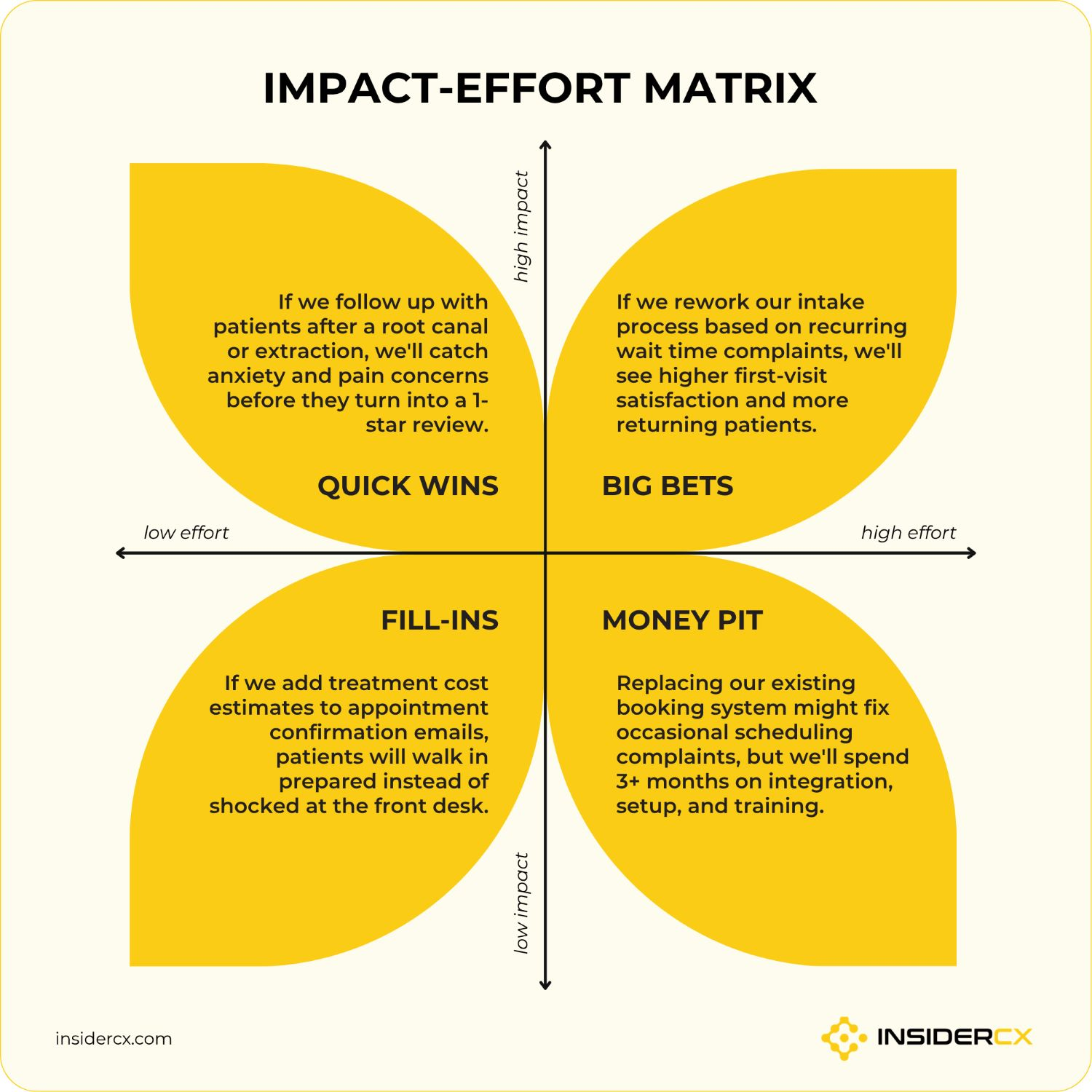
A patient journey map may reveal many issues, but not every problem can be (or should be) solved at once. It’s time to prioritize. Consider:
- How often the issue occurs
- How strongly it affects patient satisfaction or trust
- Whether it creates delays, confusion, or missed care
- How much effort or cost is required to fix it
- Whether the change supports broader clinical or business goals.
The impact vs effort matrix provides one helpful framework for prioritizing quality improvement.
2. Use patient feedback to validate improvements
Patient feedback is essential for understanding whether changes are actually working. The most useful feedback sources are carefully crafted patient satisfaction surveys, online reviews, and staff observations.
For example, if patients often say they leave appointments unsure about their next steps, the organization may revise discharge instructions, add follow-up messages, or train staff to explain care plans more clearly.
After those changes are made, new feedback can show whether patients feel more informed and confident. This creates a feedback loop where patient insights guide improvements, and future feedback measures their impact.
3. Track metrics that show real progress
Patient journey optimization should be tied to measurable outcomes. Without the right metrics, it is difficult to know whether changes are improving the experience or simply adding new processes.
Depending on the stage of the journey, useful metrics may include appointment wait times, no-show rates, overall satisfaction scores, complaint volume, patient sentiment for specific areas, time from first contact to appointment, and similar.
4. Make optimization an ongoing process
Patient journey optimization should be a part of your continuous quality improvement.
Revisit and update your maps after launching new services, changing appointment systems, adding digital tools, or noticing recurring patient complaints.
A strong optimization process helps teams continuously ask:
- Where are patients still experiencing friction?
- Which touchpoints create the most confusion or frustration?
- What changes have improved the experience?
- What new problems have appeared?
Again, to do this effectively, you will need an efficient patient feedback system to collect feedback and track patient sentiment and complaints across different touchpoints. It’s the only way to get accurate data that you can confidently plug into your patient journey map.
Patient experience platforms like InsiderCX can help you automate this process and ensure every complaint, praise, and suggestion reaches you in real time — categorised based on location, doctor, service type, and touchpoint.
Where to start?
If you’re doing it for the first time, start simple. Choose one specific part of the patient journey to focus on, such as booking a first appointment, receiving a diagnosis, starting treatment, or completing a follow-up visit.
From there, gather input from both patients and staff to understand what actually happens at that stage. Look for the moments where patients feel confused, delayed, unsupported, or unsure of what to do next. These are often the best places to begin making improvements.
Do that for the other stages until you have mapped out the full patient journey.
Then comes the hard part — prioritizing changes, implementing improvements, and tracking whether your changes worked as intended.
Good luck!


