



Every patient interaction, be it online or in person, shapes how people feel about your clinic. Without seeing the entire journey end to end, it’s easy to miss where frustration builds or trust breaks down.
That’s why healthcare organisations, especially private providers, need to visualise the patient experience from the patient’s point of view. When you map the journey, you’ll have a much better understanding of what patients actually go through — before, during, and after care.
In this article, you’ll get:
- A patient journey infographic to visualise the process.
- Examples of patient journeys from different healthcare settings.
- A practical explanation of how journey mapping connects to patient experience.
Let's get right to it.
How and why to build a patient journey map
A patient journey map is a simple way to visualise every step a patient takes when interacting with your clinic — from finding your website to ongoing care.
When you see the journey clearly, you can spot friction, confusion, and emotional highs and lows that patients experience but rarely say out loud. That insight helps you improve experiences that actually matter.
At a high level, building a journey map means:
- Identifying the key stages patients move through.
- Understanding the patient's mindset at each stage.
- Pinpointing pain points and touchpoints, both digital and human.
- Using those insights to guide patient experience improvements.
This section is just a quick overview. If you want a step-by-step walkthrough, we’ve put together a patient journey mapping guide that goes much deeper.
Patient journey infographic
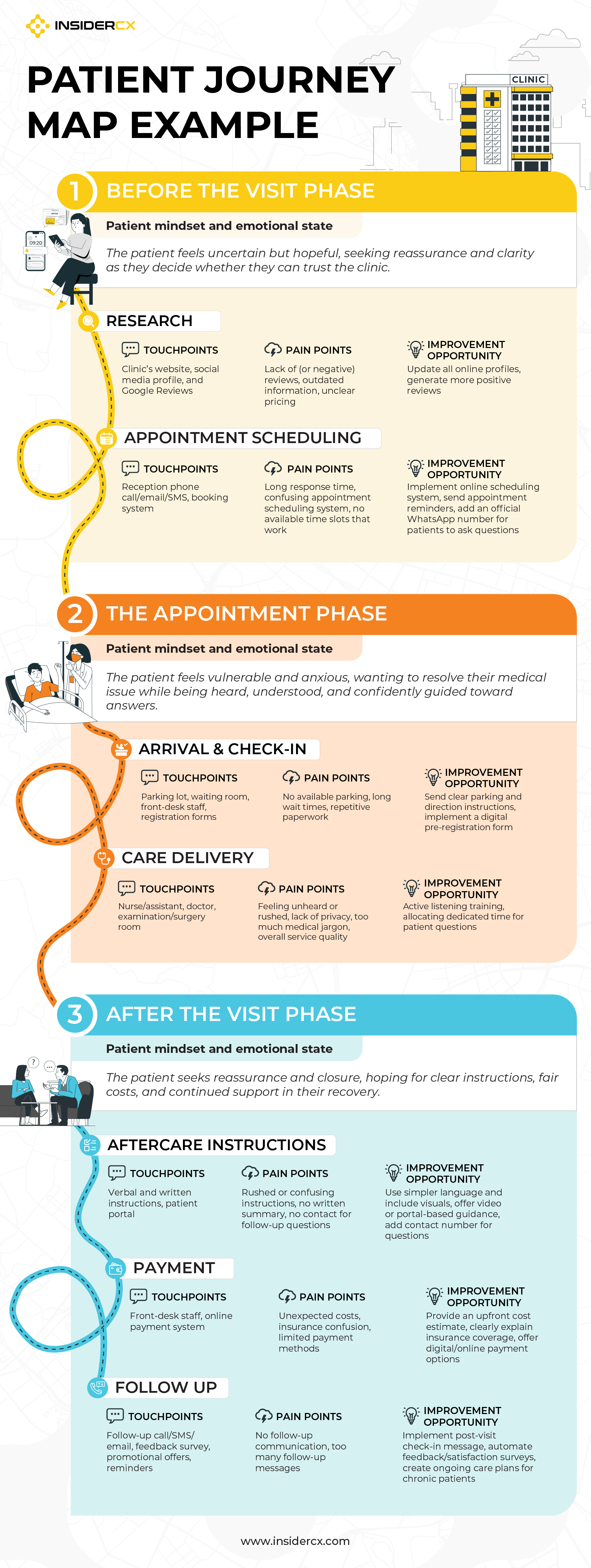
There isn’t a single right way to visualise the patient journey. Here at InsiderCX, we like to split the journey into three distinct phases:
- Before the visit: Covers everything that happens before the exam, from researching the clinic to booking the appointment.
- The appointment: Covers the arrival, check-in, and care delivery.
- After the visit: Covers everything that happens after the appointment — payment, required paperwork, scheduling follow-up appointments, etc.
The advantage of this approach is that it can be applied to any type of clinic. The person mapping the patient journey has the freedom to determine what matters most to them in each phase.
You can see these stages visualised in the patient journey infographic below.
Patient journey examples
Every clinic should map a full end-to-end patient journey at some point. However, if you think there is a critical stage in that journey, it’s perfectly reasonable to dive deep and break that phase in greater detail than the rest.
Let’s go through a couple of examples to show how this focus can shift for different types of clinics.
Patient journey example for a dental patient
For this example, imagine a mid-sized private dental clinic in an urban area. The clinic has experienced dentists and modern equipment, but its website is dated, phone lines are busy during peak hours, and follow-up processes aren’t always consistent. Patients generally trust the clinical care, but the experience around it is inconsistent.
1) AWARENESS & SYMPTOM RECOGNITION
The patient starts feeling a sharp pain when chewing. It comes and goes, but it’s getting harder to ignore.
- Patient mindset: Concerned, slightly anxious, hoping it’s nothing serious
- Key touchpoints: Clinic’s website
- Common pain points: Not knowing how urgent the issue is, delaying action, finding contact and other relevant information
2) RESEARCH & APPOINTMENT SCHEDULING
The patient looks for nearby dental clinics, compares reviews, and checks availability.
- Patient mindset: Cautiously optimistic but price- and time-sensitive.
- Key touchpoints: Clinic website, Google reviews, phone calls, online booking form.
- Common pain points: Outdated website, unclear pricing, long phone wait times, confusing appointment scheduling system.
3) CARE DELIVERY (VISIT AND TREATMENT)
The patient arrives at the clinic, checks in, and sees the dentist.
- Patient mindset: Vulnerable, uncertain about what to expect, focused on pain relief and trust.
- Key touchpoints: Front-desk staff, waiting room, dental assistants, dentist, treatment room.
- Common pain points: Waiting longer than expected, feeling or fearing pain during the procedure, rushed explanations, limited time for questions.
4) POST-VISIT FOLLOW-UP
The procedure is done, and the patient leaves with instructions.
- Patient mindset: Relieved but cautious, watching for symptoms.
- Key touchpoints: Aftercare instructions and feedback survey sent via email.
- Common pain points: No proactive follow-up, unclear aftercare guidance.
5) ONGOING CARE & LONG-TERM ENGAGEMENT
Weeks later, the pain is gone, but the relationship continues.
- Patient mindset: Evaluating whether to return or look elsewhere next time.
- Key touchpoints: Check-up reminders, hygiene appointment invites, loyalty offers.
- Common pain points: Too many follow-ups (offers and reminders), generic communication with no personalisation.
This is not a fully fleshed-out example, but it should give you a good idea of what to focus on while creating your own patient journey map.
Patient journey example for a fertility clinic
Fertility journeys are often emotionally complex and time-sensitive, which means experience gaps feel bigger — and more personal.
Here, imagine a private fertility clinic with a strong medical reputation and high success rates. Demand is high, appointments are limited, and communication between visits can feel fragmented. Patients trust the clinicians, but often feel unsure about what happens next.
In this case, we’ll start directly at the appointment scheduling phase.
1) APPOINTMENT SCHEDULING
The patient has already decided to seek fertility treatment at this clinic and is ready to book a consultation.
- Patient mindset: Hopeful but nervous, emotionally invested.
- Key touchpoints: Clinic website, enquiry form, phone calls, email responses.
- Common pain points: Long response times, limited appointment availability, unclear next steps.
2) PRE-VISIT PREPARATION
Once the appointment is booked, the patient prepares emotionally and practically.
- Patient mindset: Anxious, overwhelmed, eager for reassurance.
- Key touchpoints: Appointment reminder, intake forms, instructional emails, nurse or coordinator communication.
- Common pain points: Complex paperwork, medical jargon, lack of emotional guidance.
3) CONSULTATION
The patient attends the initial consultation and discusses options.
- Patient mindset: Vulnerable, information-hungry, cautious about outcomes.
- Key touchpoints: Fertility specialist, nursing staff, consultation room, educational materials.
- Common pain points: Information overload, rushed conversations, unclear success probabilities.
4) POST-VISIT COMMUNICATION
The appointment ends, but questions don’t.
- Patient mindset: Reflective, uncertain, emotionally drained.
- Key touchpoints: Follow-up emails and phone calls, test results, patient portal, care coordinator.
- Common pain points: Delayed results, inconsistent communication, uncertainty about timelines.
5) ONGOING CARE AND TREATMENT PLANNING
The patient decides whether to proceed — and how.
- Patient mindset: Weighing emotional, financial, and physical commitments.
- Key touchpoints: Treatment plans, feedback forms, billing discussions, check-in calls, physical and digital educational resources.
- Common pain points: Cost confusion, lack of personalised guidance, feeling like just another case.
Following this approach, the fertility clinic might recognise that emotional reassurance matters as much as clinical expertise — and that better communication could significantly reduce patient stress.
How InsiderCX turns patient journey insights into action
Seeing the patient journey is one thing. Improving the patient experience throughout that journey is another.
That’s where InsiderCX comes in. Our patient experience platform helps you track satisfaction at every stage of the patient journey, identifying quality issues and areas for improvement.
We work closely with each new client to understand their patients’ journey. Then, we help them design mobile surveys that target key touchpoints and pain points across that journey.
The rest of the process is automated — our platform sends targeted questions, at the right time, to the right patients. Gathered feedback is automatically analysed and visualised in the form of various helpful reports.
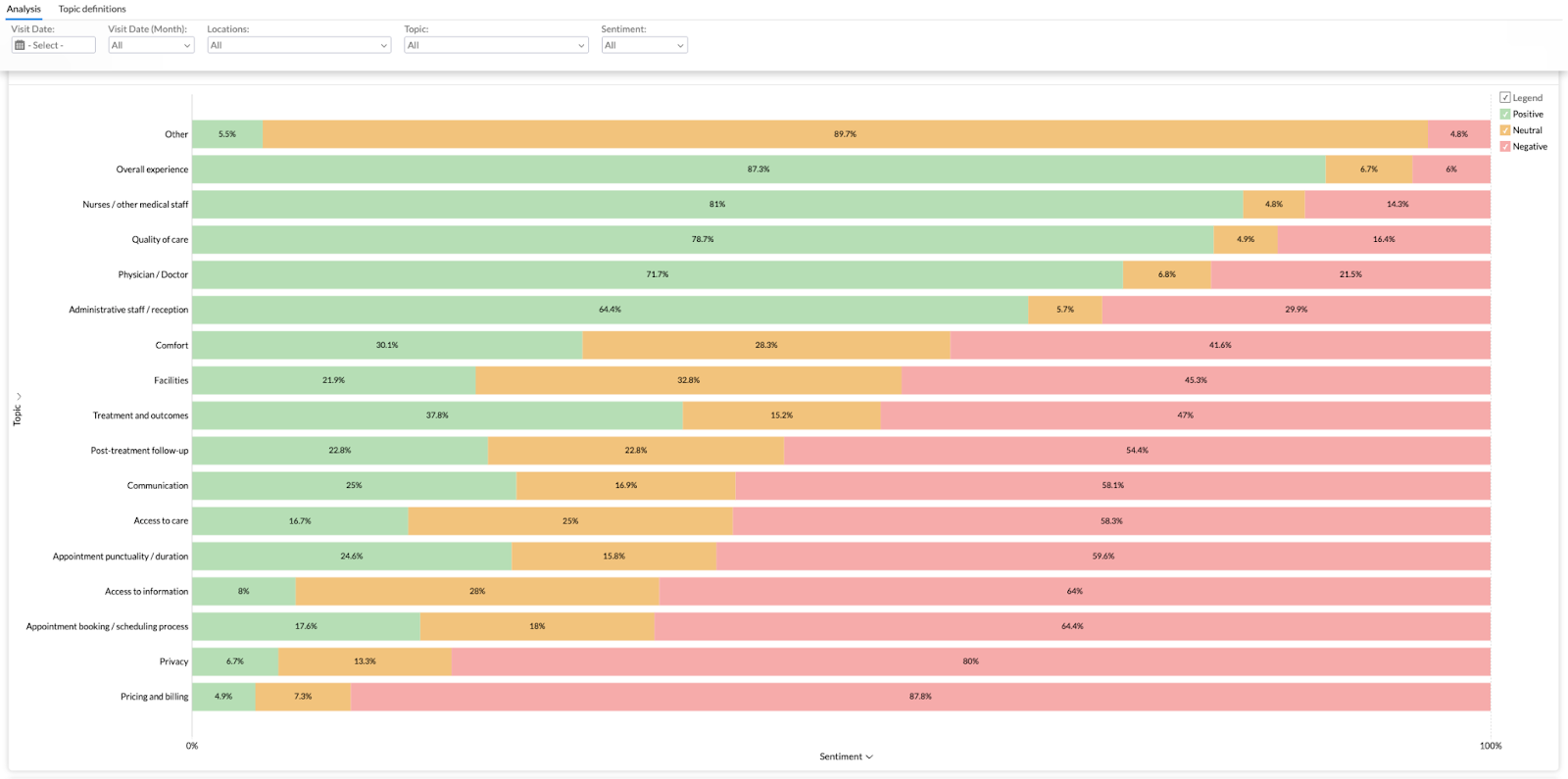
Once feedback is collected and analyzed, you can:
- Identify experience gaps that matter most to patients.
- See how performance varies by stage, location, or provider.
- Track satisfaction trends and sentiment over time to determine whether the changes you implemented have resulted in measurable improvements.
You’ll know exactly where you stand today — and what to fix next to improve care and the overall patient experience.
Want to learn more about the InsiderCX platform? Schedule a quick demo with our team.


