


For most prospective patients, their first impression of your dental practice isn't your reception area — it's a Google search result. A strong online reputation compounds over time: it lowers acquisition costs, supports premium pricing, and makes every other marketing effort work better.
The problem is that many dental practices treat reputation as something that happens to them rather than something they actively manage. Reviews trickle in at random, listings go stale, and complaints surface publicly before anyone inside the clinic knows there was an issue.
This guide covers how dental reputation management works in practice. We discuss:
- The connection between patient experience and your online image
- The channels that shape it
- And the seven most effective ways to build and protect a reputation that reflects the quality of care you actually provide.
The connection between “offline” and “online” reputation
A patient who had a poor (or superb) experience has always talked about it; the only thing that's changed is the scale. A complaint over coffee reaches three people, whereas a one-star Google review is seen by hundreds of prospective patients who search for your practice over the next several years.
Both versions of your reputation are shaped by the same thing: the sum of interactions between the patient and your dental practice. Online reputation is simply the public, searchable, permanent record of those experiences.
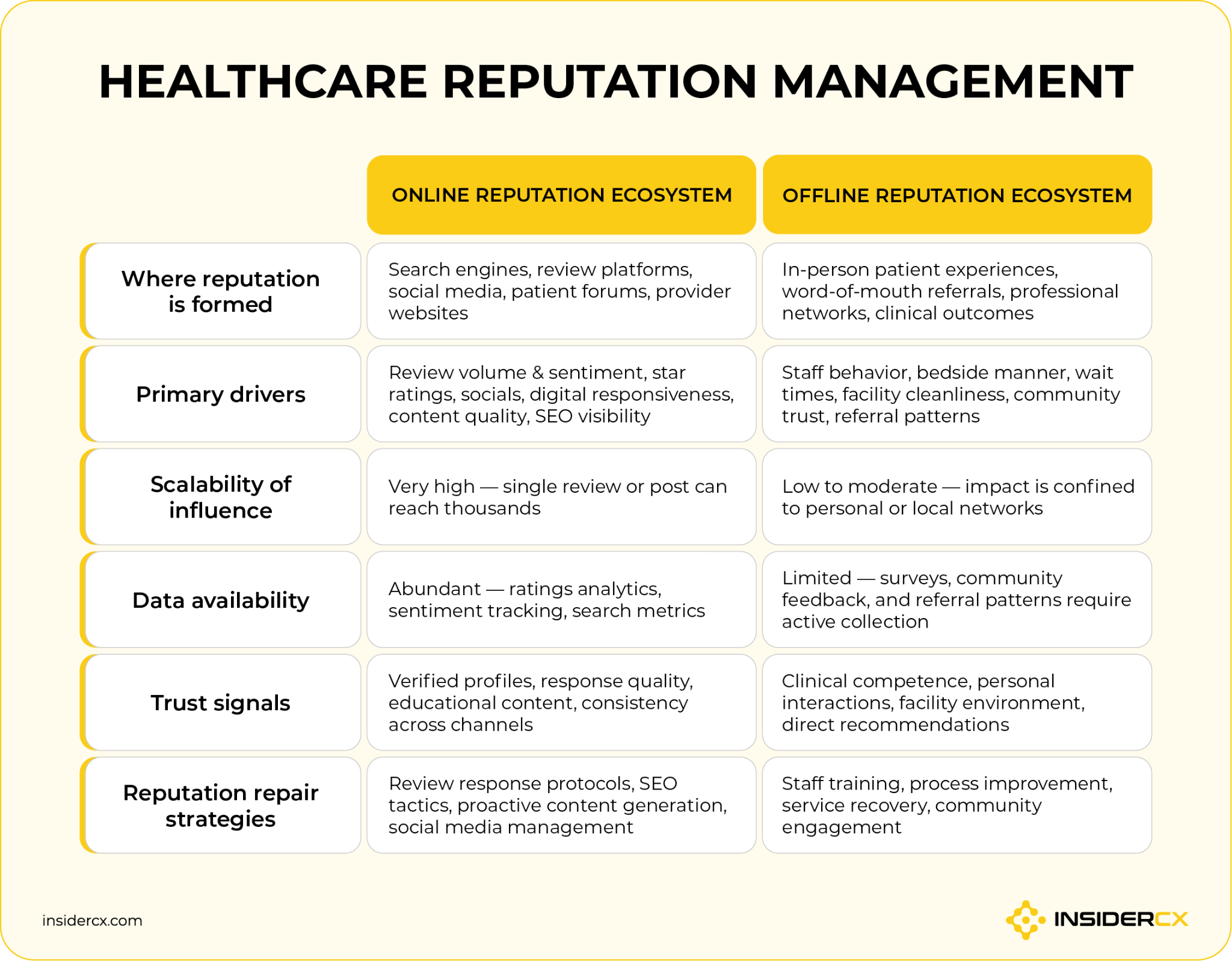
The takeaway is that you can't "manage" reputation only via communications. You manage it by improving the experience across the whole patient journey — and then making sure the online picture accurately reflects the quality of care you provide.
Everything we discuss below builds on that principle.
Channels that shape your online image
Before we evaluate different strategies, it's worth mapping where healthcare reputation lives. For a dental practice, four channels do most of the work:
- Public review profiles: Google is the dominant one, but Trustpilot, Facebook, and local directories matter too. Both the score and the content of comments influence booking decisions because patients read the reviews, not just star ratings.
- Your website: After reviews, it's the most common place patients go to learn more about your clinic. Website design quality, waiting room images, clarity of pricing, and visible social proof all signal — fairly or not — the standard of care patients can expect.
- Your social media profiles: Some patients will leave comments on your social media posts. The content of those comments and how you respond will affect the public perception. Hence, it’s important to be active on at least one social channel.
- Online groups and forums: Local community groups, Reddit threads, and parenting forums are where patients ask "can anyone recommend a good dentist near X?". Remember that these are user-generated hubs, so recommendations there are earned, not placed.
Ways to build a strong online reputation for your dental practice
There are many things you can do to improve the online reputation of your dental clinic. Below are seven tried-and-tested strategies you should seriously consider.
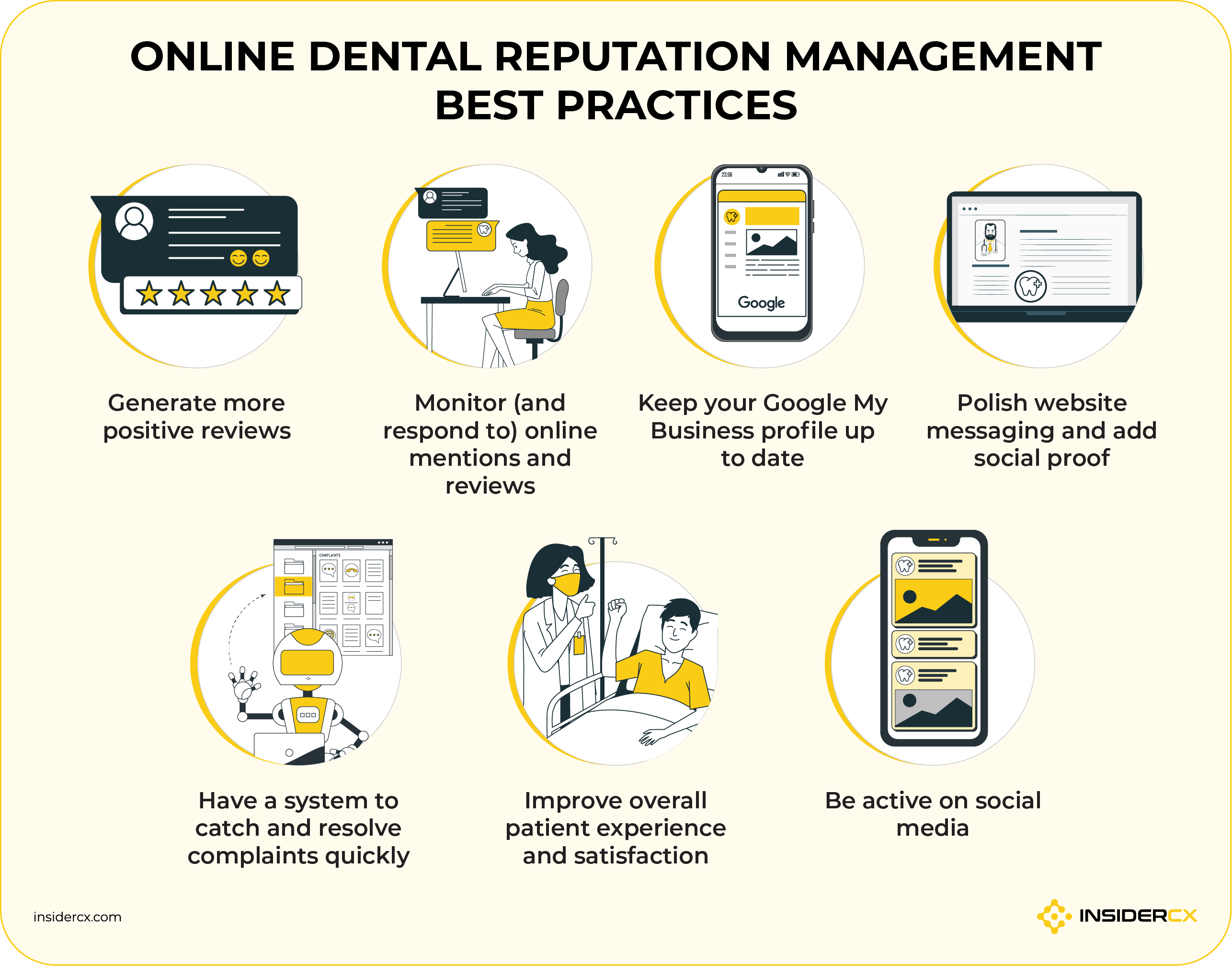
1. Generate more positive reviews
A strong review profile has three components: a good score (4.5+), a large volume of reviews (ideally triple-digit), and recency — so the most recent review isn't from 2023. Volume and recency matter because patients discount a 4.9 rating built on eleven reviews, and a profile that's gone quiet for over a year raises suspicion.
The catch is that satisfied patients rarely leave reviews unprompted. The ones motivated enough to write without being asked are disproportionately the unhappy ones — which is why passively "letting reviews happen" can lead to poor review scores.
The only reliable way to build a strong profile is to actively and consistently ask.
Doing that manually across hundreds of patients a month is too time-consuming. Most growing practices automate review collection as part of their feedback process. That way, online review generation becomes a by-product of listening to patients, rather than a separate campaign.
If you're not ready for automation, there are workable manual alternatives: a QR code at reception linking directly to your Google review form, or a templated follow-up SMS or email sent by front-desk staff after appointments.
These are less consistent — but better than nothing.
2. Monitor (and respond to) online mentions and reviews
Some healthcare reputation management software includes mention monitoring as a built-in feature, but the easiest and cheapest starting point is Google Alerts — set up alerts for your practice name and the names of your lead clinicians, and you'll get an email whenever they appear in newly indexed content. Google's step-by-step guide covers the setup in a couple of minutes.
For larger dental clinics and clinic groups, this is a great way to catch misinformation or negative publicity early. A misleading forum thread or a local news mention can be addressed calmly in its first days. It’s like a forest fire: the earlier you catch it, the easier it is to extinguish it.
If you want a one-time overview before implementing ongoing monitoring, you can use our free tool called PatientRater.
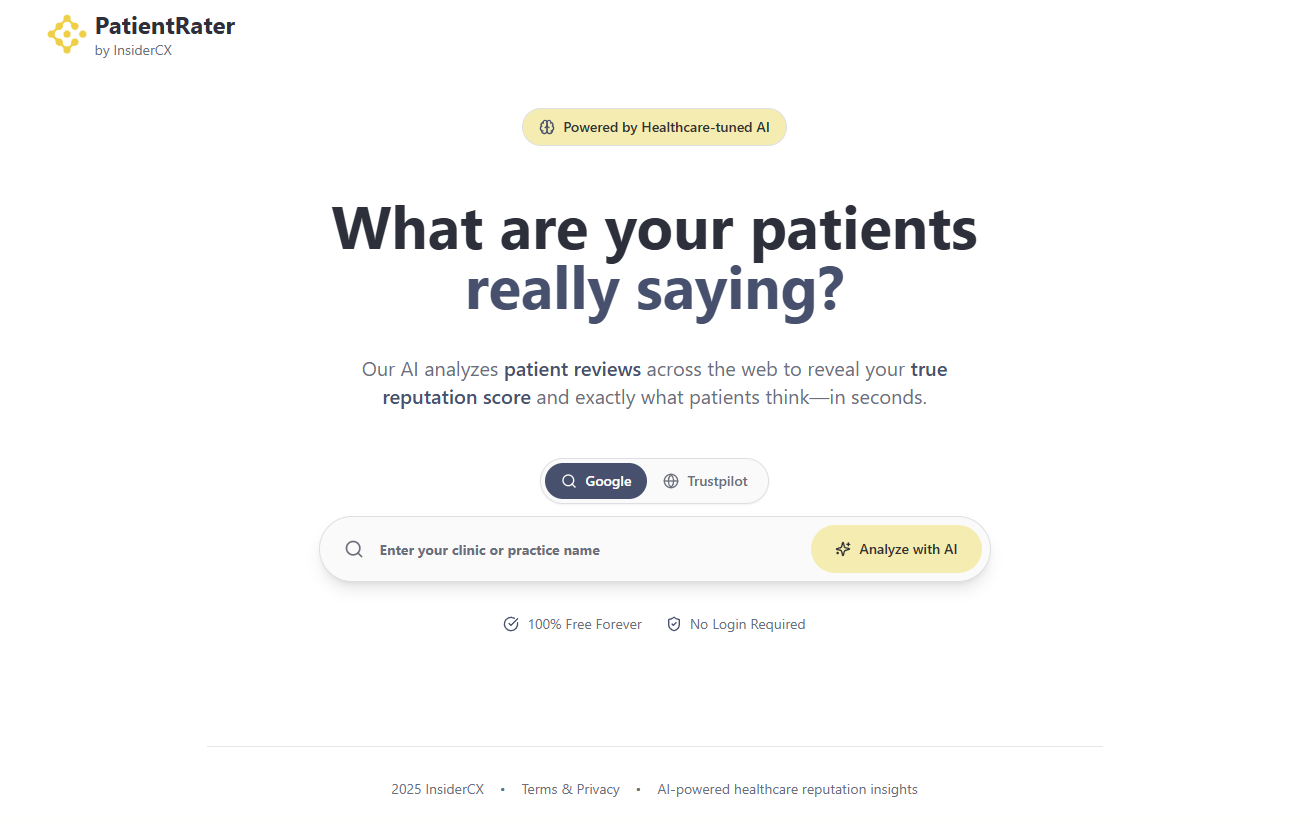
Just enter your practice name and let it analyse your public reviews across the web. You’ll get your true reputation score alongside the recurring themes — positive and negative — that patients mention most.
3. Keep your Google My Business profile up to date (and other listings)
Your Google Business Profile (formerly Google My Business) is usually the single most-viewed piece of information about your practice. It appears before your website in local search and often replaces it entirely for patients who just want your hours, location, or phone number.
An incomplete or outdated profile costs you twice: it hurts local search visibility, and it hurts trust when a patient arrives to find you closed.
At a minimum, make sure these details are complete and accurate:
- Business name and address: Your official clinic name, matching your website and signage exactly, with no keyword stuffing (i.e., [Your Clinic Name] instead of [Best Dentist Near Me]).
- Categories: Usually, "Dentist" as primary, plus relevant secondary categories such as "Cosmetic dentist" or "Orthodontist".
- Services list: Don't stop at "dentistry"; list every core service, from implants and whitening to emergency appointments.
- Business hours: Including holiday schedules and any split shifts, so patients are never met with a locked door.
- Relevant and media & attributes: Recent images of the exterior and reception, virtual tour of the treatment rooms, plus attributes like wheelchair accessibility.
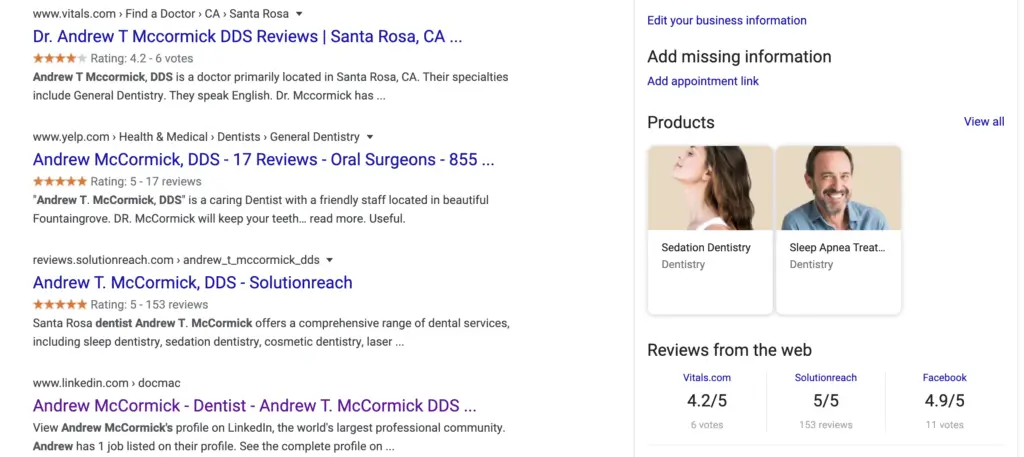
Here’s a solid guide for dentists on how to optimize their Google My Business profile.
Sidenote: Your practice is almost certainly listed in places you never registered. Think health directories, insurance networks, and map services. It's worth reviewing all of your listings and requesting updates wherever the information is missing or outdated, as AI summaries might not always pull info just from your own website.
4. Polish website messaging and add social proof
Alongside reviews, your website is the most common thing patients use to evaluate your practice before booking. It's where they decide whether the promise of your review profile holds up, which makes it a reputation asset — not just a marketing one.
A few things consistently move the needle on trust:
- Professional, modern design: An outdated site implies outdated equipment, whether or not that's true.
- Consistent messaging: The tone, claims, and photography should match what patients then experience in person.
- Clear pricing and service descriptions: Ambiguity around cost is one of the most common anxieties in private dentistry; pricing clarity can be a differentiator
- Patient testimonials and case studies: Real names, real stories, and before-and-after results where consent allows.
- Images of your environment and equipment: Modern tools and a clean, calm space do a lot of reassurance work, especially for anxious patients. If the budget allows it, 3D virtual tours and video tours are becoming more popular.
One practical way to sharpen this: Mine your patient feedback and online reviews for what patients care about most — or what they've complained about in the past. If nervous patients repeatedly praise your gentle approach, feature testimonials about exactly that on your homepage. If past reviews mention billing confusion, a transparent pricing page can tackle that objection head-on.
5. Have a system to catch and resolve complaints quickly
Just a few bad reviews can make a prospective patient hesitate to book. We're wired to notice and weigh negatives far more heavily than positives, and a wall of five-star reviews with two detailed one-star complaints near the top often reads worse than the average suggests.
The encouraging part is that most negative reviews are preventable. Very few patients go straight to Google after a bad experience — the public review is usually the last step, taken after they feel unheard.
If you give patients an easy, private way to flag a problem — and respond quickly when they do — most complaints never become public. In practice, this requires a smooth patient feedback system and a defined workflow for dealing with negative responses.
Dental clinics use the InsiderCX ticketing module for exactly this.
When a patient reports a poor experience in a feedback survey, a ticket is automatically created and routed to the right team member. This person can reach out, resolve the issue, and close the loop before frustration turns into a public complaint.
In many cases, a patient whose problem you solved becomes an advocate of your brand. It’s a great example of the concept known as service recovery.
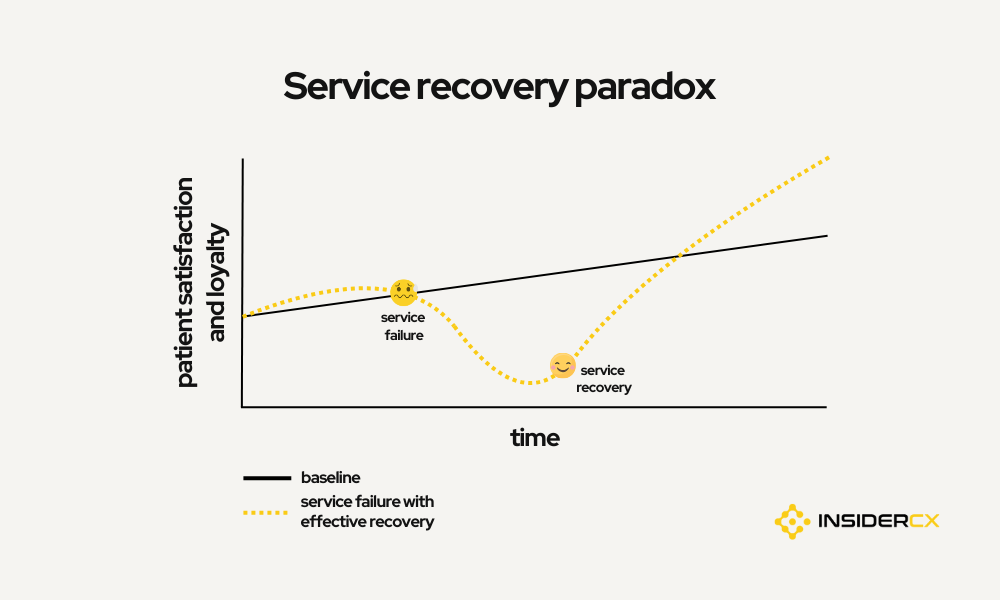
Instead of a nasty complaint, you have a person who defends and promotes your clinic. It’s a huge difference for your online image.
6. Improve overall patient experience and satisfaction
Ultimately, patient experience and satisfaction are the strongest drivers of online reputation — everything else in this list amplifies reality rather than replacing it. If patients consistently have poor experiences with your clinic, or service quality isn't meeting expectations, the word will get out, and no amount of review generation or profile polishing will hold the line for long.
The organisations doing this well treat reputation as a downstream output of a patient feedback loop, the same mechanism behind using patient feedback for quality improvement. Here’s how that loop looks like this:
- Collect feedback systematically: After appointments, after treatment completion, after complaints are resolved, and after you make targeted changes.
- Analyse it for patterns rather than reacting to individual comments: Recurring complaints or negative sentiment around themes like waiting times, communication, or billing are your improvement roadmap.
- Act on what you find: Assign owners, change processes, and track whether scores (or patient sentiment) move in the right direction.
- Close the loop with patients: Tell them what changed because of their input, which itself builds loyalty and supports retention.
When done right, this loop steadily raises the baseline experience, and your online dental reputation follows because there's simply more genuine satisfaction to draw from.
7. Be active on social media
Social media is the most discretionary channel on this list — not every practice needs to be everywhere. The first decision is which platforms to actually commit to, based on where your patients are and what you can sustain. One well-maintained profile beats four dusty ones.
At a minimum, whichever channels you choose should be kept genuinely alive:
- An always up-to-date profile (hours, contact details, branding, etc.).
- Regular posts about useful things — changes to working hours, new services, team introductions, patient testimonials, and even educational content.
- Active engagement in the comments, where responsiveness is publicly visible.
If social media is an acquisition channel for your practice rather than just a brand presence exercise, video is where the return is.
Kissdental, a Manchester-based practice, show one clever way to do this — its smile transformation videos have built an audience of over half a milion YouTube subscribers, with the same content repurposed across Instagram and TikTok. Few practices will reach that scale, but the format is replicable: short, authentic videos of results and the people behind them, published consistently.
Simplify online dental practice reputation management with InsiderCX
Running all of the above manually — review generation, monitoring, listing management, service recovery, feedback analysis — is a part-time job nobody in a busy dental office actually has.
InsiderCX is a patient experience platform built to run that system for you, turning routine patient feedback into better care quality and a stronger online reputation.
For dental practices and clinic groups, the platform brings the key pieces together:
- Automated review generation that steadily improves your public scores as part of the normal feedback process.
- A ticketing system that help you catch and resolve patient complaints privately.
- Multi-platform review monitoring, with the ability to respond to comments directly from the platform.
- Competitor benchmarking, so you know how your reputation compares locally — not just how it trends in isolation.
- Actionable patient insights that show you exactly where to improve quality and satisfaction, following proven healthcare reputation management practices.
We work with Europe's leading private healthcare providers and dental clinics to help them improve patient experience and online reputation. The roster includes big players such as Adria Dental Group, or Clinica Dentale Santa Teresa from Italy. The platform is GDPR-compliant and turnkey — our team handles the setup, and expert support is included throughout.
If you need more proof, we can set you up with free pilot project, including real surveys, real patients, and real results. Schedule a quick demo to get started.


