


Online reviews have become one of the strongest growth drivers in private healthcare. For many patients, a clinic’s Google rating and recent reviews carry as much weight as a personal recommendation.
However, consistently generating reviews remains a struggle for clinics. Staff are busy, asking for reviews often feels awkward, and follow-up is easy to forget. The result is a familiar pattern: great care delivered, but very little of it reflected publicly.
This is where automation changes the equation. When implemented correctly, review automation can handle 90% of the work — prompting patients at the right moment, reducing friction, and ensuring that patient sentiment is captured consistently.
In this article, we’ll look at why clinics struggle with generating online reviews and present the six best tools for automating the process.
Why practices struggle to generate reviews consistently
Most patients don’t leave reviews spontaneously, even when they’re satisfied. They need to be asked — and they need to be asked the right way. In a busy clinic environment, this is where things usually break down.
Manual review requests depend heavily on front-desk staff remembering to ask, choosing the right moment, and feeling comfortable doing so. When reception teams are juggling phone calls, check-ins, payments, and scheduling, review outreach understandably slips down the priority list.
There’s also the issue of friction:
- Patients have a very low tolerance for complicated processes. If leaving a review requires searching for the clinic online, logging into an account, or filling out a long form, most won’t bother — even if they had a positive experience.
- Timing matters too. Ask too early, and the patient journey isn’t complete; ask too late, and the moment has passed.
Finally, some clinics hesitate out of fear. Concerns around HIPAA, GDPR, or patient privacy lead some practices to avoid review requests altogether. Others assume that patients will leave a review if they really want to, which, in practice, results in a handful of extreme opinions (both positive and negative) rather than a representative picture of everyday care.
Benefits of automated review generation for private clinics
When review generation is automated, it shifts from being an occasional task to a reliable system. The impact shows up quickly across several areas:
- Better reputation and review scores over time. Increasing volume, consistency, and responsiveness gradually builds stronger average ratings and more trustworthy public profiles.
- Higher review volume = higher visibility in local search. A steady flow of new reviews signals relevance to search engines. Clinics with more frequent, recent reviews tend to appear more prominently in local search results.
- More consistent review quality and authenticity. Automated requests reach all patients, not just the very happy/unhappy ones. This leads to a more balanced, credible review profile.
- Reduction of staff workload by 80–90%. Once set up, automation removes the need for manual asking, tracking, and follow-up. Staff no longer need to remember or manage review outreach.
- Faster detection of patient dissatisfaction. Automated feedback captures issues immediately after the visit, while there’s still time to respond and resolve them privately.
- Improved patient experience through seamless outreach. Timely, well-designed review requests feel like a natural extension of the visit, not an interruption or a sales tactic.
How review-automation systems work behind the scenes
You can set up this automation in a few different ways. The simplest option is to digitize the process: connect your EHR/CRM to an outreach tool and automatically send review requests via email or SMS.
The more common (and effective) approach is to make a clinic review generation part of your patient feedback collection process. This is done by implementing capable patient experience survey software.
In the latter scenario, review automation relies on a series of coordinated steps that happen behind the scenes:
- Integration with the practice management system or EHR: The survey system connects to appointment data, ensuring review requests are based on actual visits rather than manual lists or guesswork.
- Automatic triggers after key touchpoints: Patient surveys are sent automatically after appointments, procedures, or completed care journeys — without staff involvement.
- Smart routing of satisfied patients: Patients who indicate a positive experience are guided to public review platforms or testimonial pages.
- Private capture of negative feedback: Patients with concerns are redirected to private feedback channels, allowing clinics to address issues before they escalate publicly.
- Monitoring, reporting, and closing the loop: Feedback is tracked over time, patterns get surfaced, and clinics can measure how changes in operations affect reviews and ratings.
Best tools for automating online review generation in healthcare
Automated review-generation platforms help healthcare providers solicit and manage patient reviews more efficiently. Once integrated into clinic workflows (e.g., after visits or through messaging), these tools prompt satisfied patients to leave online reviews and consolidate feedback into dashboards.
This not only boosts a practice’s review volume and online visibility but also enables tracking patient sentiment and service recovery.
Below, we’ll profile several leading systems that automate review collection for clinics.
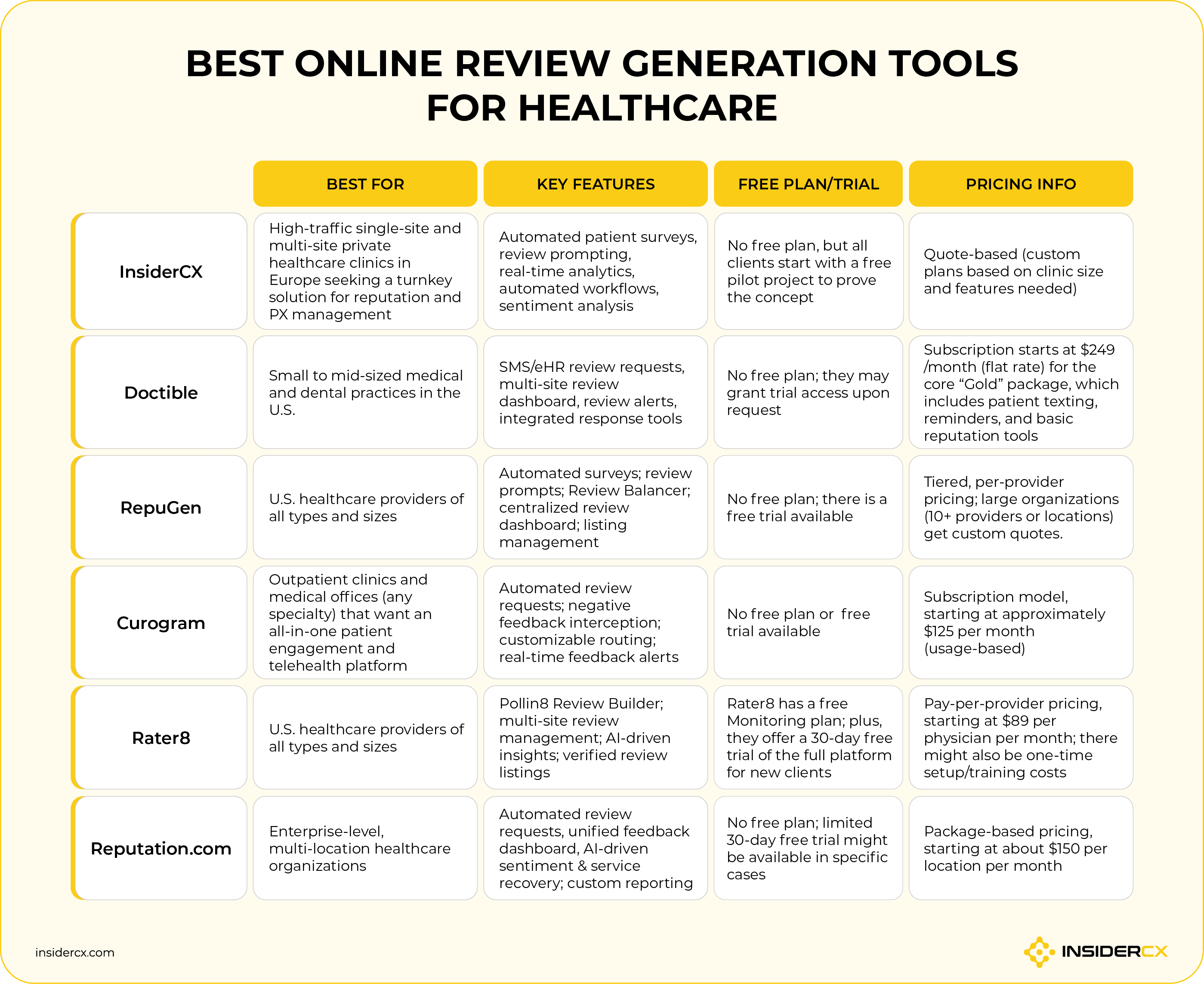
1. InsiderCX
InsiderCX is an AI-driven patient experience platform built for private healthcare practices. It automates patient surveys via SMS/WhatsApp and analyzes feedback in real time, helping clinics close the loop on complaints and quality issues. The platform also includes reputation management: it tracks clinic review scores (Google, etc.) and prompts satisfied patients to leave reviews to improve those scores.
Key review automation features:
- Automated patient surveys: Send perfectly timed post-visit feedback requests via SMS/WhatsApp to maximize response rate.
- Review prompting: Happy patients are automatically invited to post 5-star reviews on Google and other public review sites.
- Real-time analytics: Dashboards report NPS/satisfaction by provider and location, highlighting areas for improvement.
- Automated workflows: Low survey scores or negative comments trigger alerts and ticket assignment for service recovery.
- Sentiment analysis: AI categorizes open-text feedback as positive/negative and flags issues without manual review.
Strengths:
- A healthcare-focused, turnkey solution designed specifically for clinics, with integrated compliance and pre-built healthcare survey templates.
- Hands-off operation means that InsiderCX staff handle survey design, sending, and analysis, making implementation very easy.
- Users report dramatically more feedback and reviews generated, as early as one month after the implementation.
Limitations:
- The cost and implementation effort are usually not worth it for small, single-site offices.
- InsiderCX platform operates predominantly in the UK and EU markets.
Case studies that support InsiderCX review generation capabilities:
- A few months after implementation, Optical Express recorded a 500% increase in Google Reviews.
- In the first 8 months, Affidea gathered 643 new reviews, with the average monthly number of Google Reviews now reaching 120. Plus, one of their clinics saw its rating jump from 3.6 to 4.7.
- Pronatal generated over 400 new reviews, raising its average score from 4.4 to 4.9.
- In the first 30 days of using InsiderCX, Apolonija collected over 70 positive Google reviews, eventually raising their score from 4.4 to 4.7.
- Arsano Medical Group saw a dramatic shift in online visibility and reputation. Two of their locations that saw the biggest positive results were Aviva and Arithrea. Aviva polyclinic went from a monthly average of 15 Google reviews to 63, increasing their review score from 3.9 to 4.3. Arithrea started generating 24 reviews per month (up from 2), boosting their score from 3.9 to 4.5.
You can find more info about the inner workings of the InsiderCX platform here.
2. Doctible
Doctible is a patient engagement suite that includes a dedicated Review Generator tool. It automates patient outreach (texts and emails) and EHR integration to send review requests after appointments, funneling satisfied patients to Google/Facebook pages.
Key review automation features:
- SMS/eHR review requests: After each visit, Doctible texts patients a feedback survey and (if positive) a one-click link to leave a Google or Facebook review.
- Multi-site review dashboard: Aggregates and displays all Google/Facebook reviews, average ratings, and trends in one platform.
- Review alerts: Immediately notifies staff of new reviews or low scores so issues can be addressed before posting.
- Integrated response tools: Allows staff to reply to reviews directly from the dashboard.
- Patient satisfaction monitoring: Tracks patient sentiment over time to identify and resolve pain points.
Strengths:
- Doctible offers simple dashboards for tracking average ratings and the total number of reviews.
- It automates review follow-ups so staff do not have to manually request feedback or reviews.
- Doctible’s platform supports two-way texting and other communication tools, which many users find streamlines patient outreach and appointment scheduling.
“Doctible has saved me so much time with their reminders and recall… The patient communicator is life changing! I didn’t have the ability to text before and this has saved me so much time.” — Annie F., Capterra
“Great communication software. The two way texting and appointment reminder software are wonderful to use.” — Nathan, Capterra
Limitations:
- Doctible does not currently support sending messages in all languages (e.g. Spanish is not supported), which may limit communication with non-English-speaking patients.
- It also lacks an automated self-updating mechanism (updates may require manual action or support), and some users have reported that customer support response times can be slow.
“Doesn’t integrate with EMR, making for more steps for my staff. Also, they rope you into a self-renewing contract for $300/mo. Not worth it.” — Mark M., Capterra
“[I dislike] The fact that the campaigns can only be emailed and not able to text if over 500 people.” — Angela, Capterra
3. RepuGen
RepuGen is a healthcare-specific reputation management and review solicitation tool. It automates after-visit surveys and redirects happy patients to review sites while catching unhappy patients first.
Key review automation features:
- Automated surveys + review prompts: Sends post-appointment surveys; satisfied patients are guided to public review sites, boosting online ratings.
- Review Balancer: Distributes review requests across platforms (Google, Yelp, Healthgrades, etc.) according to clinic preferences for balanced profiles.
- Centralized review dashboard: Aggregates reviews from multiple sites into one view with alerts for new low ratings.
- Listing management: Manage your listings from one dashboard and instantly push updates across 50+ connected directories, including Google, Apple Maps, Facebook, Yelp, and Healthgrades.
- HIPAA compliance: Ensures patient data privacy in all communications and storage.
Strengths:
- RepuGen is praised for being very user-friendly and for its responsive customer support.
- It offers extensive customization for feedback collection, and many healthcare users note that it has substantially boosted the number of patient reviews posted online.
“RepuGen has it all. They’ve tailored their solution to my needs, have excellent customer service, and always deliver superior results for online reviews and more.” — Madhu P., G2
“Excellent product, user friendly and prompt response from the support guys (Casey) for a fraction of price from competition. Very happy with their service.” — Omid G., G2
Limitations:
- Some users note that the platform’s extensive customization options can occasionally cause minor glitches in the dashboard.
- One reviewer also noted that details like EMR integration pricing were not fully explained during setup.
“Some patients prefer not to be ‘bothered’ and get upset by RepuGen’s attempts to get a satisfaction rating.” — Amber G., Capterra
“I was not given accurate and complete information about the price for integrating with the EMR.” — Nancy A., Capterra
4. Curogram
Curogram is an all-in-one HIPAA-compliant communication platform for medical practices. While its core is two-way texting and patient reminders, it also includes a Reputation Management module to automate reviews.
Key review automation features:
- Automated review requests: After each visit, Curogram texts patients to request a review on Google, Yelp, Healthgrades, etc.
- Negative feedback interception: Alerts staff when a patient reports a poor experience (via survey), enabling quick issue resolution before a bad review is posted.
- Customizable routing: Sends review invitations based on the specific provider and location, ensuring reviews attach to the right doctor or office.
- Real-time feedback alerts: Notifies staff instantly of patient comments so they can respond while the experience is fresh.
Strengths:
- Users report that the platform is easy to use and that the setup process is straightforward.
- The platform automatically prompts satisfied patients to leave five-star online reviews through smart surveys, which helps practices boost their online reputation.
- Curogram includes secure messaging and telehealth features that improve office communication, and it integrates with existing EHR/phone systems to streamline workflows.
“I really appreciate how seamlessly Curogram integrates with our existing phone system and EMR… The two-way HIPAA-compliant text messaging is a standout feature… Automated appointment reminders and no-show reduction tools have been instrumental in reducing missed appointments…” — Ramesh R., G2
“I really appreciate that Curogram is very easy to use. It’s accessible for patients of all ages… The platform being HIPAA secure is a major plus… The simplicity and security of Curogram really enhance my workflow and help me engage effectively with patients who face language barriers. Additionally, the setup process was very straightforward and quick.” — Moez K., G2
Limitations:
- Some users report minor issues such as occasional delays when syncing new appointments with the EHR (so calendar updates may lag).
- Because Curogram identifies patients by phone number, manual entry errors (typos in numbers) can lead to message delivery problems.
- Certain user interface elements are mentioned as having room for improvement, including adding search functionality or customization options to the dashboard.
“The system can sometimes lag, and on rare occasions, messages get routed to the wrong patient.” — Samantha I., G2
“The main issue I face with Curogram is the lack of an Android app, as it currently only has an app available for iPhones.” – Moez K., G2
5. Rater8
Rater8 is a healthcare reputation management engine that uses AI to maximize online reviews. Its bespoke system automatically builds reviews where you need them most by steering patients to preferred sites (e.g. Google, Healthgrades) based on clinic goals.
Key review automation features:
- Pollin8 Review Builder: Automatically invites patients to submit reviews on selected platforms, greatly expanding 5-star review counts.
- Multi-site review management: Tracks ratings and comments across Google, Healthgrades, WebMD, etc., in a single dashboard with alerts for low scores.
- AI-driven insights: Applies sentiment analysis and reputation scorecards so practices can monitor trends and patient sentiment at a glance.
- Verified review listings: Publishes customer reviews as rich snippets in search results to improve local SEO (leveraging “verified” review status).
- Survey & feedback tools: Includes NPS and patient experience surveys that feed into the review solicitation process.
Strengths:
- Rater8 is regarded for its ease of use and intuitive interface, which simplifies gathering and managing patient feedback. Users praise its dashboard for letting them filter and view review data effortlessly, and they commend the smooth onboarding and support during setup.
- It automates review generation and feedback collection very effectively, usually with a massive increase in review generation.
- Rater8 consolidates reviews from multiple platforms into one place and provides robust analytics, helping practices improve their online ratings and patient engagement rapidly.
“The automated feedback makes it super easy to hear from patients without having to do anything manually, and it’s great seeing more positive Google reviews come in consistently. I really appreciate how simple the dashboard is — it’s clean, easy to navigate, and gives us real-time insights into how we’re doing.” — Cayla R., Capterra
“Our Google reviews and internal reviews have skyrocketed with rater8. We now have a simple way to survey patients and to share their reviews with other potential patients. The service/support with rater8 is exceptional!” — Donna D., Capterra
Limitations:
- Rater8 is primarily a reputation management tool rather than a full patient experience suite. It does not include features like appointment reminders, ticketing/workflow automation, or deep analytics beyond review management.
- Some users also mention a learning curve: the many menus and tabs can be overwhelming at first, so it takes time to become fully familiar with all capabilities.
“The only con was the number of providers we have [which] made it a bit more pricey to include all.” — Donna D., Capterra
“The only downside I can come up with is that I wish the suite of products was more comprehensive… I’d like it even better if the portfolio expanded into more customer management tools.” – John C., G2
6. Reputation.com
Reputation.com is an enterprise reputation management platform used by large healthcare organizations. It consolidates surveys, reviews, social feedback, and listings into one AI-powered solution, with advanced analytics and service-recovery tools.
Key review automation features:
- Automated review requests: Triggered post-visit or after positive survey responses, sending patients to submit reviews on platforms like Google, Yelp, and Healthgrades.
- Unified feedback dashboard: Aggregates all patient reviews, survey responses, and scores in one interface, with AI analytics to spot trends.
- AI-driven sentiment & service recovery: Detects negative feedback in real time and can automatically open a case for follow-up.
- Listings and SEO management: Maintains correct business info and review volume across directory listings, improving local search rankings.
- Custom reporting: Powerful KPI dashboards and scheduled reports for leadership (brand, location, provider-level insights).
Strengths:
- Reputation centralizes review and survey management across multiple locations. Marketing teams can leverage review monitoring and sentiment analysis to track patient and customer satisfaction in real time.
- The platform’s top-rated features include robust response management and analytics; it also provides AI-driven insights and competitive benchmarking.
- Users say they can manage and reply to all reviews from a single dashboard and even prepare social media posts more easily, improving efficiency.
“I don’t think my day-to-day operations would flow easily without Reputation. The easy-to-navigate dashboard and time management it allows is wonderful. I consider it a must-have tool.” — Felicia N., Capterra
“I love that I can manage the reviews and business listings for my multiple locations through one platform.” — Holly L., Capterra
Limitations:
- Some users have reported occasional software bugs and data syncing issues.
- Several users complain about support, noting that the customer support agents are not really knowledgeable about the product.
“I don't like that it doesn't always work. That's kind of a big issue for our company. One of the key functions don't always work and we don't get alerted that it isn't working so we have to find out ourselves after months of using and paying for the service.” — Annie, Capterra
“It messed up review syndication - for example, it categorized many of the listings wrong, which had a negative impact on client relationships and SEO.” — Verified User, Capterra
“Aside from the initial sales pitches, we had a terrible onboarding rep… he didn’t answer his phone, he didn’t train us, he didn’t know how the features worked.” — Carrie, Capterra
Grey-area tactics and practices to avoid (and why they backfire)
As review automation becomes more common, so do shortcuts that promise faster results but quietly undermine trust. These tactics often look effective in the short term, but they carry the risk of account suspensions on Google and review platforms, compliance violations, erosion of patient trust, and long-term brand damage that’s hard to reverse.
We’ll look at the most common grey-area practices clinics should avoid, and why they almost always backfire.
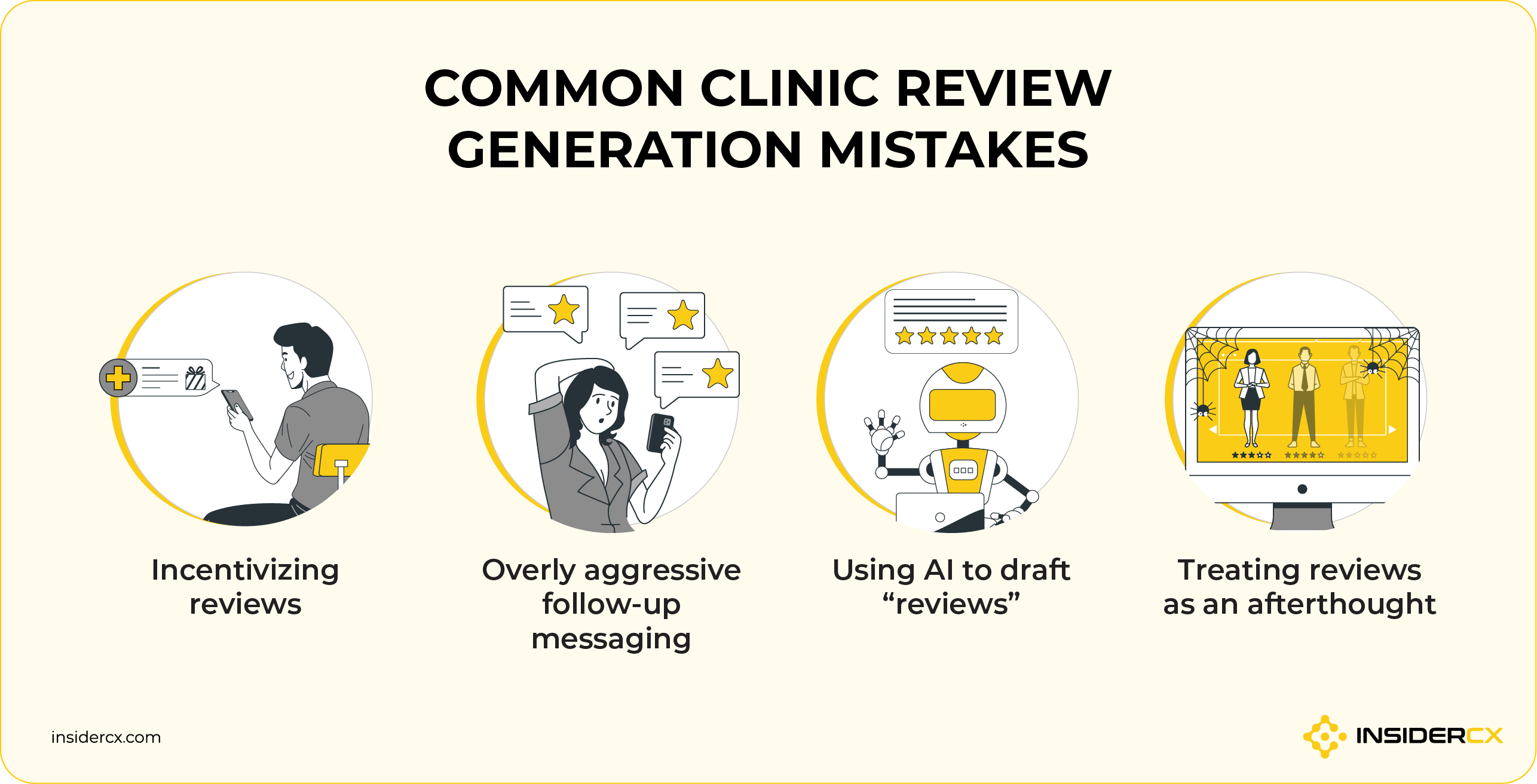
Incentivizing reviews
This usually means offering discounts, gifts, vouchers, or other benefits in exchange for leaving a review, subtly implying that a “good” review is expected. While it may boost volume temporarily, it violates the terms of most review platforms and distorts the authenticity of patient feedback.
Beyond the risk of penalties or review removal, incentivized reviews weaken credibility. Patients are quick to sense when feedback feels manufactured and, over time, this approach damages trust far more than it helps visibility.
Overly aggressive follow-up messaging
This happens when clinics send repeated reminders, use pushy language, or follow up too frequently after an initial review request. What starts as a nudge quickly turns into pressure, and patients resent it.
Effective review outreach should be short, authentic, and optional — one clear request at the right moment is usually enough. Aggressive follow-ups increase opt-outs, complaints, and negative sentiment. They often trigger exactly the opposite outcome: irritated patients leaving poor reviews about the process itself.
Using AI to draft “reviews”
Some clinics experiment with AI-generated review text, asking patients to “approve” or post it as their own. Others go further and publish synthetic reviews outright. Both practices are unethical and, in many jurisdictions, legally dubious.
Review platforms actively detect unnatural language patterns, and penalties can be severe. More importantly, fabricated or semi-fabricated reviews destroy credibility when discovered. AI is powerful for analysis and response drafting, but it has no place generating patient opinions.
Treating reviews as an afterthought
Collecting reviews without monitoring or responding to them is one of the most common and costly mistakes. Unanswered negative reviews signal indifference, while ignored positive reviews miss an opportunity to reinforce trust.
Reviews are a two-way channel. Clinics that actively monitor feedback and respond professionally consistently outperform those that don’t. Timely, empathetic responses demonstrate accountability and commitment to improvement, which patients notice and remember.
How to measure success
Automating review generation only works if you track the right outcomes. To avoid vanity metrics, focus on indicators that show whether automation is improving visibility, patient engagement, and internal efficiency.
A few metrics to consider tracking include:
- Review volume growth: Track the number of new reviews over time, not just the total count. A steady, consistent increase matters more than short spikes and signals that review collection is working as intended.
- Star rating trends: Monitor how your average rating evolves month over month. Even small upward shifts (for example, from 4.3 to 4.5) can have a meaningful impact on patient trust and scheduled appointments.
- Response rates to feedback surveys: High response rates indicate good timing, low friction, and patient trust in the feedback process. If response rates drop, it’s often an early signal that messaging, timing, or channel choice needs some tweaking.
- Percentage of negative feedback captured privately: This shows how effectively your system intercepts dissatisfaction before it becomes a public review. A higher share of private issue capture usually correlates with fewer damaging public complaints and better service recovery.
- Local ranking and visibility impact: Track changes in Google local pack visibility, impressions, and profile views over time. Since review volume and recency influence local rankings, improvements in visibility typically follow review growth with a short delay.
- Staff time saved: Measure how much manual work has been removed from front-desk or admin teams. Clinics often underestimate this benefit, but reclaimed hours are one of the clearest ROI indicators of automation.
Get more clinic reviews with InsiderCX
Automation is by far the most efficient and reliable way to build a strong online reputation — especially across multiple locations or providers. Manual review requests simply don’t scale, and inconsistent follow-up leaves reputation growth to chance.
Platforms like InsiderCX provide a compliant, patient-first system that automates feedback collection, identifies satisfaction and dissatisfaction early, and turns positive experiences into authentic public reviews.
The result is more visibility, better ratings, and fewer reputation risks — without adding workload for your staff.
If you want to see how this works in practice, schedule a demo and explore how automated feedback and review generation can support sustainable clinic growth.


