



When clinics run inefficiently, the consequences show up everywhere. Patients wait longer, complain more, and leave for competitors who respect their time. Revenue also suffers — every cancelled appointment, every duplicate intake form, every confused patient on the phone is a small drag on the bottom line.
Most inefficiencies come from familiar issues, and individually, each of them is small. But together, they slow the whole organisation down.
This article breaks down how to spot inefficiencies at your clinic, the data and feedback signals worth paying attention to, and eight proven strategies to streamline operations without compromising quality of care.
What is clinical efficiency?
Clinical efficiency means delivering high-quality care while minimising wasted time, steps, and resources in your daily clinic operations. Its focus is on removing the friction that gets in the way of good care.
Achieving high clinical efficiency requires a careful balance:
- Patient experience has to remain consistent and personal
- Staff workload should be sustainable.
- Financial performance must hold up — revenue per visit, utilisation rates, and operating margins all matter.
Push too hard on any one of these, and the other two will suffer.
The most straightforward way to improve clinic efficiency is to tackle bottlenecks: the points in your patient journey or internal workflows where things slow down, get duplicated, or fall through the cracks.
Find them, fix them, and almost every other metric improves.
How to identify bottlenecks and inefficiencies at your clinic
Most clinic leaders have a rough sense of where things are slow, but rough isn't enough to act on. To make targeted improvements, most clinics and hospitals should have at least three sources of information to pull from: internal data, frontline staff input, and patient feedback.
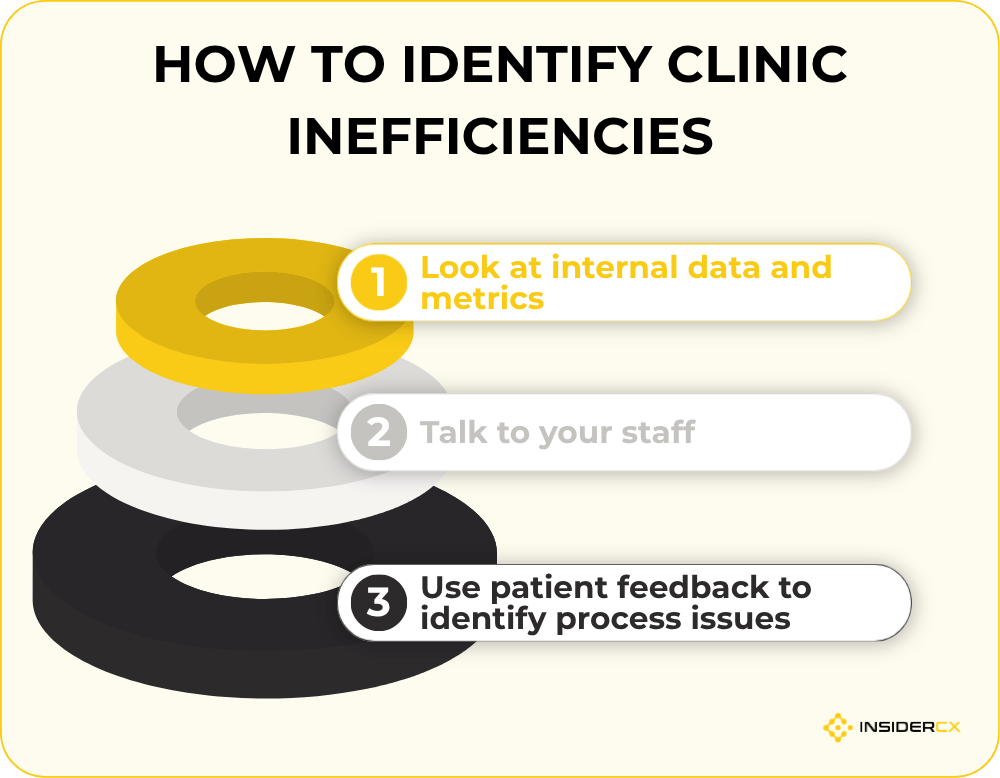
1) Look at internal data and metrics
Start with what you can measure: a handful of operational metrics will tell you most of what you need to know about how your clinic is running:
- Patient wait times: From check-in to first contact with a clinician, and from check-in to leaving the clinic; track averages and outliers separately.
- Appointment duration: How long appointments actually take versus how long they're scheduled for. Persistent overruns point to scheduling or workflow issues.
- No-show rates: Total no-shows by clinic, clinician, day of week, and appointment type — patterns matter more than the headline number.
- Staff utilisation: How clinical and administrative time is distributed. Underused staff signal scheduling problems; overstretched staff signal capacity issues.
If you do not have this data on hand, it’s time to start tracking it. For some data points or identified issues, you might even want to run a clinical audit.
Once you have a few months of data, it becomes much easier to distinguish between patterns and isolated issues: e.g., long wait on one Tuesday is noise; long waits every Tuesday morning is a signal.
2) Talk to your staff
Data tells you what is happening; your staff usually know why. The people executing day-to-day care — receptionists, nurses, technicians, clinicians — see exactly where workflows break down, which forms create confusion, and which steps could be eliminated without anyone noticing.
The organisations doing this well make sure their quality and operations managers maintain close, regular communication with frontline staff as an ongoing habit. Ten minutes a week with a charge nurse can surface issues no dashboard will.
It's also worth running occasional staff surveys that ask specific questions about workflow friction, recurring bottlenecks, and the small day-to-day annoyances that erode efficiency over time. The more concrete the questions, the more useful the answers.
3) Use patient feedback to identify process issues
Patients often see inefficiencies that staff and data both miss. They notice the gap between booking online and getting a confirmation. They feel the shift between a smooth consultation and a chaotic checkout. They're acutely aware of how many times they've had to repeat the same information to different people.
The challenge is collecting feedback consistently and at scale, with the right questions, asked the right way. But be mindful that a handful of unstructured complaints won't tell you much. What you need is enough volume and enough specificity to identify positive/negative patterns.
This is why clinics use InsiderCX to automate the feedback collection and analysis process:
- Integrate with your CRM or EHR so patient data flows in automatically — no manual exports.
- Send automated post-visit surveys that reach patients while the experience is fresh.
- Track key experience metrics like NPS (Net Promoter Score), CSAT, and journey-stage scores in one dashboard.
- Use sentiment analysis to surface recurring themes across thousands of open-text responses.
- Prioritise issues and implement changes based on what's affecting the most patients.
- Continue tracking feedback after each change to confirm whether the fix actually worked.
Using patient feedback for quality improvement creates a closed-loop system where complaints become real process changes rather than tickets that get filed and forgotten.
Proven ways to boost clinic efficiency
Once you know where the bottlenecks are, the next step is fixing them. The strategies below cover the most common and highest-impact areas where private clinics can save time, money, and patient goodwill.
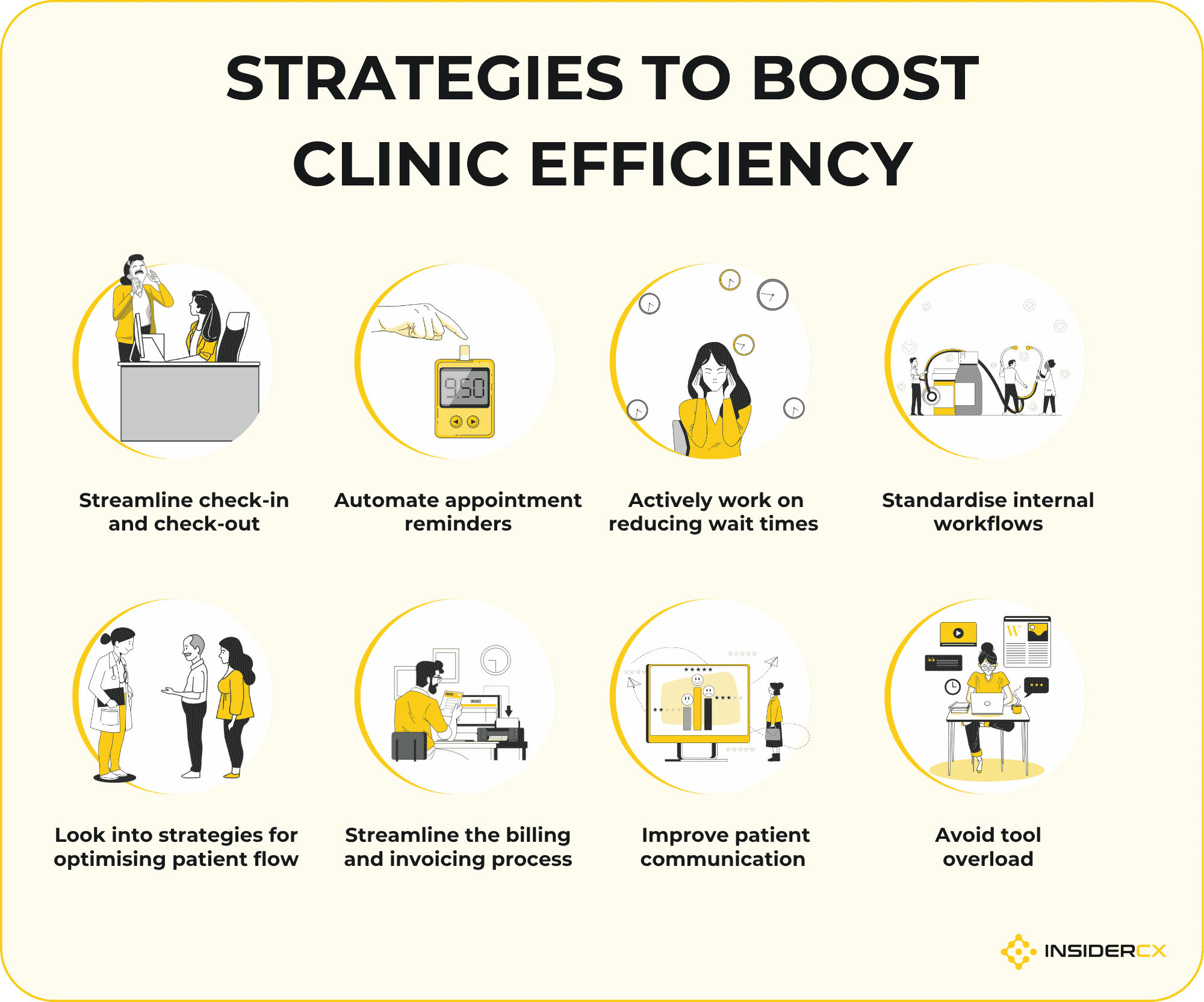
1. Streamline check-in and check-out
The first and last impressions a patient has of your clinic almost always involve admin, not care. Long check-in queues and confused checkouts are some of the easiest inefficiencies to fix.
Focus on three things:
- Digital forms and pre-visit intake let patients complete paperwork at home rather than in your waiting room, saving time for both sides. Self-service kiosks handle routine check-ins so receptionists can focus on patients who actually need help.
- Faster insurance verification, ideally automated, removes a major source of delay.
- And on the way out, a clear checkout process — payment, follow-up booking, and any post-visit instructions — should take minutes, not feel like another appointment.
2. Automate appointment reminders
Patient no-shows are one of the most expensive inefficiencies in private healthcare. Every empty slot is lost revenue and wasted staff time.
Automated, personalised reminders — sent via SMS, email, or WhatsApp at the right intervals before an appointment — consistently reduce no-show rates.
The personalisation matters: a reminder that includes the patient's name, clinician, any prep instructions, and even parking details performs far better than a generic "you have an appointment tomorrow."
A good case in point is Affidea, one of Europe's largest providers of advanced diagnostics. Using InsiderCX's automated reminder workflows, Affidea recovered over 3,500 appointments that would otherwise have been lost to no-shows, directly improving capacity and revenue without adding admin work.
3. Actively work on reducing wait times
Wait times are one of the most common patient complaints, and one of the clearest signals that something operational isn't quite working. Reducing them takes deliberate effort:
- Identify peak hours and overload patterns using your scheduling data, then redistribute capacity accordingly.
- Stagger appointments strategically rather than booking everyone on the hour.
- Set realistic appointment durations based on actual time taken, not assumed time.
- Build in buffer slots to absorb overruns and emergencies without cascading delays.
- Communicate proactively when delays happen — patients tolerate waiting much better when they know what's going on.
4. Standardise internal workflows
Workflows can be optimised at every level of the clinic, from the frontline reception desk, to doctor-patient interactions, to middle and top management. Standardisation removes guesswork and makes performance repeatable rather than dependent on whoever happens to be on shift. And it can be done across the entire hierarchy:
- Patient intake: A documented, repeatable process for greeting, registering, and orienting new patients.
- Clinical handovers: A consistent format for passing information between clinicians and shifts.
- Clinical audits: A defined methodology for conducting clinical audits, so each one is comparable to the last.
- Complaint handling: A clear escalation path with defined response times.
- Reporting: Standard templates for management dashboards and external compliance reporting.
Besides report templates, the most practical tools to use here are Standard Operating Procedures (SOPs) and checklists for various workflows. Some of these use cases should be guided by industry compliance frameworks such as ISO 9001 or CQC requirements in the UK. Others are internal choices, but they should still be written down rather than passed on by word of mouth.
5. Look into strategies for optimising patient flow
Patient flow refers to how patients move through your clinic. Smooth flow means no unexpected stops, no duplicate steps, and no patients waiting in the wrong place. A few practical strategies can make a meaningful difference:
- Map the full patient journey and look for steps that add no value.
- Reduce hand-offs between staff where possible — every transfer is a potential delay.
- Pre-screen patients before their visit so the right resources are in place when they arrive.
- Create dedicated pathways for high-volume, predictable visit types.
- Use real-time visibility tools so staff know where patients are in the process.
For a more in-depth look, this guide to patient flow management covers the operational and technological steps in detail.
6. Streamline the billing and invoicing process
Billing is one of the most common sources of patient confusion and follow-up admin work. An unclear invoice triggers calls, emails, and disputes that absorb staff time. Here’s what to do to streamline the process:
- Automate invoice generation directly from your EHR or practice management system.
- Offer multiple payment methods, including online payment links, to reduce friction.
- Send invoices and receipts digitally rather than relying on paper.
- Provide clear, itemised breakdowns so patients understand what they're paying for.
- Set up automated payment reminders for outstanding balances.
- Integrate with insurance verification to avoid surprise charges later in the cycle.
7. Improve patient communication
Poor patient communication is one of the biggest hidden drains on clinic efficiency — resulting in extra calls to clarify instructions, scheduling conflicts to solve, complaints to address, and forms to fill in again.
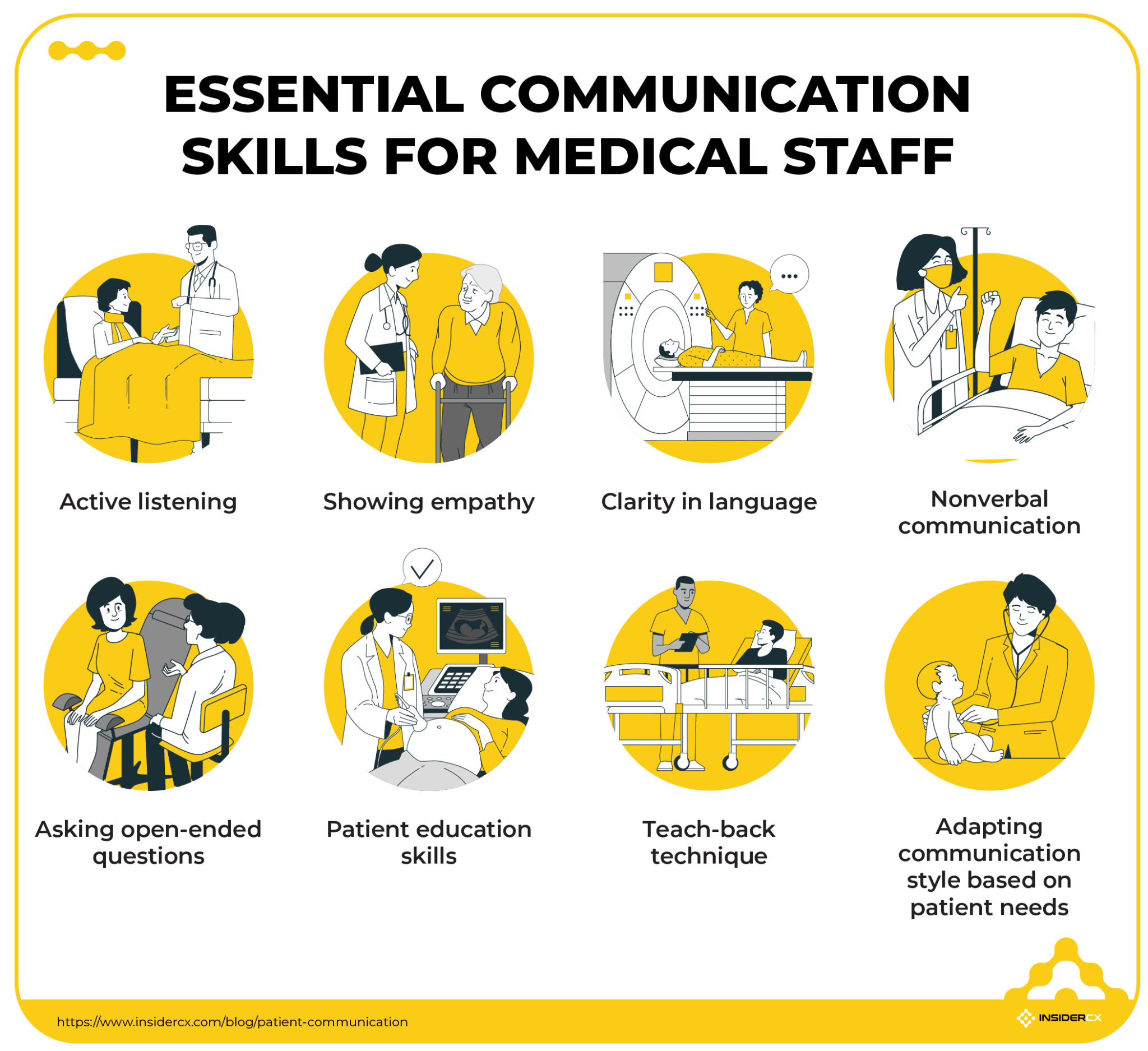
Get it right and a remarkable amount of admin simply disappears:
- Use a centralised patient communication platform rather than juggling phone, email, SMS, and printed leaflets.
- Personalise communications with the patient's actual condition, treatment, and clinician.
- Confirm instructions in writing, especially for prep, post-procedure care, and medication.
- Set clear expectations about response times, billing timelines, and follow-up steps.
- Close the loop when patients raise concerns, so they know their feedback was received and acted on.
8. Avoid tool overload
Specialised tools are excellent at automating specific workflows. The problem starts when you've layered on so many that staff spend more time logging into systems than using them. A clinic running separate platforms for scheduling, intake, EHR, billing, marketing, feedback, reviews, and complaints often discovers that the tools themselves have become a bottleneck.
This doesn’t mean you need to abandon software; simply prioritise integration and simplicity.
Look for healthcare platforms that handle more than one job, integrate cleanly with the systems you already rely on, and surface data in one place rather than five.
Modern patient experience software is a good example because they typically combine feedback collection, reputation management, complaint handling, and analytics in one centralized platform.
Boost clinic efficiency and reputation with InsiderCX
Patient feedback is one of the most useful — and most underused — sources of intelligence available to a private clinic. Used well, it tells you exactly where your operations break down, what your patients value, and which fixes are actually working.
InsiderCX is a patient experience platform built to tackle clinic inefficiency from several angles at once. Rather than adding another standalone tool, it consolidates the workflows that most directly affect efficiency and reputation:
- Automated feedback collection and analysis across the patient journey, with sentiment analysis that surfaces themes you'd miss in raw data.
- Operational and quality dashboards that help quality and operations teams uncover issues and track whether improvement initiatives are actually working.
- Reporting tools that simplify and save time on documentation for ISO, CQC, and other compliance frameworks.
- Automated appointment reminders that reduce no-show rates and recover lost capacity.
- Boosted review generation that turns satisfied patients into a steady stream of online reviews, strengthening your reputation without manual effort.
- A built-in complaints module that makes complaint management a closed-loop rather than ad hoc.
- Integrations with your CRM, EHR, and practice management systems to maintain data quality and reduce tool overload.
The clinics that win the next few years will be the ones running leaner operations, listening more carefully to patients, and acting on what they hear.
We can help you be that clinic. Let’s talk.


