



Before booking an appointment, most patients check Google reviews, browse your website and social media, and compare ratings across healthcare platforms. If your online presence is carried by 3 positive reviews from 4 years ago, you’re hurting your patient acquisition efforts.
There is no way around it. A strong online reputation is how you build credibility, reassure prospective patients, and reinforce the quality of care you provide offline.
To do that effectively and at scale, you need healthcare reputation management software. These platforms help you consistently generate new patient reviews, monitor patient sentiment, keep listings up to date, and improve review scores across key channels — all while staying compliant with healthcare regulations
But that's why you’re here. And to make your decision easier, we’ve reviewed six leading healthcare clinic reputation management tools available in 2026.
For each platform, you’ll find a comparison table, a quick overview, a list of core reputation management features, real user-driven pros and cons, and an explanation of how pricing works — so you can confidently choose the right solution for your clinic.
Features to look for in healthcare reputation management software
Not all reputation management platforms are built for healthcare. When you’re evaluating tools for your clinic, you need software that supports patient trust, regulatory awareness, and operational efficiency — not just generic review generation/tracking.
Below are the core features you should look for in healthcare reputation management software:
- Automated review collection: Automated review requests help you collect patient feedback at scale via SMS or email. This improves response rates while reducing manual follow-ups for your staff. Plus, you marketers can pull important insights to improve online messaging.
- Ticketing system: Negative comments in feedback surveys are flagged and routed to quality managers or other clinic personnel. This helps you resolve issues early, before that dissatisfaction manifests as a negative public review.
- Review generation: Automatically invite patients to leave reviews on select profiles. This invitation is usually included at the end of feedback surveys. It helps clinics build a steady flow of recent, authentic reviews without manual follow-ups.
- Multi-platform review monitoring: Patients leave reviews across Google, Facebook, NHS profiles, and healthcare directories. A centralised dashboard ensures you see and manage all reviews in one place.
- Listing management: Used to keep your clinic’s name, address, phone number, hours, and services accurate across directories. Consistent listings improve local search visibility and reduce patient confusion.
- Review response management: “New review” notifications and response templates allow you to reply quickly and consistently to patient reviews while supporting compliance.
- Reporting and performance tracking: You should be able to easily compare patient sentiment and satisfaction between different locations, services, and doctors.
Outside of that, the platform you choose should provide proper compliance and data security, as well as integrate with your existing CRM, appointment management, EHR, and other systems.
A comparison of 6 top healthcare online reputation management tools
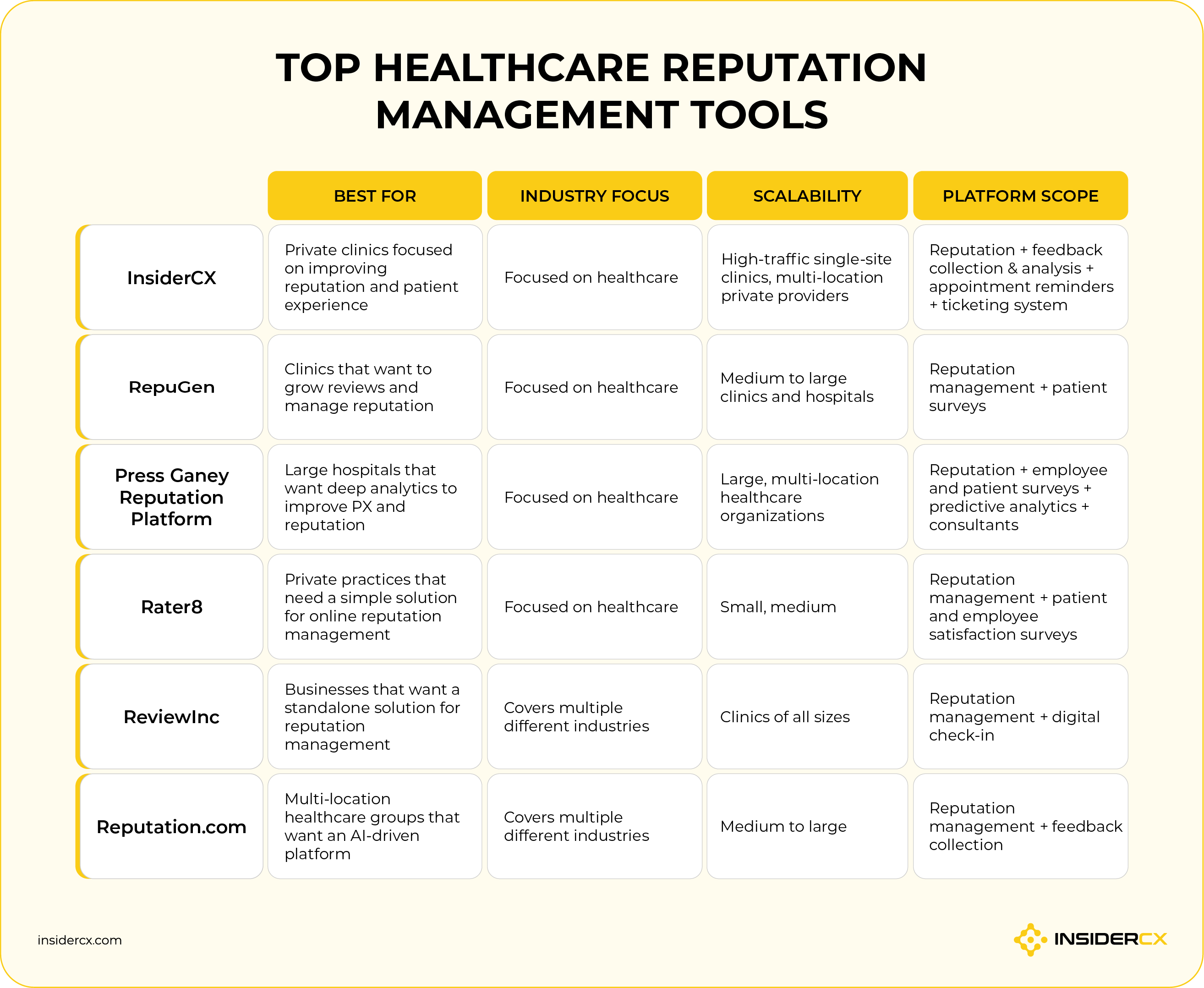
Many of these platforms offer similar-sounding features. The real differences lie in industry focus, scalability, platform scope, pricing, and support.
In this section, we will try to cover all of the above. First, we will throw a quick comparison table that outlines the key differences between the healthcare reputation management platforms.
Then, we will follow up with a more in-depth look at each solution — key features, pros, limitations, and pricing — supported by real user reviews.
1. InsiderCX
InsiderCX is a patient experience platform designed for private clinics that want measurable improvements in online reputation and patient satisfaction. The solution combines review generation, patient feedback, and expert guidance to help clinics boost ratings, streamline quality control, and deliver better care.
Key reputation management features:
- Automated review generation: At the end of automated feedback surveys sent via SMS or WhatsApp, InsiderCX invites patients to leave a review. This helps healthcare organizations build a consistent flow of authentic reviews and increase their review score.
- Multi-platform review monitoring and competitor benchmarking: Clinics can track and manage reviews across Google and other public healthcare directories from a central dashboard. You can even track profiles from other clinics for easier comparison.
- Ticketing system: Capture and route negative feedback to the right team members before issues escalate publicly. Set custom SLA targets (like resolution time) and speed up the process with pre-filled response templates.
- Deep patient insights: AI-powered sentiment analysis helps identify quality gaps and shows you what (or who) patients like and dislike the most. Quality tems can use those insight to improve patient experience, while marketing teams can improve messaging and run more effective and targeted campaigns.
Case studies that support InsiderCX online reputation capabilities:
- In the first 8 months, Affidea gathered 784 new reviews, with the average monthly number of Google Reviews now reaching 145. One of their clinics saw its rating jump from 3.6 to 4.7.
- Adria Dental Group implemented InsiderCX to benchmark satisfaction and get a central overview of the patient experience across 11 locations.
- Arsano Medical Group saw a dramatic shift in online visibility and reputation. Two of their locations that saw the biggest positive results were Aviva and Arithrea. Aviva polyclinic went from a monthly average of 15 Google reviews to 63, increasing their review score from 3.9 to 4.3. Arithrea started generating 24 reviews per month (up from 2), boosting their score from 3.9 to 4.5.
- Apolonija used InsiderCX to get real-time alerts for negative feedback, allowing the clinic to respond immediately. This proactive approach helped prevent negative public reviews and improve patient loyalty.
Pricing model: Modular, subscription-based pricing that scales based on the number of locations, outreach volume, and selected modules. This allows clinics to pay only for the features they need as they grow. Find more info about pricing here.
2. RepuGen
RepuGen is a healthcare-focused reputation management platform. It helps organisations collect patient feedback, generate reviews, and monitor online reputation across major platforms.
Key reputation management features:
- Automated review generation: RepuGen sends review invitations to patients via SMS or email after visits. This supports steady review growth while reducing manual effort for staff.
- Multi-platform review monitoring: The platform monitors reviews across Google, Facebook, and healthcare-specific review sites. All feedback is accessible from a single dashboard.
- Review management and sharing: Centralised tools allow teams to respond to reviews efficiently. Templates and approval workflows help maintain consistency across locations. You can also use it to share select reviews on social media and your website.
- Listing management: Manage your listings across 50+ directories. Make the change inside the central dashboard and instantly push updates to all connected platforms.
Top pros based on user feedback:
- Helps prevent negative reviews. [“We use RepuGen to filter out any customers who are not fully satisfied with our services so that we can address their concerns before they post a negative review online.” — Beth, TrustRadius]
- Good support with affordable pricing. [“Excellent product, user friendly and prompt response from the support guys for a fraction of price from competition.” — Omid, G2]
Top cons based on user feedback:
- Needs to be properly configured to avoid being invasive. [“Some patients prefer not to be "bothered" and get upset by RepuGen's attempts to get a satisfaction rating.” — Amber, Capterra]
- Trying to customize things can lead to glitches. [“I think due to the many customizations that RepuGen is willing to provide creates some very minor glitches that occur which is no fault of anyone really. But it does detract from the quality to be honest.” — Brian, Capterra]
Pricing model: Monthly subscription-based pricing that typically scales based on the number of locations and features selected. You will have to complete a form to get a pricing estimate.
3. Press Ganey HX Platform
Press Ganey Human Experience platform is part of Press Ganey’s broader patient experience and performance improvement ecosystem. It is primarily used by hospitals and large healthcare organisations to manage online reviews alongside clinical and operational patient experience data.
Key reputation management features:
- Review generation and solicitation: The platform encourages patients to leave reviews after care encounters. Review requests are often tied to existing patient experience workflows.
- Multi-platform review monitoring: Press Ganey monitors reviews across major public platforms, including Google and healthcare-specific sites. Feedback is consolidated into a single reporting environment.
- Review response tools: Teams can respond to reviews from within the platform. Workflow controls help standardise responses across departments or locations.
- Integration with patient experience data: Online reviews can be viewed alongside survey and experience metrics. This helps organisations connect public sentiment with internal performance data.
- Enterprise-level reporting and analytics: Advanced reporting supports trend analysis across locations, service lines, and time periods. This is designed for large-scale healthcare operations.
Top pros based on user feedback:
- Powerful analytics and reporting. [“I like how it aggregates most reviews left by customers online and provides insights on negative review trends to help us improve patient referrals and online reputation. There are multiple reports you can run which include pie chars and graph charts to help show online reputation.” — Angela, G2]
- Ability to respond to comments from a single dashboard. [“I love that I can see all my physician reviews in a single, simple dashboard and respond to comments from one place.” — Jennifer, G2]
Top cons based on user feedback:
- Some users would likefor reporting to be more customizable. [“I would also like for it to show the scores month over month on the graph charts so I don't have to keep pulling up old reports to provide continuous insight up to the current date. I would also like for it to track and measure current and improved levels of patient engagement.” — Angela, G2]
- Can be complex and resource-intensive to set up and manage. [“What I dislike is the set up of the dashboard. — Verified User, G2]
Pricing model: Enterprise-level contract pricing that is typically customised based on organisation size, scope of services, and selected modules.
4. Rater8
Rater8 is a healthcare reputation management and patient satisfaction platform focused on review generation. It is commonly used by private practices and specialty clinics that want to grow online reviews and improve visibility.
Key reputation management features:
- Review generation and solicitation: Rater8 sends post-visit review requests to patients via SMS or email. The platform is designed to increase review volume quickly.
- Provider-level review tracking: Clinics can track reviews at the individual provider level. This helps highlight high-performing clinicians and identify coaching opportunities.
- Multi-platform review monitoring: Reviews are monitored across Google and selected healthcare review sites. Clinics can view feedback from a central dashboard.
- Survey and feedback tools: Rater8 collects patient satisfaction data to complement public reviews. This provides additional insight into patient experience.
- Listing management: Keeps your online listings accurate across 40+ directories through a centralized dashboard.
Top pros based on user feedback:
- Effective at increasing review volume quickly. [“Our Google reviews and internal reviews have skyrocketed with rater8. We now have a simple way to survey patients and to share their reviews with other potential patients.” — Donna, Capterra]
- Users consistently praise ease of use. [“Our practice loves that rater8 is very simple to navigate, get stats on how well our practice is doing, automatically sends out reviews to patients and we can easily toggle if we want more surveys from patients or more reviews from patients.” — Kolbe, Capterra]
- Great customer service. [“I love Rater8. They have such an amazing customer service and a fantastic product. I work with them with several of my clients and am always impressed with the results.” — Cynthia, Capterra]
Top cons based on user feedback:
- Can get expensive if you have multiple locations. [“The only con was the number of providers we have [which] made it a bit more pricey to include all.” — Donna, Capterra]
- The feature set may feel narrow for larger organizations. [“The only downside I can come up with is that I wish the suite of products was more comprehensive… I’d like it even better if the portfolio expanded into more customer management tools.” — John, G2]
- Some users note issues with reporting. [“It would be great if they had a checkbox-style automated monthly email that would show metrics the account holder selected. Tracking the review to a particular appointment or patient isn't possible, which makes addressing issues very challenging.” — Verified User, G2]
Pricing model: Tiered subscriptions that scale per physician and feature included. There is a minimum monthly fee of $250, plus one-time setup costs.
5. ReviewInc
ReviewInc is a review and reputation management software for organisations of all sizes across healthcare, insurance, automotive, wellness, and other industries. It helps providers generate reviews, monitor online sentiment, and respond to patient feedback efficiently.
Key reputation management features:
- Review generation and sharing: ReviewInc sends whitelabeled, automated review requests to patients after visits. You can post your best reviews on socials or on your website using the testimonials widget.
- Multi-platform review monitoring: The platform monitors reviews in real-time across Google, Facebook, and major healthcare review sites. All feedback is consolidated into a single dashboard.
- Review response management: Templates and AI-assisted replies allow teams to respond to reviews efficiently. Approval workflows help maintain consistency across departments.
- Local listing management: ReviewInc flags discrepancies and helps keep business details accurate across numerous local directories.
Top pros based on user feedback:
- Successfully centralizes review management. [“Managing and responding to reviews on multiple stores, all in one place with a dashboard, saved our time and controlled the story around the brand from one place.” — Vittal, Capterra]
- Many user praise their customer support team. [“...their customer support is very prompt at answering any questions that you may have and makes your issue feel that it is of the utmost importance.” — Brandy, Capterra]
Top cons based on user feedback:
- Interface can feel complex for new users. [“I don't find the menus intuitive. The program is loaded with features, but sometimes it is hard to find them.” — Lee, G2]
- Several users complain about the lack of integrations with their existing healthcare systems. [“If there was a way to extract info from a scheduling software like Patient Now or NexTech, it would eliminate the need for having to manually input patient info.” — Verified User, G2]
Pricing model: Tiered subscription pricing, which can be customised based on organisation size and selected modules.
6. Reputation.com
Reputation.com is an enterprise-grade reputation and customer experience management platform used across multiple industries, including healthcare. It supports large healthcare organisations that want to manage reviews, listings, and brand perception at scale.
Key reputation management features:
- Review generation and response management: Trigger review requests via SMS or email instantly after a visit. Use AI to read sentiment and draft brand-aligned replies.
- Reputation IQ: An AI co-pilot that helps you understand feedback data and turn it into action without sifting through numerous reports.
- Multi-platform review monitoring: The platform tracks reviews across Google, Facebook, and numerous third-party review sites for multiple locations. Everything is accessible from a central dashboard.
- Listing management: Reputation.com manages business listings to ensure accurate and consistent clinic information across online directories.
- Analytics and benchmarking: The platform provides reporting, sentiment analysis, and competitive benchmarking to support strategic decision-making.
Top pros based on user feedback:
- Highly scalable for large, multi-location organisations. [“What I like about Reputation.com is enterprise-scale management of reviews across multiple brands and locations, sophisticated reporting usually well-designed to meet the needs of various constituents' needs, and API connectivity.” — Verified User, G2 ]
- Strong listing management and review monitoring capabilities. [“I love that I can manage the reviews and business listings for my multiple locations through one platform.” — Holly, Capterra]
- AI is well incorporated throughout the platform. [“The new AI feature significantly enhances this experience by allowing me to respond quickly, even when managing multiple stores that receive numerous reviews.” — Brandon, G2]
Top cons based on user feedback:
- Less tailored to the needs of small private clinics. [“Reputation has so many features that it can be confusing. It takes time to figure out where everything is, which can be hard if you have a small team and lots to do.” — Emily, G2]
- Many users note that the reporting could be more customizable and easier to configure. [“The look and feel of the reporting section could be improved to be more user-friendly. It would also be helpful to allow customization of the ribbon and dashboard so users can arrange the reports they use most or want to see in their preferred order, rather than being limited to the default setup provided by the platform.” — Molly, G2]
- Some users report occasional glitches. [“It messed up review syndication - for example, it categorized many of the listings wrong, which had a negative impact on client relationships and SEO.” — Verified User, Capterra]
Pricing model: Tiered subscription pricing that scales per location/per month.
Things to watch out for while evaluating providers
As you evaluate providers, it’s important to look beyond feature lists and marketing claims to avoid costly mistakes later.
Here are the key things to watch out for when comparing healthcare reputation management solutions:
- Is this a healthcare-focused platform? Many tools are built for restaurants, ecommerce, and retail, not clinics and hospitals. These platforms may lack healthcare-specific workflows, awareness of compliance requirements, or patient-focused messaging.
- Does the tool provide compliance and privacy safeguards? Reputation management involves patient data, even when anonymised. Providers that don’t clearly address data protection, access controls, and privacy standards create unnecessary risk.
- Is the platform scalable? Tools that work for a single clinic may struggle as you add more locations, providers, or services. Look for platforms that support deep multi-location reporting and role-based access.
- What is the pricing model? Some vendors lock essential features behind add-ons or long-term contracts. Always clarify what’s included, how pricing scales, and whether you can adjust your plan over time.
- Will you get onboarding and ongoing support? You do not want to be a cog in the machine. You will want turnkey solutions with implementation support and a dedicated success manager you can reach out to via phone or email.
Ideally, the solutions you’re evaluating will offer a free plan, a trial, or a pilot project so you can properly test their workflows and integrations.
InsiderCX: Leading reputation management tool for private clinics
InsiderCX is built specifically for private healthcare clinics that want measurable improvements in patient experience, satisfaction, and online reputation.
Unlike generic reputation management platforms, InsiderCX combines technology and healthcare expertise to help clinics turn patient feedback into better care and a stronger reputation:
- Purpose-built for private healthcare: InsiderCX is designed around the realities of private clinics, not retail or hospitality. The platform supports healthcare-appropriate workflows, patient-friendly messaging, and privacy-conscious data handling.
- More than just reputation management: You also get access to automated patient feedback collection and analysis, a ticketing system for managing detractors, and automated appointment reminders to reduce no-shows.
- Expert guidance included: Clinics receive hands-on guidance alongside the software. This includes the best survey design and review collection practices, strategic advice, and ongoing optimisations.
- Clear focus on outcomes and ROI: InsiderCX helps you improve online review scores, uncover service gaps, and turn patient feedback into actionable improvements.
- Scalable and modular by design: The platform supports both high-traffic single-location clinics and multi-location groups. You can customize insights, reporting, and workflows without adding unnecessary complexity.
- Turnkey setup with fast time-to-value: InsiderCX is quick to implement and easy for clinic teams to adopt. Most clinics see significant improvements by the end of the first month.
If you’re looking for a clinic reputation management platform that offers both insight and impact — you can’t go wrong with InsiderCX. Request a product demo today to see how clinics use it to improve service quality, online reputation, and patient acquisition.
FAQs
How long does it take to implement a clinic reputation management solution?
Most healthcare reputation management solutions can be implemented in a few days to a few weeks, depending on complexity. Setup time typically depends on integrations, internal data management policies, compliance requirements, the number of locations, and whether any workflow automation is included. For small and single-site clinics, implementation is often quick and low-effort.
What are the benefits of using healthcare reputation management software?
Healthcare reputation management software helps you:
- Generate more patient reviews by automating review requests.
- Improve online ratings across key platforms like Google and healthcare directories.
- Protect and strengthen your clinic’s brand with alerts and proactive detractor management.
- Respond faster to reviews using centralised workflows and templates.
- Improve local search visibility by boosting ratings and ensuring accurate business listings.
- Gain actionable insights that support service improvement, which leads to better word of mouth — both online and offline.
What is the difference between patient experience software and a healthcare reputation management tool?
Standalone reputation management tools often focus on generating reviews and managing listings. Patient experience platforms are broader in scope, offering feedback management, a ticketing system, and appointment management, in addition to online reputation management.
What is the cost of reputation management software for clinics?
The cost of reputation management software typically varies based on features, clinic size, and number of locations. Most providers charge a monthly or yearly subscription, with pricing typically scaling by location, provider, or the number of survey invites sent. Some platforms also offer modular pricing, allowing clinics to pay only for the features they need.


