


Negative patient reviews are uncomfortable, but they're also unavoidable. No matter how high the quality of care, some patients will leave unhappy — and a percentage of those will say so publicly.
The problem is that a single critical review on Google or Trustpilot can feel disproportionately damaging, especially so if handled poorly.
That said, negative reviews can also be an opportunity. Every public complaint is a chance to demonstrate empathy, show professionalism, and identify real operational issues worth fixing.
With that in mind, this article covers:
- How to respond to negative patient reviews effectively
- The most common mistakes to avoid
- Ready-to-use response templates
- And how to stop bad reviews from accumulating by addressing their root causes.
Let’s start from the top.
Tips and best practices for responding to negative online patient reviews
The basic framework for responding to negative reviews can be boiled down to three elements: acknowledge the patient's experience, protect their privacy, and move the conversation offline.
Keep in mind that every response you publish is read not just by the person who wrote the review, but by every prospective patient evaluating your clinic. This means that your reply is a public demonstration of how your organisation handles criticism.
Let's break the process down into specific best practices.
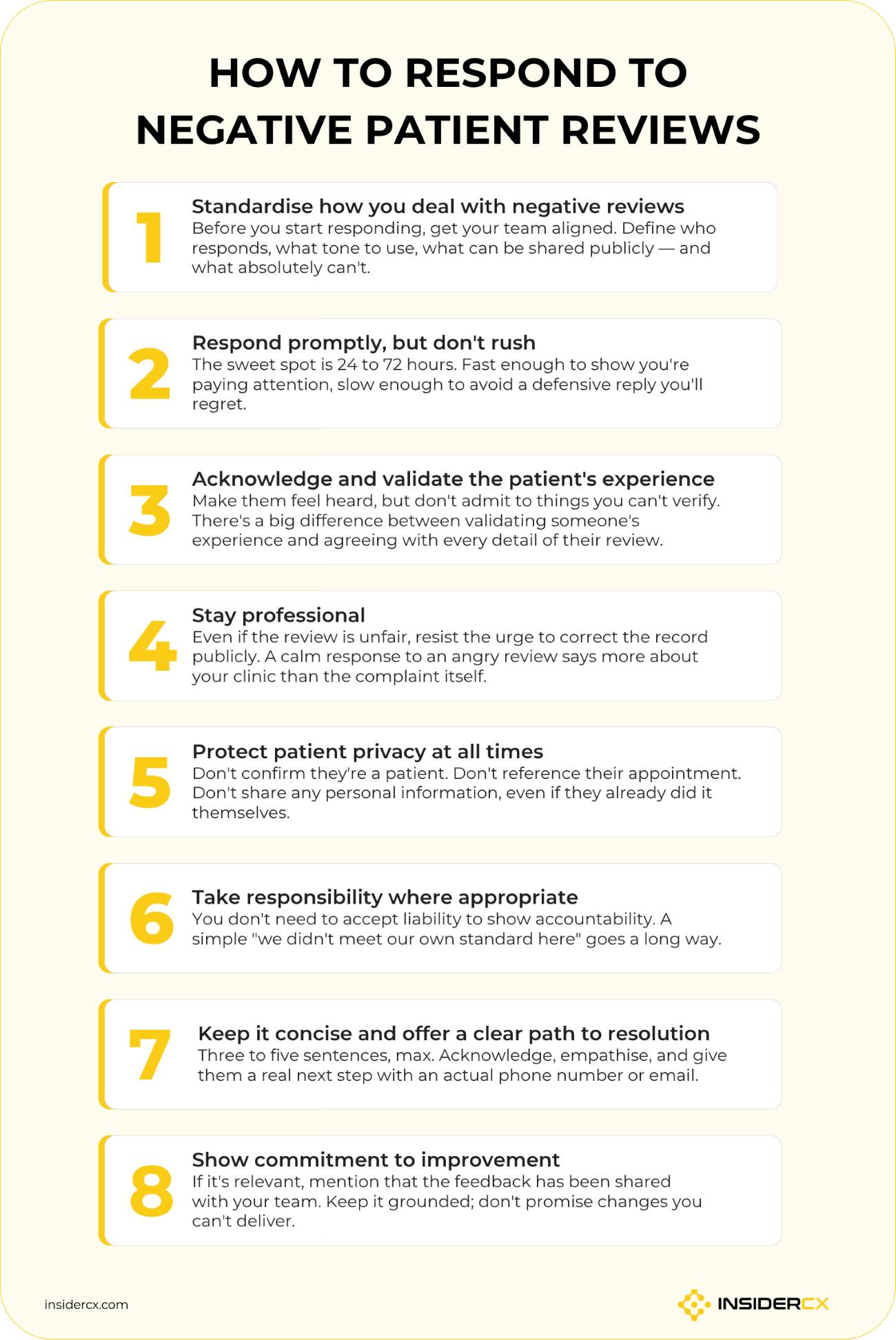
1. Standardise how you deal with negative reviews
Before you start actively responding to reviews, make sure your clinic has internal alignment on who responds and how.
You can do that by outlining a simple response framework that covers:
- Who is responsible for monitoring and responding to reviews — ideally one person or a small team, not whoever happens to see it first.
- What tone and language to use — aligned with your clinic's brand and communication standards.
- What information can and cannot be shared publicly — especially regarding patient details.
- Escalation paths — when a review raises a serious clinical or legal concern, who needs to be involved before a response goes out.
- A few critical do’s and don’ts — using a few real-life examples.
Don’t go overboard — this can be a simple policy document on one or two pages.
2. Respond promptly, but don't rush
Timing matters. A review that sits unanswered for weeks signals to prospective patients that your clinic either doesn't monitor its reputation or doesn't care enough to respond. On the other hand, a reply posted five minutes after a scathing review — especially one written in a defensive tone — can do more harm than good.
The ideal window is within 24 to 72 hours. This gives your team enough time to assess the situation, draft a measured response, and take a short cool-off period before publishing. Responding promptly shows attentiveness and professionalism; responding hastily risks escalation.
In practice, this means assigning someone to check review platforms once a day and flag any new negative reviews that the team should respond to. If you want to scale the process up, different healthcare reputation management software can automate most of the workflow.
3. Acknowledge and validate the patient's experience
The most important thing a response can do is make the patient feel heard. However, this doesn't mean agreeing with every claim in the review. There's an important distinction between validating feelings and agreeing with the facts.
You can express genuine concern about a patient's experience without confirming or denying the specifics of what happened. Effective phrasing includes:
- "We're sorry to hear about your experience and take this feedback seriously."
- "Thank you for sharing this — we understand this was not the experience you expected."
- "We appreciate you bringing this to our attention."
Avoid dismissive language — phrases like "we're surprised to hear this" or "this doesn't reflect our usual standard" can come across as invalidating, even if technically true.
4. Stay professional
This is the rule most clinics know in theory but struggle with in practice: when a review feels unfair, inaccurate, or even malicious, the instinct to correct the record is strong. Resist it.
Never argue, blame, or publicly correct a patient in a review response. Even if the reviewer's account of events is inaccurate, a defensive reply often makes your clinic look worse — not better.
As a private clinic, your audience isn't just the reviewer; it's also the hundreds of prospective patients who will read the exchange when evaluating whether to book with you. A calm, professional reply to an unfair review is one of the strongest signals of credibility a clinic can send.
5. Protect patient privacy at all times
This is non-negotiable. Never confirm that the reviewer is a patient, share appointment details, reference treatment history, or disclose any personal information, even if the patient has already shared those details in their review.
Privacy regulations — including GDPR and, in some markets, HIPAA-equivalent frameworks — impose strict obligations on how healthcare providers handle patient information. But aside from the legal risk, disclosing private information in a public response is a trust violation that prospective patients will notice immediately.
Safe phrasing strategies include:
- Responding in general terms without confirming the individual's patient status.
- Using phrases like "We encourage anyone with concerns about their care to contact us directly" rather than "We'd like to discuss your appointment".
- Keeping the response focused on your clinic's general commitments and processes, not on the specifics of any individual case.
6. Take responsibility where appropriate
The organisations that build the most credibility are the ones willing to acknowledge when something didn't go as planned, without overpromising or accepting liability.
This is sometimes called "soft accountability." It signals that your clinic takes feedback seriously and is willing to own the experience, even if the specific complaint involves factors outside your control.
Examples of effective language:
- "We hold ourselves to a high standard, and it's clear we didn't meet it in this case."
- "We're sorry your visit didn't reflect the experience we strive to provide."
- "We take this kind of feedback seriously and are reviewing our processes to ensure it doesn't happen again."
The key is credibility over defensiveness. Maybe not from a single response, but at scale, patients will be able to tell the difference between a clinic that takes responsibility vs one that relies on corporate non-apologies.
7. Keep it concise and offer a clear path to resolution
Review responses should be brief and purposeful. Stick to the three essentials: acknowledgement, empathy, and a clear next step.
Over-explaining, sharing internal details, or writing a multi-paragraph defence rarely improves the situation. Aim for three to five sentences.
If it makes sense, invite the patient to continue the conversation privately, where the issue can be discussed in detail without the constraints of a public platform. Just don’t forget to provide a phone number or an email address. Generic sign-offs like "please reach out to us" without contact details feel hollow and unlikely to lead to resolution.
8. Show commitment to improvement
Where relevant, you can briefly mention that your clinic is reviewing processes or making improvements based on provided feedback. This signals to both the reviewer and future readers that your organisation treats patient feedback as actionable data — not just something to boost their online reputation.
Effective phrasing:
- "Your feedback has been shared with our team and will be part of our ongoing quality review."
- "Our quality team has already taken steps to review the process you described."
Keep it grounded: don't promise sweeping changes you can't deliver. A brief, credible reference to improvement is more effective than grand commitments that patients have no way to verify.
Common mistakes to avoid
Even clinics with good intentions can undermine their review responses with a few recurring errors. Below is a list of the most common pitfalls and why they matter.
- Ignoring negative reviews entirely: Silence looks like indifference. Every unanswered negative review tells prospective patients that your clinic doesn't monitor or care about feedback. Responding — even briefly — is always better than not responding.
- Giving generic, copy-paste responses: When every review gets the same "Thank you for your feedback, we take all concerns seriously" reply, it stops looking like you're actually reading them. Tailor your responses to the specifics of the review.
- Using dismissive or minimising language: Phrases like "we're surprised to hear this" or "this is not our usual experience" may feel and be factual, but they come across as invalidating the patient's complaint.
- Being overly defensive: Arguing with the reviewer, correcting their account of events, or explaining why they're wrong — even politely — almost always makes the situation worse.
- Disclosing private information: Confirming someone's patient status, referencing their treatment, or sharing appointment details is both a legal risk and a trust violation. Never do this, regardless of what the reviewer has shared.
- Overpromising or making unrealistic commitments: Claiming you'll "ensure this never happens again" sets an expectation you may not be able to meet. Be specific and honest about what you're doing to improve.
- Not learning from the feedback: Responding to a review without feeding the insight back into your operations is a missed opportunity. Make sure relevant complaints (and praises!) are taken into account for patient feedback analysis.
Templates for responding to negative patient reviews
Here are two response templates that apply the best practices outlined above. Adapt them to your clinic's tone and the specifics of each situation.
Template #1: Taking responsibility and outlining improvements
Use this when the review describes a legitimate issue that your team has acknowledged internally, e.g. long wait times, a scheduling error, or a communication breakdown.
Thank you for taking the time to share your experience. We're sorry that your visit didn't meet the standard we set for ourselves — particularly regarding [specific issue, e.g., the wait time you experienced].
We've reviewed this internally and have [specific action taken, e.g., adjusted our scheduling process to reduce delays during peak hours]. We'd welcome the opportunity to speak with you directly and ensure your next visit is a better one.
Please don't hesitate to contact [Name] at [email/phone].
Template #2: Acknowledging the experience and offering a path to resolution
Use this one when the review describes a negative experience, but the specifics are unclear or disputed — for example, a general complaint about service quality or staff attitude.
We appreciate you sharing your feedback and are sorry to hear your experience wasn't what you expected. Patient satisfaction is a priority for our team, and we take all feedback seriously.
We'd like to understand your concerns in more detail so we can address them properly. Please contact our [patient relations team / Name] at [email/phone].
How to stop bad patient reviews from ruining your online reputation
Responding well to negative reviews is essential, but the more effective long-term strategy is to reduce the number of negative reviews you receive in the first place.
You can't eliminate them entirely, and you shouldn't try to. But you can build systems that catch dissatisfaction early, resolve issues before they go public, and ensure your online profile reflects the full picture of your patient experience.

Report malicious reviews
Not every negative review is legitimate. Some are spam, some come from people who were never patients, and some contain abusive or defamatory language. It's worth knowing what qualifies as a malicious or inappropriate review, and when reporting is the right course of action.
Most review platforms — including Google and Trustpilot — allow you to flag reviews that violate their content policies. Grounds for removal typically include fake reviews, spam, conflicts of interest (e.g., competitor reviews), and content containing hate speech or threats.
Reporting should be reserved for clearly inappropriate content. Attempting to remove every unfavourable review, or flagging legitimate criticism, will waste your time and won't improve your reputation.
Catch and address patient complaints before they go public
The most effective way to reduce negative online reviews is to identify dissatisfied patients before they turn to public platforms.
Most patients who leave negative reviews do so because they felt they had no other way to be heard. If your clinic actively collects feedback and responds to it, you give patients a private channel for raising concerns — one that's faster and more personal than a Google review.
In practice, this means collecting patient feedback systematically instead of waiting for patients to come to you. Clinics that send automated post-visit surveys catch dissatisfaction in real time, while it's still resolvable.
Patient experience platforms like InsiderCX helps clinics do exactly this. The platform automates patient feedback collection via SMS and WhatsApp within 24–48 hours of a visit, and uses real-time detractor alerts to flag negative responses immediately.
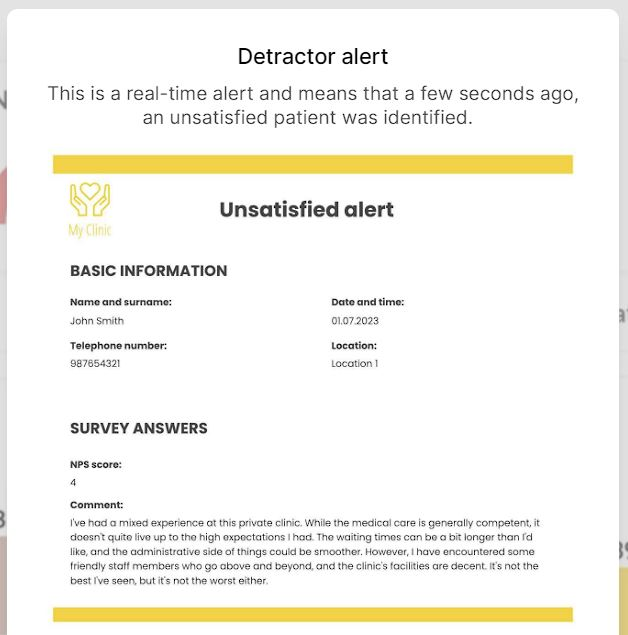
When a patient scores their experience poorly, the relevant team member is notified instantly through InsiderCX's built-in ticketing system, enabling follow-up before the patient takes their complaint public.
Get more positive patient reviews
Volume matters. A single negative review carries much less weight when it sits alongside dozens of positive ones.
Patients evaluating your clinic look at overall ratings and recent trends, not just individual complaints. Hence, another effective way to improve overall patient sentiment is to increase the volume of positive reviews.
The best approach is to make review generation a natural extension of your feedback collection process, rather than relying on staff to ask patients manually.
Again, tools like InsiderCX automate this by sending automated surveys. Patients who rate their experience highly are then prompted to share that feedback on Google or Trustpilot — turning internal satisfaction data into a glowing online reputation.
Quick example: Affidea, one of the largest healthcare providers in the European healthcare market, saw one of its clinics’ Google rating jump from 3.6 to 4.7 after implementing InsiderCX, demonstrating the effects of feedback-driven improvement.

Use patient feedback to eliminate friction points and quality gaps
Rather than treating negative reviews as isolated incidents, treat them as data. When the same complaints appear repeatedly (long wait times, poor communication, billing confusion, difficulty booking, unprofessional staff behaviour), that's a signal pointing to a systemic issue worth fixing.
The organisations doing this well follow a simple cycle:
- Identify recurring themes in patient feedback, both from internal satisfaction surveys and public reviews.
- Prioritise the issues based on frequency, severity, compliance requirements, and impact on patient retention.
- Implement targeted improvements, whether that's adjusting a scheduling process, retraining front-desk staff, or updating patient communication templates.
- Monitor the results to confirm the change is working and close the gap by communicating improvements back to patients.
Analysing patient feedback systematically is what separates clinics that react to individual complaints from those that improve their overall patient experience, reducing negative reviews as a welcome side-effect.
Centralise review management with InsiderCX
Managing reviews across multiple platforms quickly becomes unwieldy, especially for clinics with multiple locations. InsiderCX simplifies this by allowing you to connect multiple public review sources and track all online reviews in one place.

With InsiderCX's online reputation management features, your team can:
- Monitor reviews from all major platforms in a single, unified dashboard — no need to log into each platform separately.
- Receive real-time notifications when new reviews are posted, so nothing goes unanswered
- Respond to reviews directly from the platform, streamlining the workflow for your team.
- Track review trends over time — including average ratings, review volume, and sentiment shifts — to measure the impact of your quality improvement efforts.
- Improve your clinic review scores by continuously generating new positive reviews left by genuinely satisfied patients.
For clinics that want to take control of their online reputation without adding manual overhead, centralising review management is a practical first step.
InsiderCX makes this transition seamless. Learn how by scheduling a quick product demo.


