


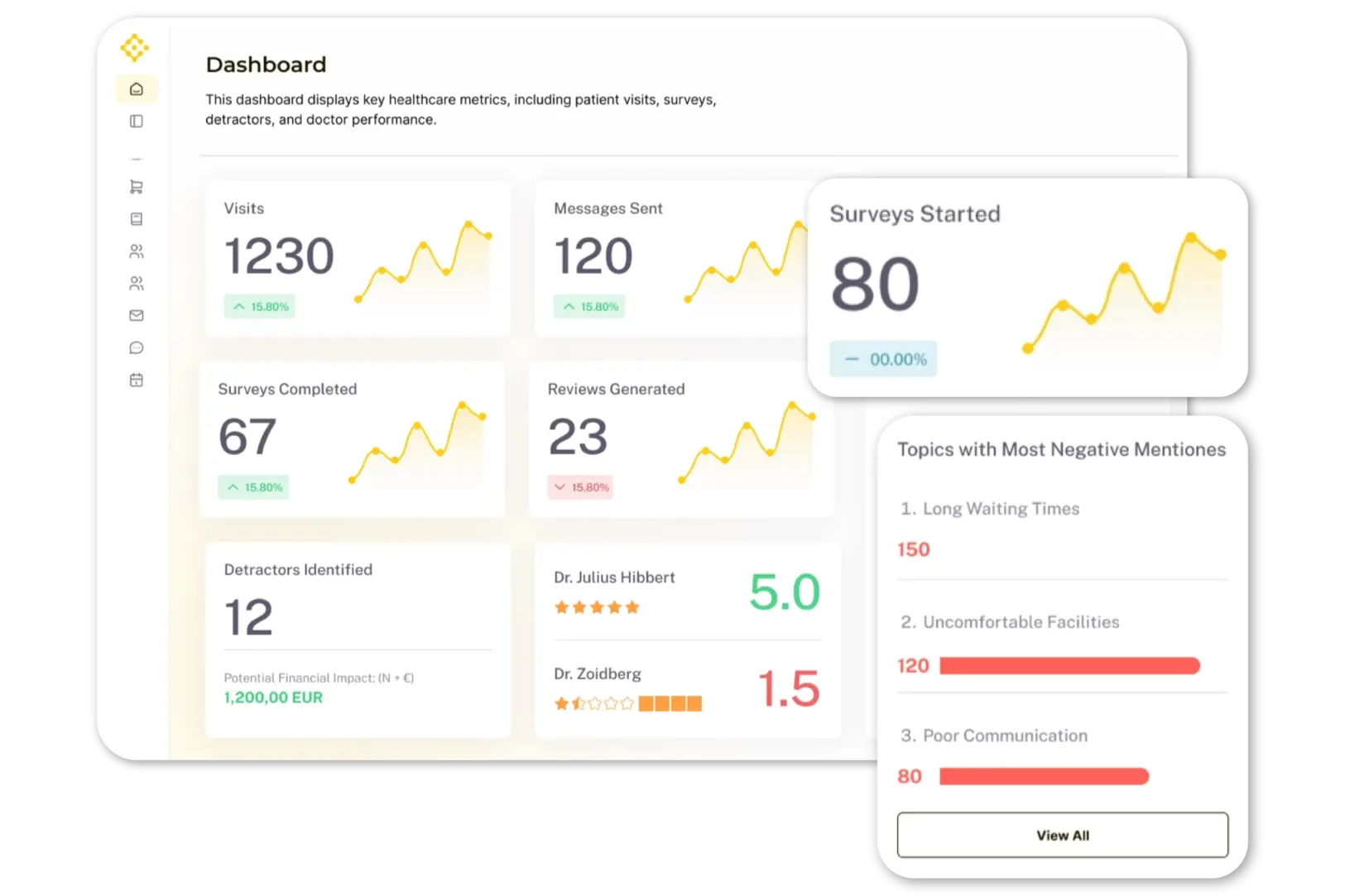
Most clinics know they should be doing more with patient feedback. For the majority, the problem isn't intent — it's capacity. Survey response rates hover in the single digits, hundreds of open-ended comments sit unread, complaints arrive across four or five different channels, and the people who could act on the insights are also the people running the daily operation.
Something has to give, and usually what gives is the work itself.
AI changes the maths. When applied to specific operational problems, it can absorb the manual, repetitive jobs and free both clinical and quality teams to focus on the decisions that actually move the needle.
That's the lens we apply at InsiderCX: AI is useful when it removes a real bottleneck.
This article walks through the AI features built into the InsiderCX patient experience platform — what each one does, how it works in practice, and what kind of value it delivers for the clinics using it.
Our approach to using AI in healthcare
Patient experience data is sensitive, and healthcare organizations have little tolerance for tools that create more problems than they solve.
We've built every AI feature in the platform around four operating principles:
- AI should solve operational problems, not add complexity: Every feature targets a specific, recurring bottleneck — manual comment review, scattered complaints, slow reporting. If a feature doesn't replace work someone is currently doing by hand, we don't ship it.
- Practical automation over novelty: The features that make it into the product are the ones that save staff time or improve the quality of decisions clinic leaders make from the data.
- Human oversight is non-negotiable: Every AI-generated output — sentiment tags, complaint categories, draft summaries, follow-up copy — is reviewable and editable. The clinic stays in control.
- Privacy and compliance come first: All AI processing runs under our GDPR data processing agreement, with EU data residency and no direct access to clinical systems or patient records.
While the features we implement tend to look small from the outside — categorise this, summarise that, time this better — they produce outsized operational gains for the teams using them.
AI features inside the InsiderCX platform
Each of the features listed below is either live for InsiderCX customers or in late-stage rollout. They are designed to work together, but each delivers value on its own.
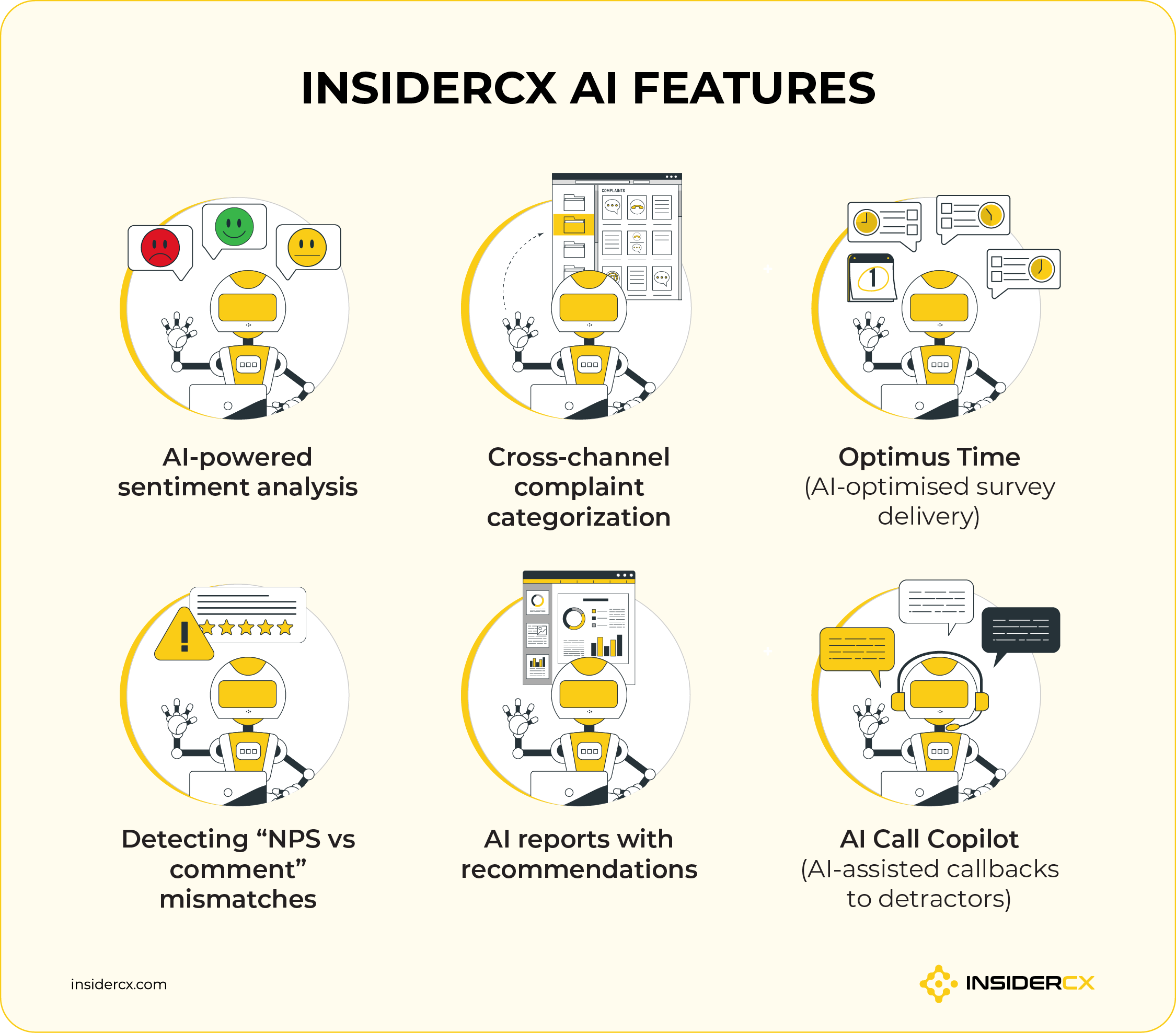
1. AI-powered sentiment analysis across the patient journey
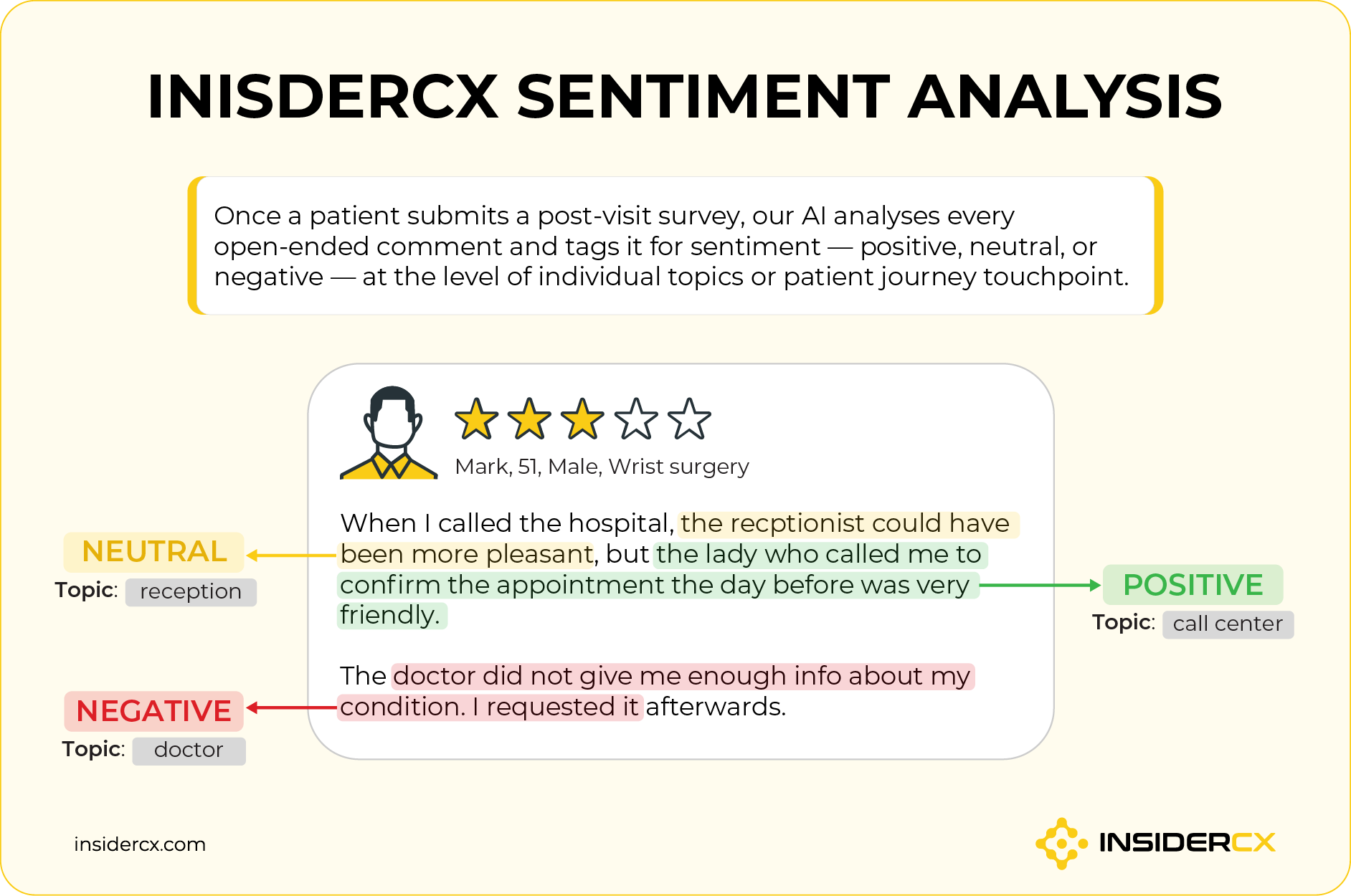
Once a patient submits a post-visit survey, the AI analyses every open-ended comment and tags it for sentiment — positive, neutral, or negative — at the level of individual topics or touchpoints.
A single comment that praises the call centre, criticises the doctor, and stays neutral on reception gets three separate topic tags, each with its own sentiment value.
All of it surfaces in the InsiderCX dashboard, visualised by topic, by department, and over time.
Value for clinic teams:
- Eliminates manual review at scale: A clinic running a few hundred surveys a week no longer needs a quality manager reading and cross-referencing every comment to spot themes.
- Pinpoints operational bottlenecks faster: Sentiment broken down by topics makes it obvious where in the patient journey patients are dropping off emotionally — and where to focus quality improvement work.
- Makes trends visible over time: Sentiment by topic plotted across weeks and months shows whether the changes you've made are actually landing with patients.
2. Cross-channel complaint categorization
Patient complaints rarely arrive in one place. Some come through the InsiderCX complaints module, others land at the front desk, in web forms, by email, or over the phone.
Our AI helps categorise complaints from all of these sources, so that each one is attributed its issue type and department, centralizing them in a single dashboard view.
A complaint about a long wait at reception logged at the front desk is treated as the same category as one submitted via a web form — the categorisation is consistent regardless of channel.
Value for clinic teams:
- Simplified complaint management: Quality managers work from one queue, not five.
- Faster root-cause analysis: You get aggregated, categorised data that exposes patterns — not isolated tickets that are easily missed or forgotten.
- Easier re-audits and compliance tracking: When clinical auditors ask for complaint history by category or department, the data is already structured and ready to be exported.
- Better visibility across departments: Operations, clinical, and front-office leaders see the same picture rather than each defending their own corner.
3. Optimus Time (AI-optimised survey delivery timing)
Survey send time is one of the most underestimated variables in patient feedback collection.
We started with a fixed send time, then moved to randomising delivery across the day to gather data on when patients actually engage. From that randomisation data, we built our own model — aptly named Optimus Time — that learns when each patient group is most likely to respond and times survey delivery accordingly.
We still run Optimus Time and randomisation on a 50/50 split, because both consistently outperform fixed-time delivery. Across the clinics using it, Optimus Time has raised response rates by a meaningful margin, particularly given that response rate is a downstream metric also shaped by delivery rates, SMS and WhatsApp copy, and channel preferences that vary by client.
Value for clinic teams:
- Higher response and completion rates: More patients respond, which means more data to work with.
- More representative feedback: A larger response pool reduces the bias that comes from hearing only from the most engaged or most aggrieved patients.
- More reliable experience and satisfaction metrics: NPS and journey-level scores get more accurate as the sample grows.
4. Detecting “NPS vs comment” mismatches
Patients occasionally give a Net Promoter Score (NPS) that contradicts their written comment. Think a 0 score alongside an explanation saying that “everything was perfect”.
These mismatches usually point to misclicks, language misunderstandings, or surveys filled out in haste.
Our AI flags contradictory responses, excludes them from headline NPS calculations and reports, and surfaces them as a separate category in the dashboard for the team to review.
Value for clinic teams:
- More accurate reporting: NPS doesn't get skewed by responses that don't reflect the patient's actual experience.
- Easier identification of accidental or misleading responses: Mismatches surface as their own category rather than disappearing into the average.
- Cleaner data for downstream decisions: When NPS feeds into quality improvement work or board reports, the underlying numbers hold up.
5. AI reports with recommendations included
Most reporting tools surface the numbers and leave the interpretation to whoever opens the dashboard. AI reports with recommendations flip that.
The AI summary engine, trained on the weekly Loom briefings we've sent clients for years, reads the data and produces a written report that explains what's changed, why it matters, and what to do next.
A spike in reception complaints doesn't just appear in a chart — it comes with a recommended action, framed for the role that will own it: review the front-desk rota for that week, check whether a recent process change is driving the trend, prioritise this over the queue-time issue that's already trending down.
The reports still cover the standard comparison views — week-over-week, month-over-month, quarter-over-quarter — but those exist to support the recommendation, not to be the deliverable.
Value for clinic teams:
- Recommendations, not just numbers: Leadership opens the report and sees what to do, not a wall of charts to interpret.
- Less time in analysis, more time in action: Quality and operations leads skip the "what does this mean" step and move straight to deciding what to act on.
- Consistent interpretation across reporting periods: The same reasoning that informed our weekly briefings is now applied automatically, so the read on the data doesn't depend on which manager opens the report that week.
6. AI Call Copilot — AI-assisted callbacks to detractors
The AI Call Copilot sits inside the complaints module and gives patient relations and front-desk staff a structured way to call detractors back.
When you open a complaint or a low-NPS response and start the call, the AI generates a tailored script and opening line based on the patient's details, treatment history, and exactly what they wrote in the survey. Once the conversation is underway, the assistant listens in real-time, tracks how the patient's sentiment shifts as you talk, and prompts you with suggested phrasing or follow-up questions to move the call toward a better resolution.
Value for clinic teams:
- Faster closed-loop follow-up on detractors: Calls get made the same day, not four days later when someone finally has time to prepare.
- Better calls without the training overhead: Less experienced staff handle difficult patient conversations with real-time guidance, rather than improvising or escalating.
- A clearer picture of how recovery is landing: Sentiment tracked through the conversation tells quality leads whether the follow-up is actually working, not just whether it happened.
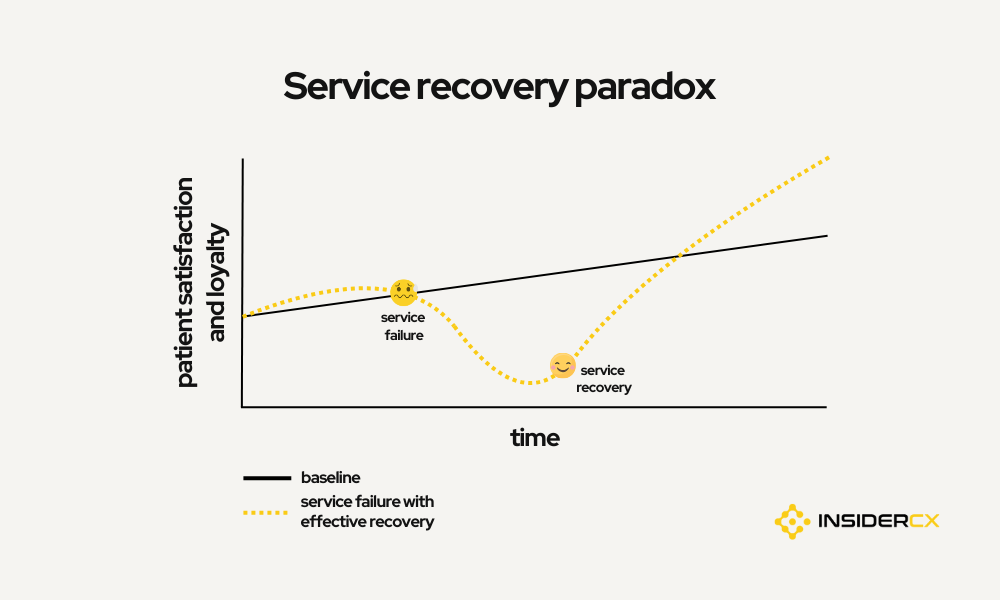
- Higher recovery rates on poor experiences: Patients who felt unheard get a prepared, well-handled follow-up — the kind that turns a complaint into a loyal patient (also known as the service recovery paradox).
Test InsiderCX through a pilot project
The fastest way to see whether any of this fits your clinic is to run it on your own data. We offer a free proof of concept — a small-scale implementation of InsiderCX, on your patient flow, before any contract is signed.
No financial commitment, no IT lift, no procurement cycle.
A typical pilot is live in under two weeks. InsiderCX handles implementation, integration, and survey design — your IT team and clinical staff aren't pulled into the rollout. The platform is GDPR-compliant by design, with a full data processing agreement, EU data residency, and no direct access to clinical systems or patient records.
You also get a dedicated account manager — a real person with healthcare operations expertise, reachable by phone or email — plus automated weekly and monthly progress reports.
That's the shift we're working towards across the InsiderCX platform: less manual processing of feedback, faster signal from the data, and more of the clinic team's time spent on the patient-facing work.
If you’re interested, the first step is to jump on a exploratory call with an InsiderCX representative.


