



For a growing number of healthcare organisations, patient experience has stopped being a marketing talking point and started becoming a core element of quality and performance measurement.
The shift is being accelerated by workforce pressure, compliance requirements, AI developments, and tighter funding (especially visible in the UK’s private and hybrid sectors). On top, patient expectations are now being set by every other consumer interaction they have, from banking apps to same-day delivery, which is a high bar to clear in healthcare.
These are the eight patient experience trends accelerating now — and what they mean operationally for your clinic and hospital.
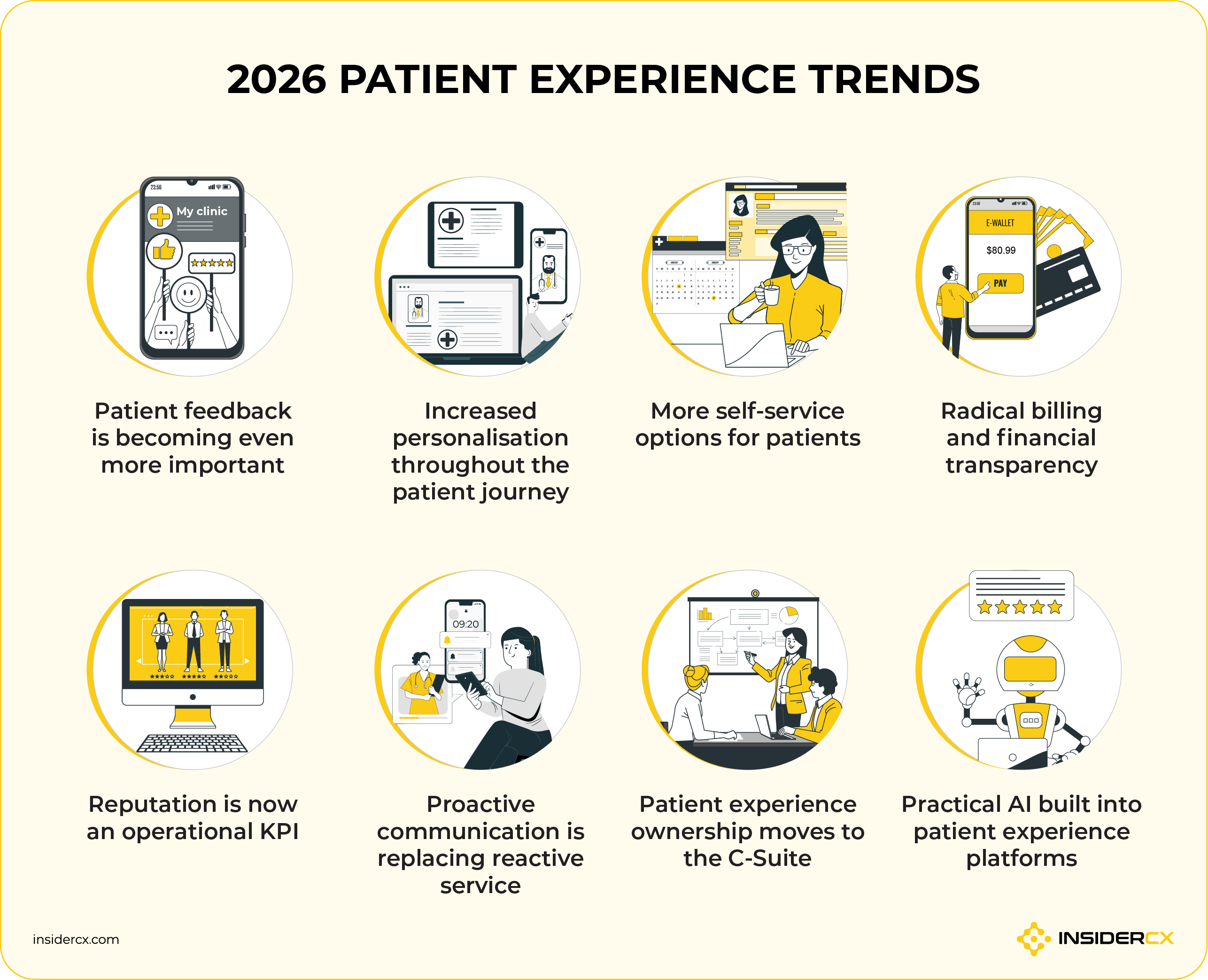
1. Patient feedback is becoming even more important
The shift from periodic satisfaction surveys to continuous, multi-channel feedback collection is well underway. SMS after appointments, QR-code prompts in waiting rooms, in-app micro-surveys at discharge — the mechanisms multiplied over the past few years.
But the private clinics pulling ahead in 2026 aren’t distinguished by how much feedback they collect. They’re winning because of how fast they analyze and act on it.
Boards and regulators increasingly want evidence that patient input changes operations, not just that it’s been recorded. Feedback that sits in a spreadsheet for six weeks before anyone reads it is a wasted asset. Feedback that routes to a department lead within hours, categorised by theme and severity, is an operational advantage.
In practice, the organisations doing this well have moved from monthly PDF reports to live dashboards segmented by service line and touchpoint. They:
- Assign closed-loop workflows so that every negative response has a named owner and a resolution timeline.
- Categorise feedback by patient journey stage or operational theme — access, communication, billing, wait times, etc.
- Map each theme to a responsible team.
- Use automated alerts to escalate high-risk responses before they become public complaints or regulatory issues.
The return on real-time feedback infrastructure shows up in reduced churn, increased patient loyalty, faster service recovery, and stronger regulatory standing.
2. Increased personalisation throughout the patient journey
Personalisation in healthcare is no longer a premium add-on — it’s the baseline. Patients expect their providers to remember how they prefer to be contacted, to send follow-ups that reflect their actual condition and treatment history, to deliver educational content that’s relevant to where they are in a care pathway, and to communicate in a language and tone that feels appropriate.
Anything less reads as indifference.
In private, self-pay, and hybrid models — markets where patients actively choose their provider — personalised communication is a retention lever. Generic communication, especially for the younger people, drives disengagement.
Delivering personalisation at scale, however, can be a technical challenge. Providers need to:
- Unify patient information that currently sits in separate EMR, scheduling, billing, and communication silos into a single, actionable profile.
- Apply CRM-style segmentation so that messaging can be targeted by demographics, condition, behaviour, and engagement history.
- Implement two-way communication channels where patient preferences feed back into the system rather than disappearing into an inbox.
All of these technical challenges are solved by modern patient experience platforms that integrate with healthcare systems and automate personalisation at scale through built-in segmentation and dynamic fields.
As more and more healthcare providers adopt these platforms in 2026, the personalisation options are bound to grow alongside them.
3. More self-service options for patients
Patients now expect to handle routine interactions on their own terms: booking and rescheduling appointments, filling in forms before they arrive, checking test results without phoning the practice, updating their details, and paying invoices — all digitally, all without waiting on hold.
Important note: this isn’t a generational preference. It’s a universal access expectation shaped by how every other industry already works.
The workforce argument makes the case even harder to ignore. Administrative hiring remains one of healthcare’s most persistent bottlenecks. Every task that still requires a staff member to mediate — taking a scheduling call, processing a paper form, sending test results, fielding a billing question — absorbs capacity that most organisations can’t afford to waste.
Organisations that have invested in comprehensive self-service options consistently report measurable operational gains:
- Significantly fewer inbound calls for routine scheduling, billing, and records requests.
- Shorter queue and hold times for patients who do need to speak to someone.
- Reduced front-desk workload, freeing staff for higher-value patient interactions.
- Fewer transcription and scheduling errors that come from manual phone-based booking.
- More predictable demand patterns that make staffing and resource planning easier.
Well-designed self-service improves both experience and efficiency. When routine admin tasks still require a phone call, the operating model is just absorbing unnecessary friction.
4. Radical billing and financial transparency
Healthcare billing has operated with a level of opacity that patients increasingly refuse to accept. With the rising cost of living putting pressure on their budget, they want to know exactly what something costs before they agree to it.
The stakes are high because the financial experience is an emotionally loaded part of the patient journey. A confusing or unexpected bill erodes trust, drives negative reviews, and increases the likelihood of delayed or defaulted payment.
We analyzed over 50,000 patient surveys with open-ended feedback. Pricing and billing were mentioned in 3,5% of them — mostly in a negative context. Access the full report here.
The downstream costs of bad debt, collections, and lost patient lifetime value significantly outweigh the investment needed to communicate costs clearly.
Healthcare organisations are getting ahead of this by:
- Sending pre-visit cost estimates (including insurance-adjusted figures)
- Offering online calculators for common procedures
- Providing flexible payment plans through digital portals
- Proactively messaging patients with clear, plain-language billing summaries.
This means that, in 2026, you need to stop treating financial experience like a back-office concern. It’s a trust-shaping, revenue-impacting, reputation-defining part of how patients experience care. Ignoring it is a strategic risk.
5. Reputation is now an operational KPI
Online reviews have moved well past the domain of marketing. Increasingly often, reputation scores now sit on operational dashboards alongside patient volume, complaints, revenue per encounter, and other metrics.
The implications of poor reputation ripple further than patient acquisition: Prospective staff research employers online before applying, and a pattern of poor patient reviews signals broken processes and unsupported frontline teams. Organisations and referral networks factor reputation into their decisions on who to partner with.
The feedback loop is tightening: experience quality drives reputation, reputation drives growth, and growth funds new patient experience improvement strategies.
What does this mean for clinics and hospitals on an operational level? It requires:
- Tracking sentiment at the department and clinician level rather than relying on aggregate scores.
- Building systematic pipelines that invite satisfied patients to share their experience publicly — so the online picture reflects reality rather than just the extremes.
- Responding to negative reviews within 24–48 hours with genuine resolution, not template replies.
- Reading review themes as diagnostic signals: e.g., recurring complaints about wait times in one department aren’t a marketing problem, they’re a scheduling problem.
In other words, patient experience metrics are moving into board-level reporting, and its influence on strategic decisions is growing accordingly.
6. Proactive communication is replacing reactive service
The traditional healthcare communication posture — “get in touch if you need us” — is being replaced by something closer to anticipation.
Top providers are reaching patients before problems (re)surface: automated follow-ups after procedures, medication adherence reminders, nudges to keep patients on track through multi-step care pathways, and escalation protocols that flag vulnerable individuals who’ve gone quiet.
The operational logic is straightforward. Reactive models are expensive by design: they depend on staffed phone lines, inbound triage, and service recovery after the fact. Proactive outreach front-loads a small, automatable cost to prevent a much larger downstream one.
It also transforms the patient relationship from something transactional and episodic into something continuous — which is where loyalty, referrals, and lifetime value come from.
Making it work requires mapping patient journeys across service lines to understand where the high-value communication moments are. It also requires clean, integrated data so that each message reflects the individual patient’s actual situation.
When communication becomes anticipatory rather than reactive, PX stops being a series of isolated encounters and becomes a continuous relationship. That’s a fundamentally different competitive position.
7. Patient experience ownership moves to the C-Suite
Patient experience used to sit in a middle-management silo — housed within quality, marketing, or nursing operations. Important enough to be reported on, but not important enough to shape strategy. In 2026, that’s changing.
Chief Experience Officers are gaining real influence, reporting directly to CEOs, and PX metrics are being woven into the same dashboards that track financial performance and service quality.
The question leadership asks about experience has also evolved. It’s no longer about satisfaction scores in isolation; it’s about the relationship — how does patient experience impact utilisation, efficiency, retention, and revenue?
That reframing helps turn PX from a cost centre into a growth driver that needs executive ownership.
When PX has a seat at the leadership table, resources follow: technology investments get evaluated through an experience lens, cross-functional teams align around shared journey objectives, and experience data evolves from an occasional appendix to a standing item in board reporting.
8. Practical AI built into patient experience platforms
The AI conversation in healthcare (and many other industries) has matured past the hype curve. The question is no longer simply about “using AI”; it’s about whether the AI is doing anything operationally useful.
The highest-value deployments aren’t flashy generative tools — they’re quiet, workflow-level applications embedded into the platforms healthcare teams already use.
In patient experience specifically, we see several examples:
- Automated response drafting: AI generates initial replies to patient feedback and reviews; staff edit and send rather than composing from scratch.
- Intelligent triage and routing: Inbound patient messages are categorised by content and sent to the right team without manual inbox sorting.
- Predictive no-show modelling: Machine learning identifies at-risk appointments and triggers targeted outreach rather than blanket reminders
- Sentiment analysis on open-text feedback: Thousands of free-text comments analysed in minutes, surfacing emerging themes that would take human reviewers weeks to do.
- Escalation triggers for vulnerable patients: Behavioural and sentiment patterns flag individuals who may need urgent clinical follow-up.
The executive filter for evaluating any AI deployment in 2026 comes down to three questions:
- Does it remove friction from existing workflows?
- Does it reduce labour cost or free up capacity for higher-value work?
- Does it improve speed or quality of decisions?
If the answer to at least two is yes, it’s worth pursuing. If not, it’s an experiment that may or may not work out.
When evaluating healthcare solutions in 2026, do not fall for the sales talk. Require hands-on testing of highlighted AI features (and other functionality) before signing any contracts.
Start optimising your patient experience with InsiderCX
InsiderCX is a patient experience platform purpose-built for clinics, hospitals, and multi-site health systems. It gives operational leaders the tools to move from static survey data to continuous, actionable patient intelligence and to connect experience improvements directly to business outcomes.
Here’s how InsiderCX helps healthcare organisations improve patient experience:
- Automated, multi-channel feedback collection across every stage of the patient journey — without adding workload to frontline teams.
- AI-powered sentiment and theme analysis that turns open-text feedback into operational insights in real time.
- Closed-loop resolution workflows that route issues to the right team, track response times, and ensure nothing falls through the cracks.
- Online reputation management tools that systematically convert positive experiences into public reviews.
- Granular performance dashboards benchmarked by department, clinician, and location for targeted decision-making.
- ROI-ready reporting that ties experience data to retention, acquisition, and revenue so leadership sees the impact.
Better patient experience doesn’t just improve scores. Ideally, it drives measurable revenue growth through higher retention, stronger referral rates, improved online visibility, and greater staff engagement. InsiderCX is the operational layer that makes that connection visible and repeatable.
Want a modern platform that will help you operationalise PX and keep up with all of these patient experience trends? Schedule a demo with the InsiderCX team.


