



The stakes in healthcare keep rising. Accreditation requirements are getting tighter, reimbursement is increasingly tied to quality outcomes, and patients don't stick around after a bad experience. Without a structured system behind it all, quality problems only surface when they're already expensive to fix.
Healthcare quality management software helps providers stay compliant with industry guidelines, keep patients safe and satisfied, and prove they're doing both systematically.
In this guide, we are taking a look at eight platforms that tackle healthcare quality from different angles. By the end, you’ll have a better idea of what to look for and how top platforms compare in terms of features, use cases, price, and user sentiment.
Features to look for in healthcare quality software
Not every organisation needs the same thing from their quality software. Hospitals, private clinics, long-term care facilities, and pharma/med device manufacturers all fall under the "healthcare quality" umbrella, but the quality problems they're solving day-to-day don't look alike.
Hospitals need the full stack: incident reporting, peer review, regulatory compliance, and analytics that tie quality to reimbursement. Private clinics have a strong focus on patient experience: catching complaints early, standardising care across locations, and protecting their reputation. Pharma companies live in a regulatory world where quality means document control, CAPA, and FDA audit readiness.
While there's no single tool that does everything for everyone, most healthcare QMS systems will have these basic features:
- Incident and safety event reporting: This is the foundation. Your team needs to be able to report safety events, near misses, medication errors, falls, and complaints quickly and easily, ideally from any device.
- Compliance and regulatory tracking: Whatever regulatory bodies govern your organisation (CMS, Joint Commission, FDA, ISO, CQC), your software should help you track the right data and generate useful reports.
- CAPA (Corrective and Preventive Action) management: When something goes wrong, you need a structured way to investigate, identify root causes, assign corrective actions, and verify they actually worked.
- Document control: Policies, SOPs, and protocols need to be version-controlled, accessible, and up to date. Look for automated review reminders, e-signatures, and clear audit trails.
- Audit management: Whether you're running clinical audits or preparing for external inspections, you need tools to plan, schedule, execute, and follow up. The best systems link audit findings directly to corrective actions.
- Analytics and reporting: Quality data is only useful if you can see patterns and act on them. At a minimum, you need dashboards that track key quality metrics over time, the ability to drill down by department or provider, and exportable reports for leadership and regulatory bodies.
Those are the essentials. But if you want to future-proof your investment in healthcare quality software, here are a few additional capabilities worth having on your checklist:
- AI-driven analytics: AI can take your quality data further and identify trends you'd miss manually, flag emerging risks before they escalate, analyse unstructured feedback like patient comments, and even predict which issues are most likely to recur. It's essential for larger systems dealing with high volumes of data.
- Real-time dashboards: There's a meaningful difference between reviewing last month's quality data in a static report and seeing what's happening right now across your facilities. Real-time dashboards let quality leaders spot dips and act on them while there's still time to intervene, not after the fact.
- Integration with EHR/EMR systems: Quality software that pulls data directly from your EHR eliminates duplicate entry, reduces errors, and gives you richer context for every quality event or patient feedback data point. If you're evaluating tools, ask specifically which EHRs they integrate with and how; some offer native integrations, others require middleware or manual imports.
- Workflow automation: The less manual work your quality team has to do on routing, escalation, reminders, and follow-ups, the more time they spend on actual improvement. Automated workflows ensure the right people get notified at the right time, nothing sits in a queue forgotten, and every process follows the same steps consistently.
Have in mind the needs your healthcare organisation has, and use the list to make a perfect blend of needed features.
A comparison of leading healthcare quality management software
Now that you know what features to look for, let's get into the actual tools. We've picked eight platforms that approach healthcare quality management from different angles. Not all of them are quality management tools first, but each one has capabilities that are directly relevant to improving care quality.
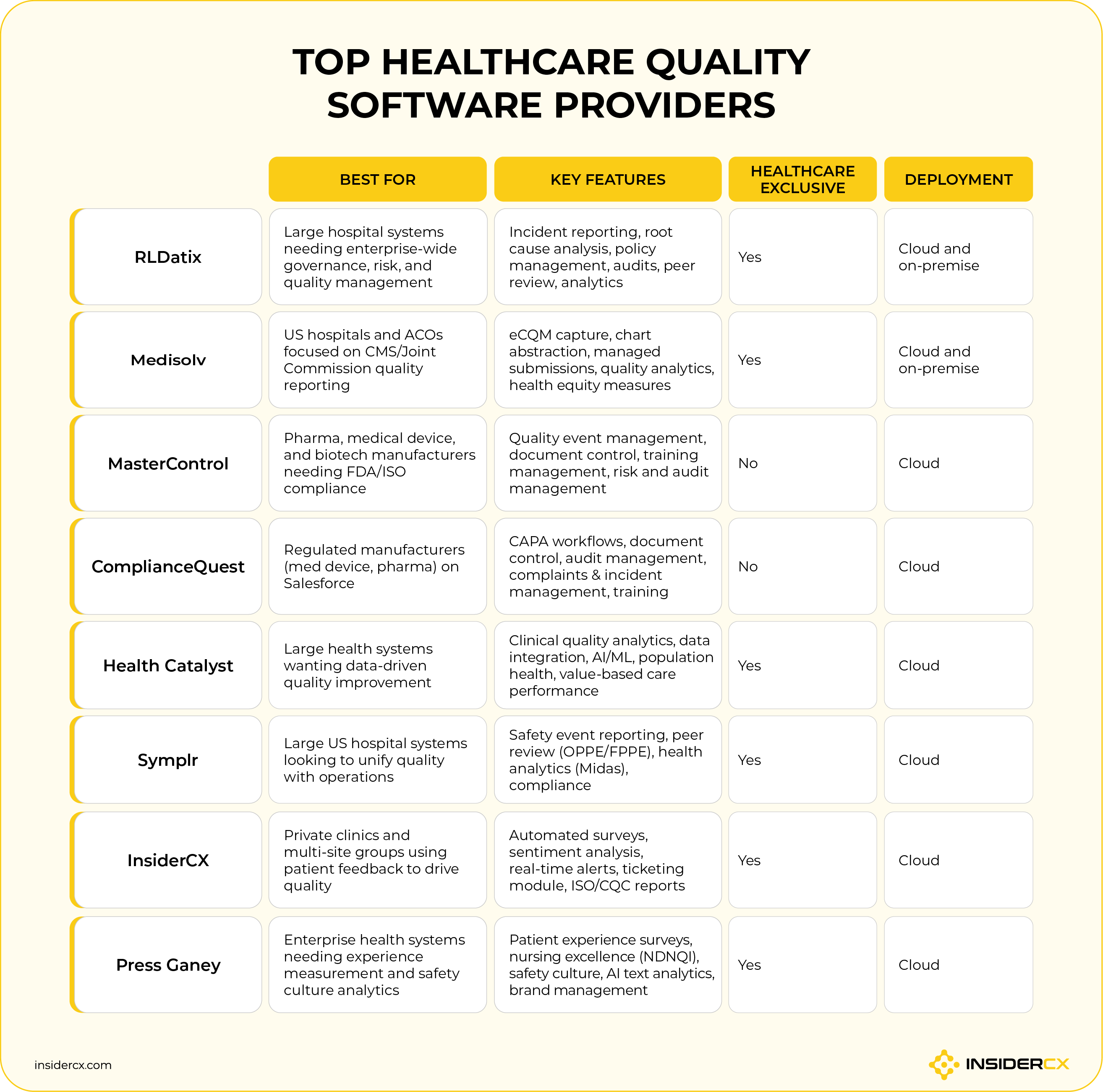
1. RLDatix
RLDatix is a global healthcare governance, risk, and compliance platform that offers solutions for patient safety, incident reporting, risk management, policy management, and quality improvement, among others. It serves over 10,000 healthcare organisations worldwide (most are in the UK and Ireland) and earned a Best in KLAS recognition in 2025.
Best for: Large hospital systems and health networks that need an enterprise-wide platform connecting safety, risk, compliance, and quality under one roof, especially those operating across multiple facilities and dealing with complex regulatory requirements.
Notable features relevant for quality management:
- Incident and event reporting: A structured process for staff to report patient safety incidents, near-misses, and adverse events. Includes automated notifications and configurable workflows so the right people are looped in immediately.
- Root cause analysis and trend identification: Goes beyond recording what happened to help uncover why it happened. Pattern and trend analysis tools flag recurring issues across departments or locations.
- Policy and document management: A centralised repository where organisations can create, review, approve, and distribute policies. Automated reminders flag when policies are due for review, and version control keeps everything current.
- Audit and standards management: Customisable audit templates, scheduling across locations, and inspection readiness workflows that help organisations stay survey-ready for accreditation bodies.
- Peer review and provider performance tracking: Connects risk data, patient feedback, claims, and event reports into one view of provider performance. Role-based access keeps sensitive review data secure.
- Analytics and benchmarking: Dashboards for monitoring KPIs, tracking performance over time, and benchmarking against industry standards. Reports are exportable for board presentations and regulatory submissions.
Top 3 advantages:
- All-in-one governance platform. RLDatix is one of the few tools that genuinely connects incident reporting, risk management, policy control, audits, peer review, and compliance under a single roof.
- Built for healthcare from the ground up. Unlike generic GRC platforms adapted for healthcare, RLDatix's workflows, terminology, and compliance frameworks are designed specifically for clinical environments, from NSQHS Standards to CMS requirements and PSIRF/LFPSE in the UK.
- Proven scale. With over 10,000 organisations that adopted their solution, RLDatix has a track record that smaller or newer platforms can't match. That scale also feeds into stronger benchmarking data.
Top 3 drawbacks:
- Complexity and learning curve. The breadth of the platform means there's a lot to learn. Organisations with smaller quality teams or limited IT resources may find the setup and daily navigation overwhelming, especially across modules that work slightly differently from one another.
- Enterprise-focused, enterprise-priced. Smaller clinics or single-site providers will likely find the platform oversized for their needs, both in terms of functionality and cost.
- Granular permissions and workflow flexibility. While the system is highly configurable, some areas (like multi-user document editing or locking documents to specific individuals) can feel rigid. Organisations with non-linear review processes may hit a snag.
Pricing: RLDatix does not publish pricing on its website; you'll need to contact the sales team directly for a tailored quote.
2. Medisolv
Medisolv is a US-focused quality reporting platform that handles the full lifecycle from EHR data extraction and eCQM capture to chart abstraction and regulatory submission to CMS and The Joint Commission. It serves over 1,800 organisations, backed by dedicated clinical advisors and a managed submissions service.
Best for: US-based hospitals and health systems that need a dedicated partner for CMS and Joint Commission quality measure reporting; particularly those struggling with eCQM compliance, MIPS/MVP reporting, or managing quality data across multiple facilities and EHRs.
Notable features relevant for quality management:
- eCQM capture and management: Pulls clinical data directly from your EHR (supports Epic, Cerner, Meditech, CPSI, Allscripts, eClinicalWorks, Athena, and others) with nightly refreshes.
- Chart abstraction: Pre-populates patient information from EHR data daily, with real-time pass/fail displays as cases are abstracted. Designed to streamline the most time-intensive part of quality reporting.
- QualityIQ analytics: An enterprise-level dashboard that consolidates performance data across eCQM and MVP programmes. Includes drill-down from system level to individual provider, benchmarking against national averages and Medisolv's client base. Plus, you get goal tracking with visual alerts.
- Managed submissions (SubmissionsPlus®): Medisolv handles the actual submission process to CMS, TJC, and other reporting bodies on your behalf, including error resolution and audit support.
- Health equity measures: Includes all available SDOH and health equity measures in the CMS IQR programme, supporting organisations tracking disparities across patient populations.
Top 3 advantages:
- End-to-end quality reporting in one platform. Medisolv covers eCQM capture, chart abstraction, MIPS/MVP reporting, and ACO submissions in a single system, so quality teams aren't stitching together separate tools for each programme.
- Managed submissions take the burden off your team. Medisolv saves time by handling the submissions to CMS, TJC, and other bodies.
- Dedicated clinical advisors, not just a help desk. Every client gets a Clinical Customer Success Manager plus a team of regulatory, data, and compliance experts who proactively monitor your data quality, keep you ahead of reporting deadlines, and ensure you have access to updated measures and specifications early.
Top 3 drawbacks:
- US regulatory focus only. Medisolv is built entirely around CMS, Joint Commission, and US-based quality reporting programmes. Organisations outside the US won't find applicable frameworks here.
- Not a broader QMS. It seems Medisolv doesn't cover incident management, patient safety event tracking, CAPA, or operational quality functions. It's mainly a reporting and analytics tool.
- Long implementation timeline. Medisolv's own documentation states implementation takes approximately 22 weeks, and potentially longer for organisations with multiple or less common EHRs.
Pricing: Specific figures aren't published; you'll need to contact them directly for a quote.
3. MasterControl
MasterControl is a QMS built for life sciences (pharma, medical devices, biotech) where FDA, ISO, and GxP compliance are non-negotiable. Its Quality Excellence suite connects document control, training, quality events, and audit management into a closed-loop system with 21 CFR Part 11-compliant e-signatures.
Best for: Pharmaceutical companies, medical device manufacturers, and biotech organisations that need a comprehensive, regulation-ready QMS to manage FDA, ISO, and GxP compliance; particularly those looking to connect quality processes with manufacturing and training under a single platform.
Notable features relevant for quality management:
- Quality event management: A no-code designer for building, modifying, and optimising quality event forms and workflows. Rules-based routing automates processes based on conditions and context, and native integrations with document management, change controls, and training close the loop on quality.
- Document management: Automates version control, e-signatures, and archiving, with real-time collaboration and automatic change communication. Documents are searchable, traceable, and 21 CFR Part 11 compliant. AI features include automatic document translation and AI-generated change summaries.
- Training management: Handles scheduling, routing, tracking, follow-up, and escalation of training tasks. Delivers role-based exams and tracks employee competencies. Training and exams launch automatically from document changes, CAPAs, and production records.
- Risk management: Identifies, analyses, and mitigates risks as an integrated part of the QMS.
Top 2 advantages based on user reviews:
- Closed-loop system where everything connects. [“I appreciate how MasterControl Quality Management System keeps all documents organized with wonderful revision and version control. The collaboration features are great for editing documents, and it's very easy to use with a nice user interface. I really value the ability to create customized forms for CAPAs and foreign material investigations; they are very detailed and work well.” — Stephanie C. on G2]
- Strong document management and compliance. [I really appreciate the interconnectability of MasterControl Quality Management System. It allows me to see different quality events all tied together, which makes it easier to find root causes. The setup was fairly easy and everything just works well. — Verified User in Pharmaceuticals on G2]
Top 2 drawbacks based on user reviews:
- Steep learning curve and complex setup. [“Features like interconnectivity between modules and a few extra navigation steps make the documents side a bit of a learning curve.” — Verified User in Medical Devices on G2]
- Data migration is often complex and slow. [“Migrating existing quality data to MasterControl QMS can be a complex and time-consuming process. Ensuring data accuracy and completeness during migration is critical but can be challenging.” — Verified User in Medical Devices on G2]
Pricing: MasterControl doesn't publish specific prices on their website; you'll need to contact their sales team for a tailored quote.
4. ComplianceQuest
ComplianceQuest is a cloud-based quality and compliance platform built natively on Salesforce, covering CAPA, document control, audits, complaints, training, risk, supplier quality, and change management for regulated industries including medical devices, pharma, and healthcare. Its Salesforce foundation means enterprise-grade security, reporting, and scalability come built in.
Best for: Mid-sized to enterprise manufacturers in regulated industries, particularly medical device and pharma companies, that already use Salesforce and want a unified QMS that integrates natively with their workflows. Also worth a look for healthcare organisations seeking a cloud-native QMS with built-in regulatory alignment for FDA, ISO 13485, and HIPAA.
Notable features relevant for quality management:
- CAPA management: Automates the full cycle — identification, root cause analysis, corrective actions, and verification. Tracks nonconformances and prevents recurrence.
- Document control and training: Automates SOPs, policies, and regulatory submissions with version control and access controls. Training management is linked directly, so document changes trigger relevant training automatically.
- Audit management: Schedule, execute, and track internal and external audits for FDA, ISO, and other regulatory compliance from a single interface.
- Risk and change management: Risk assessments are integrated into CAPA, audits, and change control so changes to processes, materials, or designs are evaluated for regulatory impact before they go live.
- AI-powered quality agents (CQ.AI): Purpose-built AI agents that handle issue intake via natural language, auto-categorise nonconformances, assist investigations, flag recurring issues, generate audit-ready summaries, and predict supplier and safety risks.
Top 2 advantages based on user reviews:
- Salesforce-native integration and reporting. ["I like that everything is within the same system — its functions for document management, access control and Salesforce-based reporting, the ease of generating reports and the simplicity of audits all in one place is excellent." — Leandro A. on Capterra]
- Modular and customisable to specific workflows. ["ComplianceQuest truly is a one-stop shop for all of your QMS needs, from EDMS to CAPA! Their out-of-the-box application is solid, but I love that it was customisable to meet our specific business requirements." — Katrina K. on Capterra]
Top 2 drawbacks based on user reviews:
- Salesforce dependency is a double-edged sword. ["I don't like the licence dependency because the cost and performance are tied to the licence and Salesforce's limitations." — Ismail B. on Capterra]
- Implementation delays and support response times. ["Whenever we encounter a critical bug, it takes a year or longer to resolve with CQ. The support and escalation are just not there when it is needed most." — Audra R. on Capterra]
Pricing: ComplianceQuest offers customised pricing based on modules; you'll need to contact them for a tailored quote.
5. Health Catalyst
Health Catalyst is a healthcare data analytics platform that unifies clinical, financial, and operational data into a single analytics layer, with purpose-built applications for tracking quality metrics, care variation, and population health outcomes. It processes data from over 100 million patient records.
Best for: Large health systems and integrated delivery networks that want to take a data-first approach to quality improvement; particularly those looking to unify siloed data sources, benchmark performance across facilities, and make clinical quality decisions based on real-time analytics.
Notable features relevant for quality management:
- Clinical quality analytics: Pre-built tools for surfacing care variation, identifying at-risk patients, and tracking outcomes across chronic disease management, surgical quality, patient safety, and inpatient performance. Includes real-time alerts for adverse events and data-driven insights for prioritising interventions.
- Data integration and democratisation: Unifies data from diverse systems (multiple EHRs, claims, registries) into a single trusted source, and makes it accessible to everyone, from analysts to clinicians, without creating bottlenecks.
- Machine learning and AI: Practical, explainable AI embedded into daily workflows that turns complex data into predictions and insights that teams can actually act on.
- Interoperability: Flexible architecture that connects diverse data sources, supports emerging standards, and adapts to future data demands.
Top 3 advantages:
- Unifies fragmented data sources. Health Catalyst can pull data from multiple EHRs, claims systems, and registries into a single analytics layer without requiring organisations to rip and replace their existing infrastructure.
- Purpose-built clinical quality applications. Pre-built analytics tools surface care variation, track quality measures like readmissions and infections, and help prioritise improvement opportunities based on where the biggest gaps exist.
- Built for value-based care performance. Health Catalyst helps organisations identify which contracts, populations, and interventions drive the biggest impact, with transparent analytics that replace black-box tools. Role-based dashboards align finance, clinical, and operational teams around shared goals.
Top 3 drawbacks:
- Analytics-focused, not a full QMS. Health Catalyst is great at surfacing insights from data, but it doesn't offer operational quality management workflows like incident reporting, document control, CAPA management, or policy management. You'll need separate tools for those.
- Built for large, complex health systems. Smaller clinics or single-site providers won't find the complexity justified.
- Requires organisational readiness. Health Catalyst's value depends on having data to unify and teams ready to act on insights. Their platform works best when there's already a foundation of data maturity in place.
Pricing: Health Catalyst does not publish pricing, you'll need to contact them directly for a quote.
6. Symplr
Symplr is a broad healthcare operations platform covering workforce management, provider credentialing, compliance, quality and safety, and spend management. Its quality tools include Midas for enterprise analytics, symplr Safety for incident reporting, and Quality Review for peer review and provider performance.
Best for: Large US hospital systems and health networks that want to unify quality and safety management with credentialing, workforce, and compliance operations under a single vendor; particularly those already using symplr for credentialing or workforce management and looking to expand into quality.
Notable features relevant for quality management:
- Safety event reporting (symplr Safety): Capture patient and non-patient occurrences — safety events, medication errors, falls, equipment concerns, near misses. Reporters can easily track their ticket.
- Peer review and provider performance (Quality Review): Automated workflows for OPPE, FPPE, and peer review, including batch review to focus time on poor performers and specialty-specific indicators for TJC and DNV requirements.
- Health analytics (Midas): A unified analytics platform with three integrated modules — Care Management (event capture, readmission reduction), DataVision (national benchmarking, risk-adjusted metrics), and Statit (quality dashboards, provider scorecards, OPPE automation). Pulls data from EHR, discharges, lab, surgery, Rx, claims, appeals, and privileging.
- Quality resolution workflows: Automated workflows for identifying intervention opportunities, analysing undesirable outcomes, and assessing results after intervention, replacing manual processes with data-driven decision making.
Top 3 advantages:
- Quality improvements tied directly to financial outcomes. Symplr explicitly connects quality metrics to reimbursement, helping organisations reduce payer denials, improve CMS Star ratings, and maximise incentive payments.
- National-scale benchmarking. Midas DataVision connects to one of the largest quality databases in the country, giving organisations risk-adjusted metrics they can benchmark against nationally, not just internally.
- Streamlines the most painful part of quality management. OPPE, FPPE, and peer review are notoriously time-consuming and fragmented in most health systems. Symplr automates the full workflow; batch review lets teams skip straight to poor performers.
Top 3 drawbacks:
- You might be buying more than you need. Symplr bundles 28 product classes under one platform. If you only need quality and safety, you're evaluating a much bigger ecosystem than necessary.
- Quality data is siloed from the broader care context. Symplr's quality tools are strong on safety events, peer review, and analytics, but they don't capture patient-reported feedback, experience data, or outcomes from the patient's perspective.
- The platform targets large health systems. If you're a single-site clinic or a mid-sized group, the scope and pricing won't make sense.
Pricing: Symplr does not publish pricing on its website; contact the sales team for a tailored quote.
7. InsiderCX
InsiderCX is a modern patient experience platform for private healthcare providers that automates survey collection via SMS and WhatsApp and surfaces real-time quality insights across locations. Rather than traditional compliance workflows, it approaches quality through continuous patient-reported data; currently processing feedback from over 1.5 million patients across European markets.
Best for: Private clinics and multi-site healthcare groups (particularly in Europe) that want to use real-time patient feedback as the foundation for quality improvement.
Notable features relevant for quality management:
- Automated patient feedback collection: Surveys are sent automatically via SMS or WhatsApp after each visit, linked to medical data for contextual insights. No manual work is required from clinic staff since the system integrates directly with existing clinic software and handles the entire process.
- AI-powered feedback analysis: Proprietary AI analyses patient comments in real time, categorising feedback by sentiment and topic, identifying trends, and flagging recurring quality issues across providers, departments, or locations.
- Real-time detractor alerts: When a patient reports a negative experience, the relevant staff member gets notified immediately — not in next week's report. That gives your team a window to recover the situation before it turns into a formal complaint or a one-star Google review.
- Ticketing and case management: Flagged issues don't just sit in a dashboard. The built-in ticketing system routes negative feedback for resolution, tracks cases with custom SLAs and resolution targets, and offers pre-filled response suggestions so your team can act fast without starting from scratch every time.
- Multi-location quality benchmarking: For clinic groups, InsiderCX provides a centralised dashboard that compares patient experience and quality metrics across all sites. This makes it easy to spot underperforming locations, track improvement over time, and standardise care quality.
- ISO/CQC reporting: Instead of pulling patient feedback data just before an audit or inspection, your quality team has everything ready — satisfaction scores, trend data, and improvement tracking — in a format that's built for external stakeholders.
Top advantages:
- Quality improvement driven by the patient's voice. Most QMS tools track internal processes, but InsiderCX flips the perspective by using continuous patient-reported data to surface quality issues as they happen, not after an internal audit catches them months later.
- Minimal effort to get started. InsiderCX handles survey design, technical integration, and ongoing optimisation. Setup takes 10–12 days for large clinic groups, and all plans start with a free pilot project — so you can test before committing.
- Built specifically for private healthcare. The platform, survey templates, benchmarks, and AI models are all designed for clinical environments, not adapted from a generic feedback tool.
Main drawbacks:
- Not a traditional QMS. No document control, CAPA workflows, incident investigation, or audit management. If you need those, you'll need a separate tool alongside InsiderCX.
- Currently available only in the European and UK markets. InsiderCX is deployed across private healthcare providers in Europe and the UK. If you're operating outside these regions, the platform isn't available to you yet.
Pricing: InsiderCX offers three plans (Essential, Standard, and Enterprise) that scale based on user count, features, integrations, and support level. All plans start with a free pilot project so clinics can test the system before committing.
8. Press Ganey
Press Ganey is the largest healthcare experience measurement company globally, serving 41,000+ organisations with its Human Experience Platform that connects patient experience, safety culture, employee engagement, and clinical quality analytics.
Sidenote: They have been recently acquired by Qualtrics. This might change the focus of the platform going forward.
Best for: Large health systems, hospitals, and health plans that need enterprise-grade patient experience measurement, safety culture analytics, and the benchmarking data to tie experience and quality improvement together — particularly US-based organisations where CMS Star Ratings and value-based reimbursement are tied to patient experience scores.
Notable features relevant for quality management:
- Patient experience analytics (PX Foundations): Integrates regulatory and proprietary survey data into pre-built dashboards at system, facility, and service level. Includes AI summary widgets, drill-down dashboards, and what-if tools. Overview dashboards connect patient experience metrics with safety, employee experience, and nursing data.
- Nursing excellence and NDNQI: Tools for simplifying the journey to Magnet accreditation. NDNQI provides nursing performance benchmarks to improve patient care. Connects pulse surveys, rounding, safety events, and turnover data to show how staffing impacts safety and how culture shapes care.
- Safety and high reliability: Safety event reporting, culture measurement, and a Patient Safety Organisation that analyses safety events to surface trends and drive improvement.
- AI-powered text analytics (Narrative HX): Turns unstructured patient and employee feedback into structured insights (themes, sentiment, and trends) that highlight quality gaps.
Top 3 advantages:
- Everything connects on one platform. Patient experience, employee engagement, safety, nursing quality, and brand data all feed into a single HX Platform.You can see how burnout affects safety events, how culture shapes patient outcomes, and how staffing impacts care quality.
- AI that moves you from data to action fast. Press Ganey's AI summarises patterns, automates responses, recommends next steps, and claims mid-90% predictive accuracy for patient behaviour. Narrative HX turns mountains of unstructured patient feedback into actionable themes.
- Backed by real expertise, not just software. Nursing experts, dedicated consulting teams for patient experience and safety, and partnerships with 80%+ of US hospitals. They position themselves as an extension of your team, not a vendor you log into.
Top 3 drawbacks:
- Built for large health systems. The platform's depth and complexity are aimed at enterprise-scale hospital systems and health plans. Small or mid-sized private clinics will likely find it oversized for their needs.
- Qualtrics acquisition adds uncertainty. The $6.75 billion deal announced in late 2025 means the platform's roadmap, pricing, and integration strategy are actively evolving. Organisations buying in today should factor in that the product may look different within 12–18 months.
- Strong on measurement, lighter on operational follow-through. Press Ganey is excellent at telling you what's happening and where to focus, but it's not an operational QMS. There's no document control, no CAPA workflows, no incident investigation management. The action still needs to happen in other systems or through your own processes.
Pricing: Press Ganey doesn't publish pricing publicly, so contact them directly for a quote.
How much does healthcare quality management software typically cost?
The short answer: it depends. Pricing in this space varies wildly based on the type of tool, the size of your organisation, and how many modules you actually need. But there are some patterns worth understanding before you start talking to sales teams.
Most healthcare quality management software falls into one of two pricing models:
- Subscription-based pricing is what you'll see from platforms like ComplianceQuest, InsiderCX, and MasterControl. You pay a recurring fee (monthly or annually) that scales with usage. The variable is usually the number of users, the number of facilities, or the volume of data (like patient count or survey responses).
- Enterprise/quote-based pricing is the norm for larger platforms like RLDatix, Press Ganey, Health Catalyst, and Symplr. You contact sales, describe your organisation, and get a tailored proposal. These deals are typically structured around the number of facilities, beds, providers, or employees, and they often bundle multiple modules together. Annual costs for full-suite enterprise deployments can easily run into six or seven figures.
But the subscription or licence fee is just the starting point. Before you commit, make sure you understand the full picture:
- Implementation fees can be substantial, especially for enterprise platforms that require data migration, system configuration, and workflow mapping. Some tools (like InsiderCX) include implementation in the package; others charge separately, and it can add tens of thousands to your first-year cost.
- Training is easy to underestimate. Complex platforms like MasterControl and Symplr have steep learning curves, and getting your team up to speed takes real time and money, whether that's internal training hours or paid vendor training sessions.
- Integrations with your existing systems (EHR, claims, scheduling software) may or may not be included. Some platforms offer native connectors; others require custom API work or middleware, which adds both cost and timeline.
- Support tiers are where some vendors get creative. Basic support might be included, but faster response times, dedicated account managers, or strategic advisory services often sit behind a higher-priced tier. Ask upfront what "support" actually includes at your price point.
Pro tip: Always ask for the total cost of ownership for your first year, not just the annual licence fee. That's the number that actually matters for your budget.
How clinics and hospitals use InsiderCX to streamline quality management
InsiderCX is primarily a patient experience and feedback platform that helps private healthcare providers turn what patients are saying into a continuous quality improvement engine. It gives quality and operations teams a centralised view of what's working and what's not — across every location, service, and doctor.
A great example is Aviva polyclinic, which made InsiderCX an integral part of its quality-management rhythm. Teams reviewed trends in meetings, updated risk registers based on detractor categories, and fed insights directly into the PDSA cycle.
When AACI (American Accreditation Commission International) surveyors and ISO 7101 auditors assessed Aviva, they noted that feedback was not treated as an administrative add-on, but as a structural component of risk management and improvement.
Using InsiderCX, they were able to effectively close the feedback loop as a part of their quality management workflow and improve issue resolution satisfaction by 51%!
Need proper data to make the same meaningful quality improvements at your clinic? Schedule a free demo with the InsiderCX team and start your free pilot project.


