



As private healthcare groups expand, maintaining a consistent patient experience across locations becomes increasingly difficult.
What often starts as a small operational issue quickly becomes a data visibility problem: feedback scattered across locations, different processes in each clinic, and no reliable way to compare performance.
Without a centralised system, leadership teams struggle to answer basic questions.
- Which clinics are performing best?
- Where are patients unhappy?
- What operational changes should be prioritised?
These aren't abstract concerns — they directly affect retention, reputation, and revenue.
So let’s see how multi-location healthcare providers can efficiently manage patient feedback and consistently turn it into real operational improvements.
Why patient feedback becomes harder to manage at scale
Implementing a solid patient feedback process at one clinic is one thing. Replicating that across dozens or hundreds of locations — each with its own team, culture, specialty, and workflows — is a fundamentally different challenge. Three problems tend to surface as organisations grow.
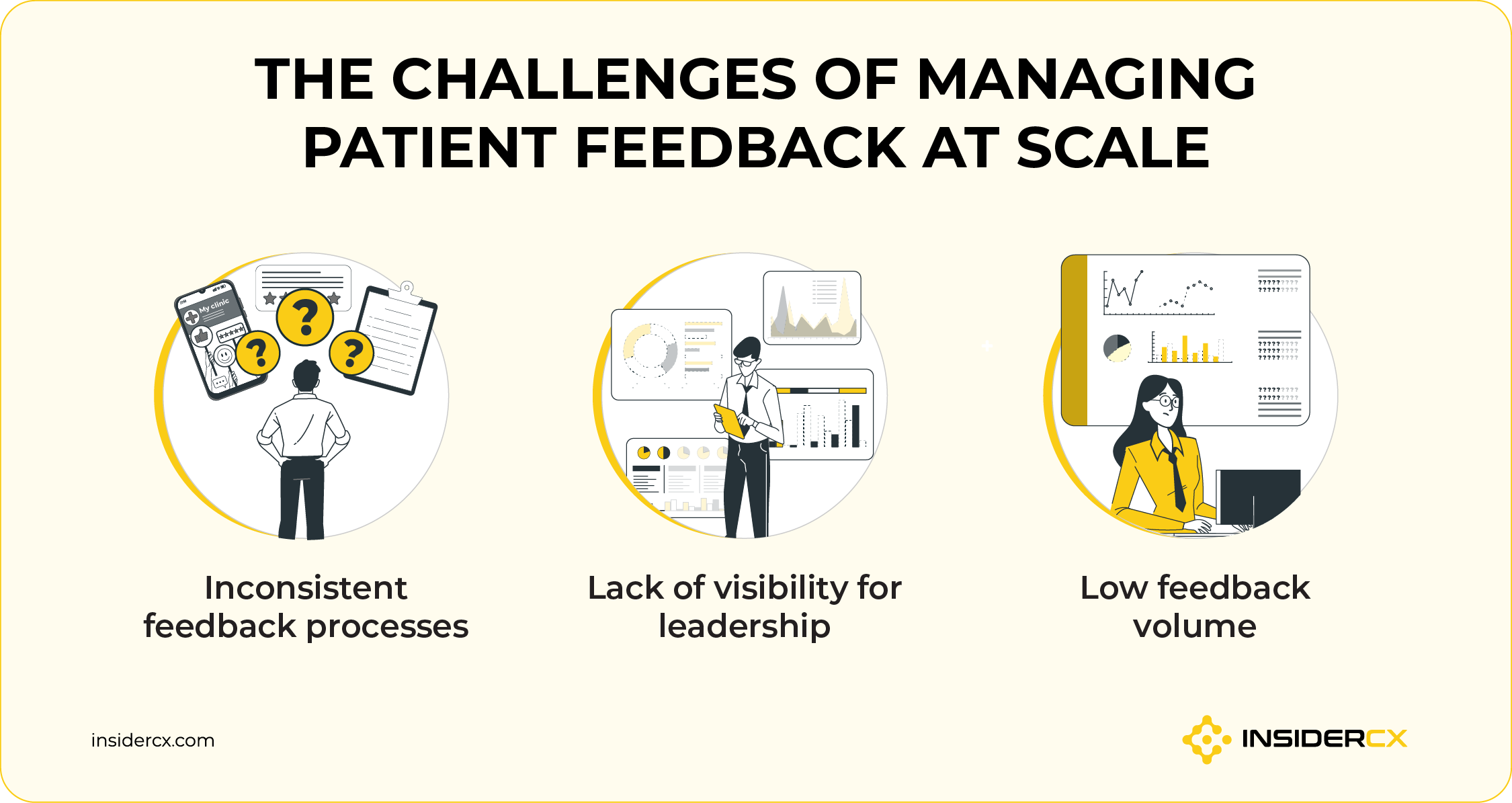
1. Inconsistent feedback processes
In a multi-site healthcare group, each clinic often manages feedback differently. The inconsistencies typically fall into three areas:
- Feedback collection methods vary: One location might send SMS surveys, another might rely on paper forms at reception, a third might only monitor Google reviews, and a fourth one might not collect structured feedback at all.
- Survey design differs: Questions, rating scales, and survey length are rarely standardised, making it impossible to compare findings across sites.
- Analysis and reporting are uneven: Some clinics have a structured monthly reporting process, others do ad-hoc manual reviews, and many have no reporting rhythm at all. Even the KPIs they do track might not be the same.
The result is incomplete, incomparable data. Leadership can't identify patterns or worst/top performers because there's no shared baseline to work from; even clinics that collect good feedback in isolation contribute little to the bigger picture if their data can't be aggregated with the rest.
2. Lack of visibility for leadership
When feedback processes are fragmented, executives lose sight of what's actually happening on the clinic floor. Rather than working from structured insights, decisions end up relying on:
- Anecdotal feedback, such as a complaint mentioned in a meeting or a positive comment relayed by a clinic manager.
- Isolated complaints in individual cases that get escalated but don't represent the full picture.
- Sporadic review monitoring, usually limited to occasional checks of Google or Trustpilot scores without any systematic tracking.
This makes it nearly impossible to prioritise resources, identify underperforming locations, or replicate what top-performing clinics are doing well. In other words, you're trying to manage quality without the data to back up your decisioins.
3. Low feedback volume
When you operate dozens or even hundreds of locations, many of those clinics simply won't receive enough structured feedback to identify meaningful trends. A handful of reviews per month — or worse, a few paper comment cards — doesn't give you enough data to identify quality issues or track the effectiveness of implemented changes.
The only way to fix that is to set up a structured process for collecting feedback. And the only way to scale and benchmark it across a clinic network is to automate most of the process with a patient experience and feedback platform like InsiderCX.
Centralising feedback management
Centralised patient feedback management means collecting feedback systematically, analysing it across all locations, and making insights actionable at every level of the organisation.
Rather than treating each clinic as a standalone unit, you create a single, unified view of patient experience across your entire network.
In practice, this requires three layers of visibility.
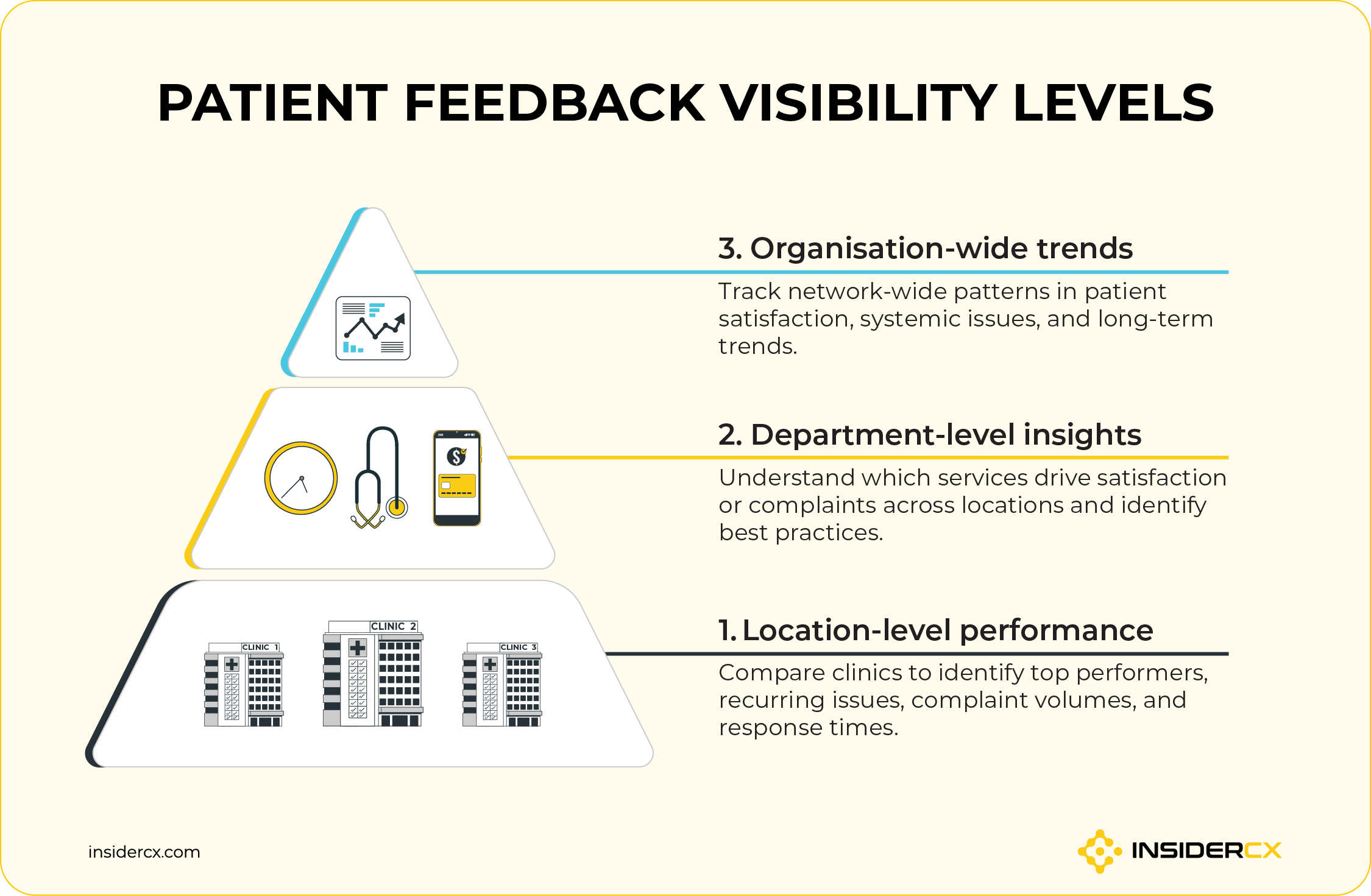
1. Location-level performance
At the most granular level, leadership needs to see how each clinic is performing relative to the rest. This means answering questions like:
- Which clinics provide the best patient experience — and what are they doing differently?
- Where are Net Promoter Scores consistently low, signalling systemic issues rather than one-off complaints?
- Which locations have the highest complaint volumes, and how quickly are those complaints being resolved?
2. Department-level insights
Looking within each location, it's equally important to understand which services or departments are driving satisfaction, and which are dragging it down. You want to find answers to questions like:
- Which services generate the most complaints? Is it wait times for consultations, post-treatment follow-ups, or administrative processes like billing?
- Are certain departments consistently outperforming others across multiple locations, suggesting a best practice worth replicating?
- Where are patients dropping off in the journey? Does that pattern repeat across sites?
3. Organisation-wide trends
At the highest level, leadership needs a view of patterns that affect the entire network, not just individual clinics. These patterns are usually obvious and predictable, but make sure you leave room for a wildcard every now and then.
Here are the most common ones:
- What systemic issues affect all locations — for example, are patients across the network dissatisfied with communication after procedures?
- How is overall patient satisfaction trending month over month, and is it moving in the right direction?
- Are there seasonal or regional patterns that require different operational responses?
A practical framework for managing patient feedback across locations
The organisations doing this right follow a clear operational framework. We can break it down into four steps.
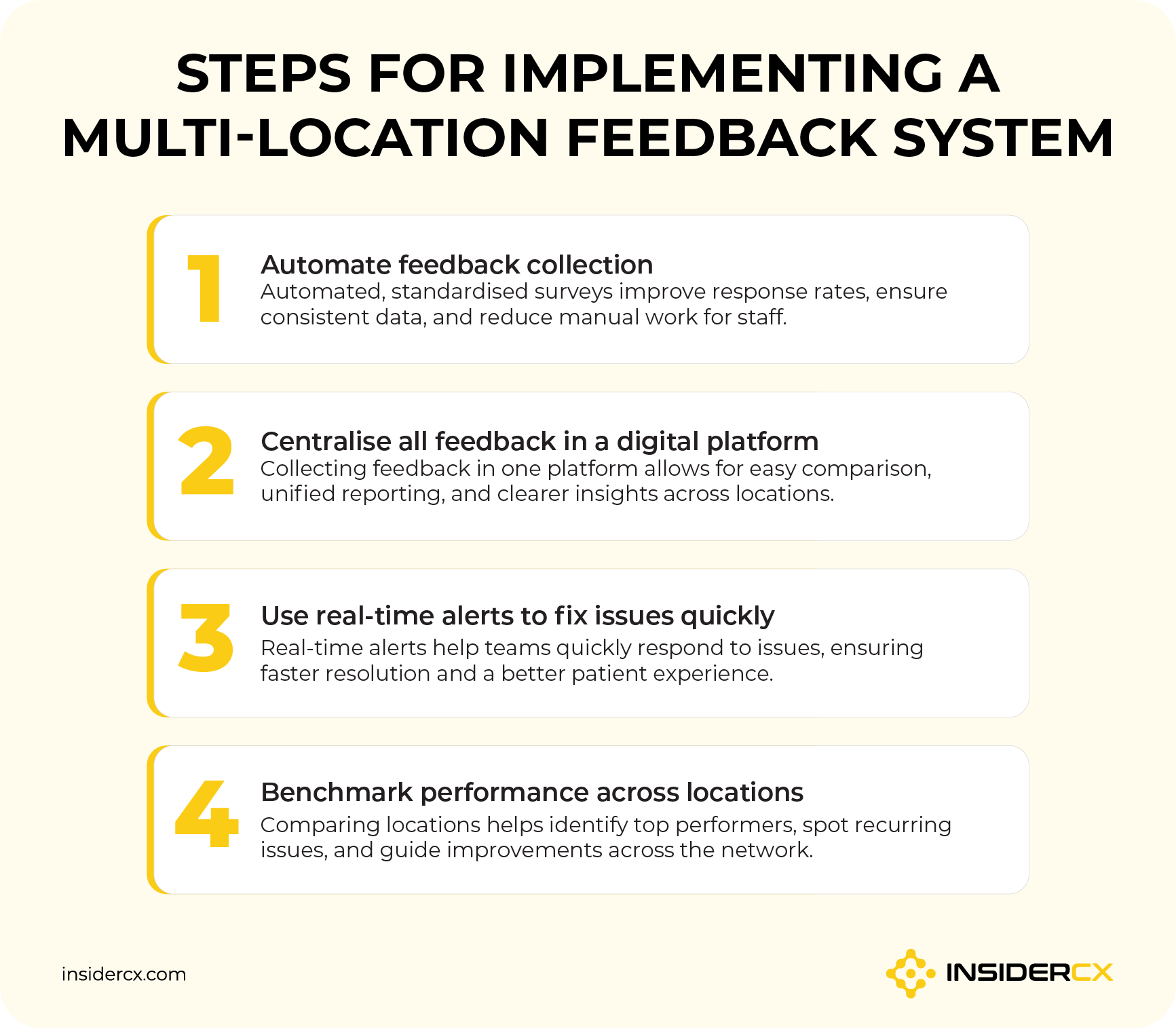
Step 1: Automate feedback collection
Manual surveys like paper forms, ad-hoc emails, and front-desk follow-ups lead to low response rates and fragmented data. They also place an unnecessary administrative burden on clinic staff who already have full schedules.
Modern clinics automate patient feedback collection with a consistent approach across all sites. To make the most of it, follow these best practices:
- Use patient experience/feedback platforms to automatically send white-labeled SMS or WhatsApp surveys 24–48 hours after a visit. This ensures the experience remains fresh while allowing the patient time to reflect.
- Use a mobile-first survey design, meaning short, easy to complete on a phone, with no app download required.
- Define and use standardised questionnaires across all locations so every clinic measures the same things in the same way.
The shift from manual to automated feedback collection delivers higher response rates, more consistent data, and real-time visibility into patient sentiment. It also removes the variability that comes with each clinic doing its own thing.
Step 2: Centralise all feedback in a digital platform
Feedback shouldn't live in spreadsheets, email inboxes, comment boxes, or individual clinic dashboards. When done right, all patient feedback flows into a single platform where it can be aggregated, compared, and acted upon.
Digitalisation and centralisation enable performance comparison, so you see how each location stacks up against others on the same metrics. They also enable unified reporting and generate organisation-wide reports without manually pulling data from multiple sources. Finally, cross-location insights spot trends that only become visible when you look at the full picture.
Quick example: Adria Dental Group used InsiderCX to centralise feedback and collected over 16,000 patient surveys across its locations — creating a comprehensive, comparable view of patient experience across its entire network.
Step 3: Use real-time alerts to fix issues quickly
Collecting and centralising feedback is only valuable if you act on it. Negative experiences should trigger immediate action, not sit in a report waiting for a monthly review meeting.
Best practices for closing the loop on negative feedback include:
- Automatic alerts for low ratings or negative comments, so the right person is notified the moment a patient reports a poor experience
- A ticketing system for complaints with automatic routing, where each issue gets assigned to the appropriate staff member. That’s how you ensure ownership and speed up resolution.
- Direct follow-up with the patient. You should have a process to reach out personally to acknowledge the issue and, where possible, resolving the complaint before the patient switches providers or leaves a negative review.
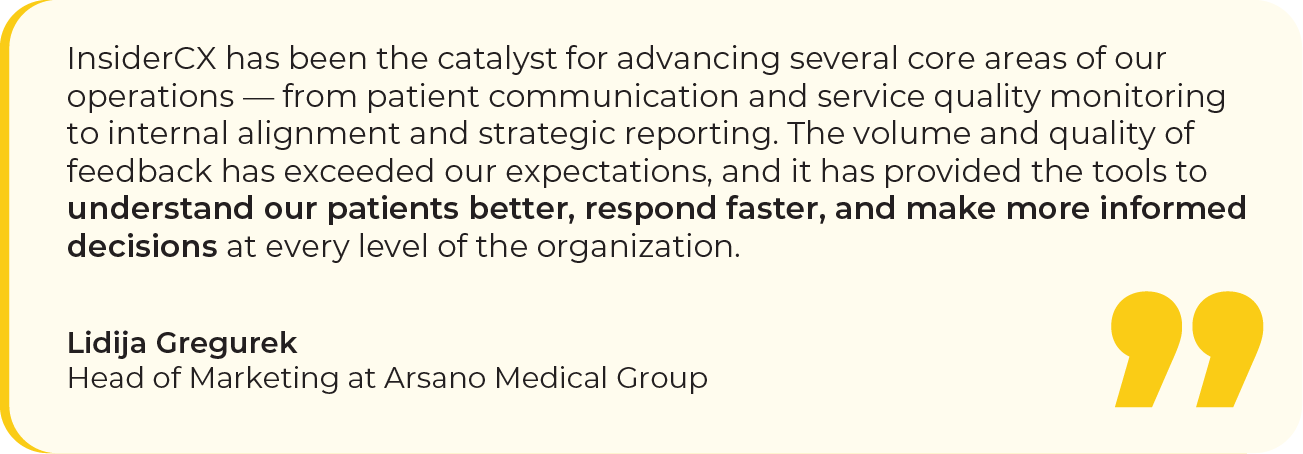
Quick example: Arsano Medical Group implemented automated detractor alerts through our platform, enabling managers to quickly follow up with dissatisfied patients and prevent unnecessary escalation of the issue.
Step 4: Benchmark performance across locations
One of the biggest advantages of centralised feedback is performance benchmarking. Rather than evaluating each clinic in isolation, leadership can compare locations against each other, against the organisation's overall averages, and even industry standards.
This makes it possible to identify top-performing clinics and understand what specific practices or behaviours set them apart. Issues that appear across multiple locations get flagged as recurring problems, suggesting a systemic root cause rather than a local one.
Talking about staff and organizational impact, benchmarking comes with two distinct benefits:
- Identifying and catering to training needs — departments or roles where patient satisfaction scores consistently lag behind, signalling a skills or process gap.
- Impact of operational changes — whether a new intake process, scheduling adjustment, or staffing change is actually improving the patient experience.
Quick example: The Dermatology Partnership, a UK-based network of six dermatology clinics, used InsiderCX to benchmark performance across its locations. Within three months, the group saw an overall NPS increase of 16.4 points, driven by the ability to identify which clinics needed targeted support and which were setting the standard for the rest.
What to look for in a multi-location patient feedback platform
Not all feedback tools are built for multi-site healthcare groups. When evaluating platforms, these are the features that matter most:
- Automated survey distribution: After the initial setup, the platform should help you effectively automate feedback collection. We recommend using mobile surveys, as they have the highest survey response and completion rates.
- Granular benchmarking: You need the ability to compare NPS scores, satisfaction ratings, and complaint volumes across locations, clinics, services, and doctors. Without this, centralisation adds complexity without insight.
- Custom dashboards and reports: The ability to set up custom dashboards ensures you always keep an eye on the most important metrics, while automated reports eliminate a lot of admin work.
- Feedback sentiment analysis: You can’t manually review hundreds or thousands of comments each month. So, beyond numerical scores, the platform should be able to analyse open-text responses to surface recurring themes (both positive and negative).
- Automatic ISO/CQC reports: For healthcare groups operating in regulated markets, the ability to generate compliance-ready reports from patient feedback data saves significant time and reduces audit risk.
- Ticketing system with automatic routing: Negative feedback should automatically generate detractor alerts and a ticket and route it to the right person — whether that's a clinic manager, a department head, or a patient relations team.
- Integration with existing clinic systems: The platform should connect with your CRM, practice management software, or EHR system to minimise data silos and administrative overhead.
Why is InsiderCX becoming the go-to solution for private healthcare groups
As private healthcare networks grow, the groups that pull ahead are those with clear, real-time visibility into the patient experience across every location.
The healthcare groups that treat patient feedback as a core operational function — rather than an afterthought — are the ones building sustainable competitive advantages. A robust patient feedback system is no longer optional for multi-site providers, it's the infrastructure that makes quality improvement possible at scale.
InsiderCX covers all of the features listed in the section above. Plus, each client gets:
- A domain expert who helps you develop questionnaires.
- Ability to set up location-specific questions.
- A dedicated account manager who sends you weekly and monthly progress reports.
- A GDPR-compliant, turnkey solution that integrates with software and tools your clinic is already using.
Want to learn more? Book a demo with the InsiderCX team — let’s chat and see how we can help!


